

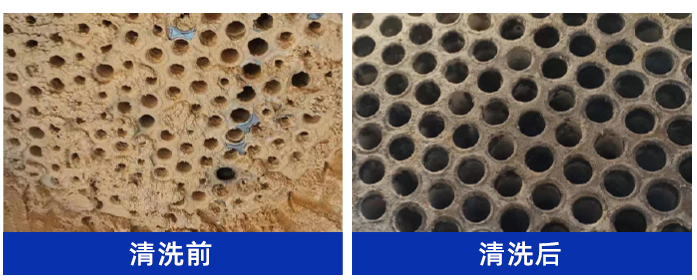
In industrial processes such as high-salt concentration and evaporation crystallization, heat exchanger tube bundles are prone to salt deposition due to continuous salt precipitation. As salt scale thickens, the effective flow area of the tubes gradually decreases, potentially leading to complete tube blockage in severe cases.
For heat exchanger tubes with hardened salt scale, treatment should not rely solely on conventional water washing. The appropriate cleaning method should be selected based on salt scale hardness, blockage severity, tube diameter, and tube configuration. For severe hard scale and complete blockage, mechanical drill breakdown combined with water flushing to evacuate debris is an effective approach.
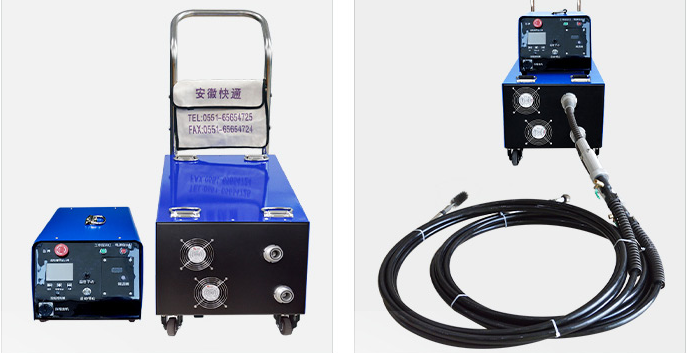
Anhui Kuaitong Pipeline Cleaning Technology Co., Ltd. provides flexible shaft and alloy steel drill bit configurations for various tube diameters and complex blockage conditions in industrial tube bundle cleaning applications. The KT-307 Industrial Pipe Unclogging Machine delivers mechanical power, offering unclogging solutions for heat exchangers, evaporators, condensers, air preheaters, and other industrial tube bundle equipment.
1. Why Are High-Salt Heat Exchangers Prone to Salt Scale Blockage?
Compared with conventional heat exchange equipment, high-salt heat exchangers operate with significantly higher salt concentrations in the process medium.
During concentration, evaporation, and heat exchange, certain salts gradually precipitate and adhere to the inner walls of heat exchanger tubes.
Over time, salt scale undergoes a progressive development:
Salt precipitation → Wall deposition → Scale thickening → Diameter reduction → Flow capacity decline → Localized blockage → Complete tube blockage
Therefore, high-salt heat exchanger blockage is typically not sudden but results from long-term accumulation. If cleaning maintenance is neglected for extended periods, tubes that initially have only light scaling may gradually develop into severe blockages.
2. Characteristics of Salt Scale in High-Salt Heat Exchangers
Actual industrial salt scale conditions vary, but severe blockages typically share the following characteristics:
1. Significant deposit volume
After continuous concentration of high-salt media, thick deposit layers readily form inside heat exchanger tubes.
2. Hard scale formation
Over extended operation, salt deposits gradually compact and crystallize, forming hard scale.
3. Progressive reduction of effective flow area
Salt scale grows from the tube wall toward the center, continuously reducing the available flow space.
4. Potential for complete blockage in severe cases
As deposits continue to thicken, tubes may progress from localized constriction to complete blockage.
5. Possible presence of mixed fouling
Actual heat exchanger interiors may contain not only salt scale but also material deposits, crystallized substances, rust, and particulate debris.
Therefore, cleaning plans should be selected based on actual deposit characteristics rather than treating all cases as simple "salt scale."
3. Effects of Severe Salt Scale Blockage on Heat Exchangers
When heat exchanger tube bundles develop severe scaling, the primary impact is on internal flow capacity.
As blockage severity increases, the following may occur:
Reduced tube flow area
Decreased media flow rate
Reduced heat transfer efficiency
Partial tube bundle failure
Altered equipment operating parameters
Increased energy consumption
Shortened cleaning maintenance intervals
Potential disruption to the entire production system in severe cases
For heat exchangers with multiple tube bundles, even partial tube blockage can affect overall equipment performance. Therefore, high-salt heat exchangers should be inspected and maintained before scaling develops into severe blockage.
4. Cleaning Methods for Salt Scale Blockage
Treatment options can be selected based on deposit characteristics and blockage severity:
1. Chemical Cleaning
For salt deposits that react with specific cleaning agents, chemical cleaning may be considered. However, chemical selection must account for salt composition, tube material, and process conditions. If salt scale is already thick, hard, or has caused complete blockage, chemical cleaning alone may have limited effectiveness.
2. High-Pressure Water Flushing
High-pressure water relies on impact force to remove wall deposits. It is suitable for relatively thin and loose deposits. However, for thick, hard scale—especially when tubes are completely blocked—water penetration into the blockage core is restricted. This is one reason why some tubes remain blocked even after standard high-pressure water cleaning in many industrial sites.
5. Why Mechanical Unclogging Is Suitable for Severe Salt Scale
For hard salt scale, mechanical unclogging operates on a fundamentally different principle from high-pressure water. Rather than relying solely on water impact, it works as follows:
Rotary power → Flexible shaft → Alloy steel drill bit → Mechanical breakdown of salt scale → Water flushes out debris
After the drill bit enters the heat exchanger tube, it progressively breaks down hard deposits through rotation. Once the blockage is fragmented, water flow evacuates the debris.
Therefore, for severe hard scale, material fouling, and crystallization blockage, mechanical breakdown serves as an alternative or supplementary method to high-pressure water cleaning.
6. How the KT-307 Is Used for High-Salt Heat Exchanger Tube Bundle Unclogging
For severe blockage in heat exchangers, evaporators, condensers, and other tube bundle equipment, Anhui Kuaitong offers the KT-307 Industrial Pipe Unclogging Machine.
The KT-307 features a 5500W power system that delivers rotational power through a flexible shaft to the front-end drill bit for mechanical breakdown of hard deposits inside tubes.
Applicable tube diameter range: Φ6.35–800 mm
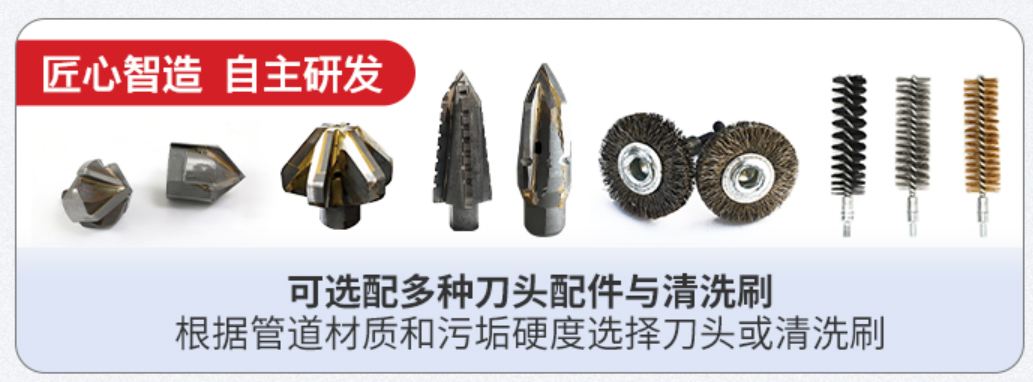
The equipment can be configured with shafts and alloy steel drill bits of appropriate specifications based on tube diameter, length, and blockage conditions. For high-salt heat exchangers, suitable drill bits and operating parameters can be selected based on actual salt scale conditions.
7. Technical Features of the KT-307 for Hard Salt Scale Treatment
1. 5500W Power System
The KT-307 uses a 5500W power unit to provide mechanical rotational power to the flexible shaft and front-end drill bit. For severe hard scale and blockage conditions, mechanical rotation effectively breaks down deposits.
2. 0–4000 rpm Adjustable Speed
The KT-307 supports speed adjustment from 0 to 4000 rpm. Different tube diameters, tube materials, and salt scale hardness levels require different operating parameters. Speed can be adjusted based on site conditions rather than using a fixed speed for all applications.
3. Intelligent Torque Adjustment System
Resistance encountered by the drill bit inside tubes varies with blockage severity. The KT-307 incorporates an intelligent torque adjustment system that controls output torque based on operating resistance. The core function is not simply to increase power, but to match power output to actual blockage conditions. This reduces abnormal shaft stress from brute-force operation while delivering the power needed for hard scale breakdown.
4. Adaptive Shaft Protection Technology
The flexible shaft is a critical transmission component in industrial tube bundle cleaning. If the drill bit suddenly becomes jammed, shaft load increases rapidly. The KT-307 features advanced adaptive shaft protection technology that monitors operating load to reduce abnormal stress and damage risk to the shaft. For companies requiring long-term industrial tube bundle cleaning, this reduces shaft and consumable replacement costs.
5. High-Strength Alloy Steel Drill Bits
The KT-307 uses high-strength alloy steel drill bits, available in multiple specifications for different tube diameters and blockage conditions. The drill bits mechanically break down hard deposits inside tubes. For salt scale, material fouling, crystallized deposits, and other hard accumulations, appropriate tools and operating parameters should be selected based on specific conditions. With correct selection and proper operation, both cleaning effectiveness and tube wall protection can be achieved.
8. KT-307 Supports Dry and Water-Assisted Cleaning
Cleaning high-salt heat exchangers does not always require large volumes of high-pressure water.
The KT-307 offers flexible operating modes based on site conditions:
Dry Mechanical Unclogging
Relies primarily on the drill bit to mechanically break down blockages.
Suitable for conditions where the blockage must first be opened.
Water-Assisted Cleaning
Water is supplied simultaneously with mechanical breakdown to flush out fragmented debris. The water also provides cooling for the drill bit and shaft.
For severe salt scale blockage, the combination of mechanical breakdown + water-assisted debris evacuation is recommended.
9. Why the KT-307 Suits Various Heat Exchanger Tube Sizes
Industrial heat exchanger tube diameters vary significantly—some equipment uses small-diameter tubes, while others have larger industrial tube bundles.
The KT-307 covers a diameter range of Φ6.35–800 mm.
In practice, appropriate shafts and drill bits must be configured for the specific tube diameter—a single set of accessories cannot serve all tubes.
For different heat exchangers, selection should consider:
Tube diameter → Tube length → Tube material → Salt scale hardness → Blockage severity → Shaft selection → Drill bit selection → Speed and torque settings
This condition-based configuration approach is better suited for industrial tube bundle maintenance.
10. Basic Unclogging Procedure for High-Salt Heat Exchanger Salt Scale
Before starting, the heat exchanger structure and tube conditions should be confirmed.
Step 1: Equipment Inspection
Confirm heat exchanger tube diameter, length, material, and bundle configuration.
Step 2: Blockage Assessment
Determine whether the condition is light scaling, severe hard scale, or complete blockage.
Step 3: Select Shaft and Drill Bit
Choose appropriate specifications based on tube diameter and salt scale hardness.
Step 4: Set Operating Parameters
Adjust speed and torque based on tube diameter, deposit hardness, and shaft specifications.
Step 5: Mechanical Breakdown
Gradually feed the drill bit into the tube to mechanically break down salt scale.
Step 6: Debris Evacuation
Supply water as needed to flush out broken salt scale and other deposits.
Step 7: Flow Verification
After unclogging, verify tube flow and perform additional cleaning if necessary.
11. Other Tube Bundle Equipment Applicable to the KT-307
The KT-307 is not limited to high-salt heat exchangers. Depending on equipment configuration and site conditions, it can also be used for:
Heat exchangers
Evaporators
Condensers
Surface condensers
Air preheaters
Boiler tube bundles
Economizers
Other industrial tube bundles and process piping
For different equipment, proper equipment and accessory selection should be based on actual tube diameter, length, deposit type, and tube configuration.
12. Important Considerations for High-Salt Heat Exchanger Cleaning
1. Do not select cleaning method based solely on "salt scale"
Salt scale composition, hardness, and deposition state vary, so treatment methods may differ.
2. Avoid blindly increasing drill bit speed
Mechanical unclogging must consider the drill bit, shaft, tube material, and blockage conditions simultaneously. The KT-307's 0–4000 rpm speed adjustment allows operation to be optimized for site conditions.
3. Assess blockage length for completely blocked tubes
The difficulty of clearing a blockage near the tube entry differs from removing long-section hard scale throughout the tube.
4. Tube wall protection is equally important
The purpose of mechanical unclogging is not to damage heat exchanger tubes but to break down internal blockages. Therefore, drill bit specifications and operating parameters must be properly matched.
13. Frequently Asked Questions (FAQ)
Q: Why do high-salt heat exchangers readily form hard salt scale?
A: During concentration and evaporation, salts in high-salt media become enriched and precipitate. Precipitated salts gradually adhere to the inner walls of heat exchanger tubes, forming thick deposit layers over extended operation.
Q: Can heat exchanger tubes blocked with salt scale still be unclogged?
A: Feasibility depends on salt composition, hardness, blockage length, tube diameter, and tube material. For hard salt scale, mechanical drill breakdown can be considered.
Q: What should be done if salt scale cannot be removed by high-pressure water?
A: If salt scale has formed a hard blockage layer that water impact cannot effectively break down, a combination of mechanical breakdown and water-assisted debris evacuation can be considered.
Q: What tube size is suitable for the KT-307?
A: The KT-307 covers a diameter range of Φ6.35–800 mm. Actual operation requires proper shaft and drill bit selection based on the specific tube diameter.
Q: Why does the KT-307 require torque adjustment?
A: Different tube diameters and shaft specifications have different load capacities, and blockage resistance varies during operation. Torque adjustment allows power output to match operating load while reducing shaft damage from abnormal stress.
Q: Can the KT-307 perform dry unclogging?
A: Yes. The KT-307 supports dry mechanical unclogging and can also perform water-assisted cleaning based on site requirements.
About Anhui Kuaitong Pipeline Cleaning Technology Co., Ltd.
Anhui Kuaitong Pipeline Cleaning Technology Co., Ltd., established in 2009, is a subsidiary of Anhui Kuaitong Environmental Technology Group Co., Ltd., specializing in the R&D, manufacturing, and technical services of industrial pipeline cleaning and unclogging equipment.
The company develops and manufactures industrial pipe unclogging machines, heat exchanger cleaning equipment, boiler tube bundle unclogging systems, air preheater cleaning equipment, and other industrial pipeline cleaning solutions. For issues such as scale, salt deposits, material fouling, crystallization, and hard accumulations in heat exchangers, evaporators, condensers, boiler tube bundles, and other equipment, we provide corresponding equipment selection and pipeline unclogging solutions.
This document is compiled by the technical team of Anhui Kuaitong Pipeline Cleaning Technology Co., Ltd.
Website: www.kuaitonggroup.com
Technical Consultation (Phone/WhatsApp/WeChat): +86 18226181287
Table of Contents
- 1. Why Are High-Salt Heat Exchangers Prone to Salt Scale Blockage?
- 2. Characteristics of Salt Scale in High-Salt Heat Exchangers
- 3. Effects of Severe Salt Scale Blockage on Heat Exchangers
- 4. Cleaning Methods for Salt Scale Blockage
- 5. Why Mechanical Unclogging Is Suitable for Severe Salt Scale
- 6. How the KT-307 Is Used for High-Salt Heat Exchanger Tube Bundle Unclogging
- 7. Technical Features of the KT-307 for Hard Salt Scale Treatment
- 8. KT-307 Supports Dry and Water-Assisted Cleaning
- 9. Why the KT-307 Suits Various Heat Exchanger Tube Sizes
- 10. Basic Unclogging Procedure for High-Salt Heat Exchanger Salt Scale
- 11. Other Tube Bundle Equipment Applicable to the KT-307
- 12. Important Considerations for High-Salt Heat Exchanger Cleaning
- 13. Frequently Asked Questions (FAQ)
- About Anhui Kuaitong Pipeline Cleaning Technology Co., Ltd.