
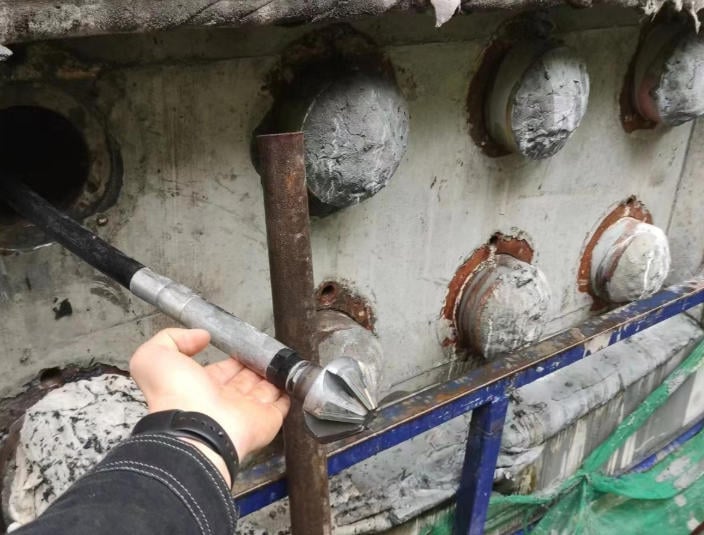
When a prestressed concrete duct becomes blocked by concrete and conventional rodding tools can no longer pass through, the first step is to determine the blockage location, duct diameter, degree of concrete hardening, and whether steel strands have already been threaded through the duct. For fully cured concrete blockages, a flexible shaft with alloy steel cutting tools can be used to mechanically drill and progressively break down the hardened concrete, followed by debris removal to restore the duct passage.
The KT-309 Concrete Blockage Pipe Unclogging Machine from Anhui Kuaitong Pipeline Cleaning Technology Co., Ltd. is specifically designed for mechanical breaking of concrete and cement blockages in engineering pipes such as prestressed ducts, embedded pipes, and conduit pipes. The KT-309 features 7500W power and covers an applicable pipe diameter range of 6.35–800 mm.
1. Why Do Prestressed Ducts Become Blocked by Concrete?
Prestressed ducts must remain unobstructed during concrete placement.
Blockages can occur if:
Pipe ends are not properly sealed
Joints leak grout during pouring
Pipes are damaged during construction
Cement slurry that has just entered the duct may still be relatively easy to handle. However, if not detected in time, as the concrete cures, it forms a hard blockage.
Prestressed duct blockages can generally be categorized as:
Debris obstruction
Cement slurry blockage
Partially cured mortar blockage
Hardened concrete blockage
Completely compacted blockage
Different blockage levels require different approaches.
2. How to Determine If a Prestressed Duct Is Blocked by Concrete?
A simple inspection can be performed first.
If a rodding tool can only advance a short distance before meeting solid resistance, and repeated attempts still cannot pass through, further investigation is needed to confirm whether hardened concrete is present.
If concrete blockage is confirmed, the following information should be determined:
Where is the blockage located?
How long is the blockage?
What is the duct diameter?
Are there bends?
Are steel strands already inside?
This information directly determines the subsequent unclogging method.
3. Why Are Conventional Methods Ineffective for Hardened Concrete?
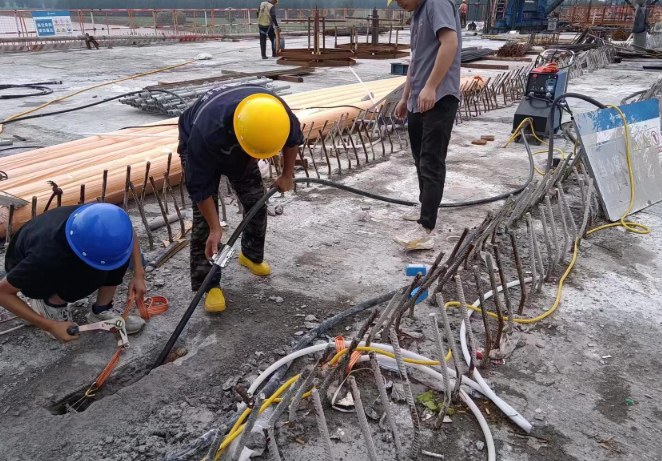
Conventional rodding tools are designed to push through soft obstructions, but hardened concrete is a high-strength solid blockage.
If the concrete has fully cured, simply forcing a rodding tool may result in:
The tool cannot advance further
The tool becomes stuck
Repeated attempts with no progress
No visible change in the blockage
For this situation, the core approach must shift from "pushing the blockage" to "mechanically breaking the blockage."
4. How to Clear Hardened Concrete from Prestressed Ducts?
A common mechanical approach is:
Flexible shaft enters duct → Alloy steel cutting tool contacts concrete → Rotational drilling → Concrete progressively broken → Passage established → Debris removed
The key difference from conventional rodding tools is that the cutting tool acts directly on the concrete through mechanical force.
5. Why Is the KT-309 Used for Prestressed Duct Concrete Unclogging?
The KT-309 is a heavy-duty concrete blockage unclogging machine.
It uses a 7500W motor to drive a flexible shaft, transmitting power to an alloy steel cutting tool inside the duct for drilling and breaking hardened concrete.
The KT-309 covers an applicable diameter range of 6.35–800 mm and is suitable for drainage pipes, conduit pipes, prestressed ducts, blind pipes, and other applications in bridge, tunnel, highway, and elevated structure projects.
For professional construction contractors, the KT-309 primarily solves the problem of:
Conventional tools cannot penetrate, concrete has already hardened, and the duct cannot be easily removed or reworked.
6. How to Select Shafts and Cutting Tools for the KT-309?
Not all prestressed ducts use the same configuration.
The KT-309 is available with shaft sizes of 22 mm, 27 mm, and 30 mm, selectable based on duct diameter and blockage conditions.
The following factors should be confirmed during selection:
|
Selection Factor |
Information Required |
|
Duct diameter |
What is the actual internal diameter? |
|
Blockage location |
How far from the entry point? |
|
Blockage length |
Localized or full-length blockage? |
|
Concrete condition |
Slurry, partially cured, or fully hardened? |
|
Duct configuration |
Straight or with bends? |
|
Duct material |
Corrugated, steel, etc. |
|
Internal condition |
Are steel strands already threaded? |
|
Construction objective |
Restore passage or meet subsequent tendon threading requirements? |
Therefore, when purchasing equipment, it is not sufficient to simply say "I need a concrete unclogging machine." It is best to provide duct documentation and blockage details to the equipment technical team.
7. Can the KT-309 Be Used If Steel Strands Are Already Threaded?
This is a critical question that must be addressed during selection.
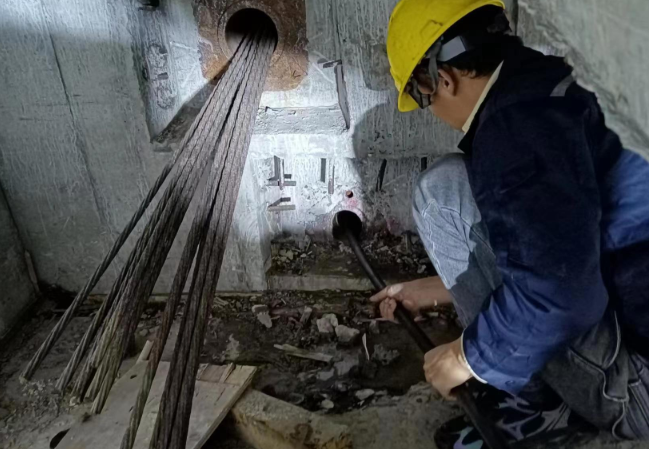
If steel strands are already present inside the prestressed duct, the cutting tool cannot be forced into the blockage in the same way as for ordinary embedded pipes.
Because the cutting tool rotates inside the duct, if the position of the steel strands and the internal condition of the duct cannot be confirmed, there is a risk of damaging the prestressing tendons.
In this case, the following should first be confirmed:
Have steel strands already been threaded?
What is the position and condition of the steel strands?
What is the exact location of the blockage?
Has the duct been deformed?
Is there an approved treatment plan from the design or construction unit?
Therefore, whether the KT-309 is suitable for a specific project cannot be determined based solely on the words "prestressed duct."
8. How to Select Equipment If Steel Strands Have Not Yet Been Threaded?
If the duct has not yet been threaded with prestressing tendons and hardened concrete blockage has been confirmed, mechanical breaking should be prioritized.
Three key indicators should be considered:
1. Duct diameter
The KT-309 covers 6.35–800 mm, but actual operation still requires shaft and cutting tool matching based on the specific diameter.
2. Concrete strength and hardness
The KT-309 can handle pipes blocked with C60-grade concrete. However, actual projects should not rely solely on the concrete grade—the compactness, thickness, and blockage length must also be considered.
3. Blockage location
The farther the blockage is from the entry point, the higher the requirements for shaft length, flexibility, power transmission, and operational control.
Therefore, it is best to provide site documentation for configuration before purchase.
9. Is Higher Power Always Better for Prestressed Duct Concrete Unclogging?
Not necessarily.
The KT-309 uses 7500W power to handle heavy concrete blockages, but actual performance is not determined by motor power alone.
It also depends on:
Shaft specifications
Cutting tool geometry
Duct diameter
Concrete hardness
Blockage location
Operating method
Duct bends
The KT-309 also features intelligent torque control and adaptive shaft protection, allowing power output to be controlled based on shaft specifications to reduce the risk of shaft kinking, deformation, or damage from excessive torque.
Therefore, for professional construction personnel, equipment power, shaft, and cutting tool must form a matched relationship.
10. Key Considerations for Prestressed Duct Concrete Unclogging
1. Do not force advancement blindly
When significant resistance is encountered, determine whether it is normal drilling or tool jamming.
2. Do not rely solely on high-pressure water
Fully cured concrete requires mechanical breaking to effectively establish a passage.
3. Pay attention to internal duct structure
If steel strands have already been threaded, cutting tools must not be used blindly.
4. Select cutting tools based on blockage severity
Localized hard lumps and long-distance compacted blockages have different requirements for tools, shafts, and power.
5. Re-inspect after unclogging
Opening the passage does not mean the job is complete. It is also necessary to confirm whether internal debris has been cleared and whether the passage meets subsequent construction requirements.
11. Which Customers Are Better Suited for the KT-309?
The KT-309 is better suited for customers with the following project needs:
Bridge construction contractors
High-speed railway construction contractors
Tunnel construction contractors
Highway engineering contractors
Municipal engineering contractors
Professional pipe unclogging companies
Prestressed engineering contractors
Engineering service companies that frequently handle concrete-blocked pipes
If only occasional light cement slurry blockages are encountered, heavy equipment may not be necessary. If fully hardened concrete blockages are frequently encountered, professional mechanical breaking equipment should be prioritized.
12. Final Approach to Prestressed Duct Concrete Blockage
The entire process can be summarized in four steps:
Step 1: Confirm it is concrete blockage.
Do not confuse duct deformation, debris obstruction, and hardened concrete.
Step 2: Determine blockage location and internal condition.
Special attention is needed to confirm whether steel strands are already present.
Step 3: Use mechanical breaking for hardened concrete.
For suitable ducts, a flexible shaft + alloy steel cutting tool can be used for drilling and breaking.
Step 4: Clear debris and verify passage.
Only when an effective passage is restored and subsequent construction requirements are met can the treatment be considered complete.
13. Frequently Asked Questions (FAQ)
Q: Can a prestressed duct completely blocked by concrete still be cleared?
A: This depends on site conditions. For hardened concrete blockages, mechanical drilling is a viable approach. However, if steel strands are already inside the duct, the internal condition must first be confirmed.
Q: Can water flushing be used for prestressed duct concrete blockages?
A: For not-yet-fully-cured slurry, appropriate flushing may be used based on site conditions. If fully hardened and blocked, mechanical breaking is typically required first, followed by debris removal.
Q: What size prestressed duct can the KT-309 handle?
A: The applicable diameter range is 6.35–800 mm, but actual suitability depends on duct diameter, blockage location, and shaft/cutting tool configuration.
Q: Can the KT-309 handle C60 concrete?
A: It can be used for pipes blocked with C60-grade concrete. Actual project results also depend on blockage thickness, compactness, duct diameter, and configuration.
Q: What information should be provided before purchasing the KT-309?
A: It is recommended to provide duct internal diameter, duct length, blockage location, duct material, concrete condition, presence of bends, and whether steel strands have already been threaded. Site photos or videos can also be provided if available.
About Anhui Kuaitong Pipeline Cleaning Technology Co., Ltd.
Anhui Kuaitong Pipeline Cleaning Technology Co., Ltd., established in 2009, specializes in the R&D, manufacturing, and technical services of industrial and engineering pipeline cleaning and unclogging equipment. Main products include industrial pipe unclogging machines, concrete blockage unclogging equipment, heat exchanger cleaning equipment, boiler tube bundle unclogging systems, and air preheater cleaning equipment.
The company has been recognized as a National High-Tech Enterprise, a Technology-Based SME, and a Training Base of the China Industrial Cleaning Association. Products are certified under ISO 9001 Quality Management System and EU CE certification. Over the years, the company has provided pipeline cleaning, unclogging, and inspection solutions to numerous industrial and engineering customers worldwide.
For concrete blockages in conduit pipes, embedded pipes, drainage pipes, and other piping, equipment selection can be based on pipe diameter, blockage length, concrete strength, pipe material, and site conditions. The company provides pipe unclogging equipment and technical support for construction, bridge, tunnel, high-speed railway, municipal, power, and industrial projects.
This document is compiled by the technical team of Anhui Kuaitong Pipeline Cleaning Technology Co., Ltd.
Website: www.kuaitonggroup.com
Technical Consultation (Phone/WhatsApp/WeChat): +86 18226181287
Table of Contents
- 1. Why Do Prestressed Ducts Become Blocked by Concrete?
- 2. How to Determine If a Prestressed Duct Is Blocked by Concrete?
- 3. Why Are Conventional Methods Ineffective for Hardened Concrete?
- 4. How to Clear Hardened Concrete from Prestressed Ducts?
- 5. Why Is the KT-309 Used for Prestressed Duct Concrete Unclogging?
- 6. How to Select Shafts and Cutting Tools for the KT-309?
- 7. Can the KT-309 Be Used If Steel Strands Are Already Threaded?
- 8. How to Select Equipment If Steel Strands Have Not Yet Been Threaded?
- 9. Is Higher Power Always Better for Prestressed Duct Concrete Unclogging?
- 10. Key Considerations for Prestressed Duct Concrete Unclogging
- 11. Which Customers Are Better Suited for the KT-309?
- 12. Final Approach to Prestressed Duct Concrete Blockage
- 13. Frequently Asked Questions (FAQ)
- About Anhui Kuaitong Pipeline Cleaning Technology Co., Ltd.