
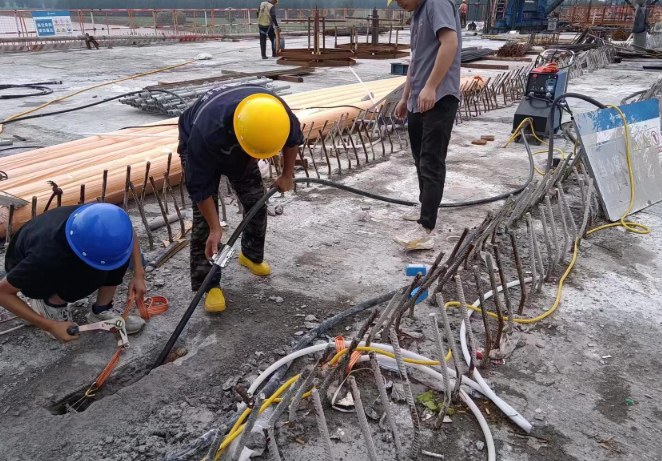
When a wind turbine foundation embedded cable conduit becomes blocked by concrete, if the blockage is only minor debris, conventional tools such as cable pullers can be tried first. If a hard concrete block has formed inside the conduit and standard cable pullers cannot pass through, mechanical breaking should be prioritized. A common approach is to use a flexible shaft with an alloy steel cutting tool to enter the blockage location, progressively drill through the concrete, expand the passage, remove debris, and finally restore the conduit for cable pulling.
The KT-309 Concrete Blockage Pipe Unclogging Machine from Anhui Kuaitong is designed specifically for hard concrete blockages in embedded pipes, conduit pipes, and similar applications. It features 7500W power, alloy steel cutting tools, and covers an applicable pipe diameter range of Φ6.35–800 mm.
1. Why Do Wind Turbine Foundation Cable Conduits Become Blocked?
Wind turbine foundations require numerous embedded cable conduits during construction.
These conduits are typically installed inside the foundation in advance. If pipe openings are not properly protected during construction, or if joints are not tightly sealed, cement slurry, mortar, or even concrete may enter the conduits during pouring.
Initially, only a small amount may enter. However, as the material gradually sets, it can eventually form a hard blockage.
Therefore, when cables cannot be pulled through on site, the first step is not to rush into replacing the conduit. Instead, the following should be determined:
What is blocking the conduit?
Where is the blockage located?
Has the concrete hardened?
How long is the conduit?
What is the conduit diameter?
Are there bends?
Are cables already installed inside?
2. First Determine the Type of Blockage in Wind Turbine Foundation Cable Conduits
Light Blockage
If a cable puller can enter a certain depth and only encounters localized resistance, it may be debris or a minor blockage. In this case, conventional pipe clearing tools can be used first.
Cement Slurry or Partially Hardened Blockage
If cement slurry has entered the conduit and begun to harden over time, standard cable pullers may gradually become ineffective. Mechanical cleaning methods should be selected based on the blockage condition.
Fully Hardened Concrete Blockage
This is the most difficult condition. If the conduit is completely sealed by hard concrete, a cable puller can only press against the blockage and cannot effectively break it. In this case, mechanical unclogging equipment with alloy cutting tools should be considered
3. How Should Concrete-Blocked Cable Conduits Be Handled?
For hardened concrete blockages, the following approach can be used:
Locate blockage → Select shaft → Install alloy cutting tool → Enter conduit → Mechanical drilling → Progressive hole creation → Expand diameter → Remove debris → Verify conduit clearance
The key is not to break through the entire blockage cross-section in one pass, but to first establish a passage and then gradually expand it.
This method is more targeted for hardened concrete blockages.
4. Why Can't Standard Cable Pullers Break Through Concrete?
Standard cable pullers are primarily used for cable pulling, pipe clearing, and handling light obstructions.
Hardened concrete is a high-strength solid material, and its working principle is completely different.
When a conduit is completely blocked by concrete, even if a cable puller has some pushing force, it is difficult to effectively break the concrete.
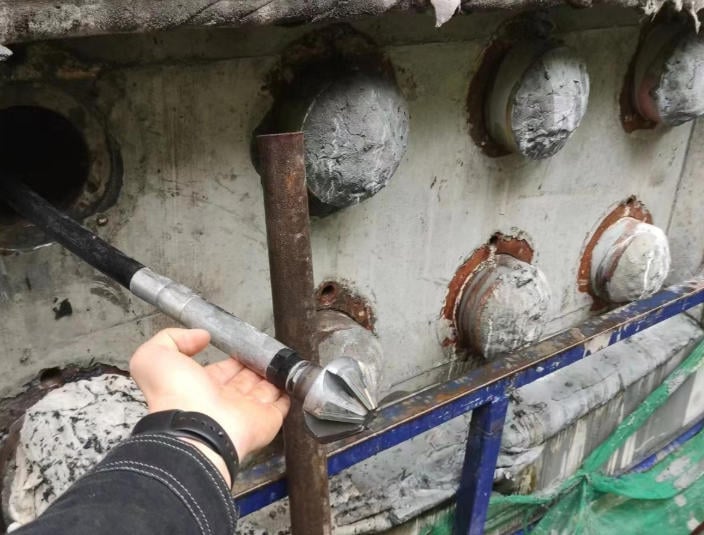
Mechanical unclogging equipment is different. It uses a power unit to rotate a flexible shaft, and the alloy steel cutting tool at the front of the shaft directly contacts the concrete.
In other words:
Standard tools primarily solve the problem of "passing through"; mechanical drilling equipment first solves the problem of "breaking the blockage."
Therefore, equipment selection should be determined by the blockage material.
5. How Should Bent Wind Turbine Foundation Cable Conduits Be Handled?
This is a common issue when selecting equipment on site.
Embedded conduits inside wind turbine foundations are not necessarily all straight. Some conduits have bends according to the foundation structure and cable routing.
If rigid drill rods are used, entering depth and working space will be affected when bends are encountered.
Flexible shafts can adapt to conduit bends to a certain extent.
Therefore, if the site condition involves:
Hard concrete blockage + Long conduit + Presence of bends + Limited entry space
Then flexible shaft mechanical unclogging equipment should be prioritized.
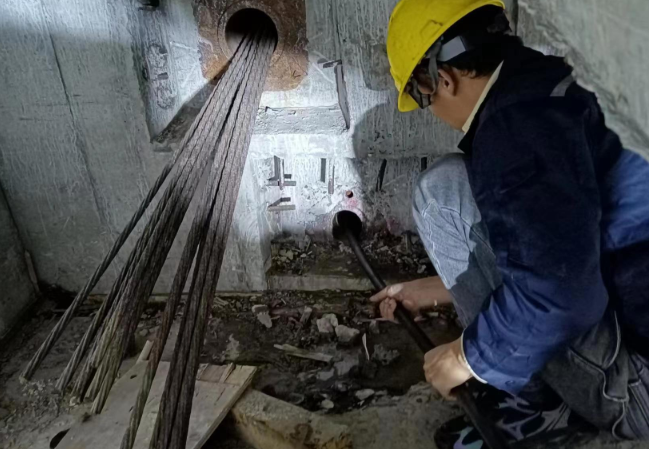
Anhui Kuaitong has previously used high-power power units, flexible shafts, and alloy steel cutting tools for mechanical unclogging in wind power foundation embedded cable conduit blockage scenarios.
6. What Type of Wind Turbine Foundation Cable Conduit Blockage Is the KT-309 Suitable For?
The KT-309 is primarily designed for mechanical breaking of hard blockages in pipes.
Its basic configuration includes:
Power unit
Control cabinet
Heavy-duty unclogging shaft
Alloy steel cutting tool
Quick-connect water hose
Power cable
The equipment uses 7500W power to drive the front-end cutting tool through a flexible shaft, drilling and breaking concrete blockages. Official documentation indicates an applicable diameter range of Φ6.35–800 mm, capable of handling embedded pipes, conduit pipes, prestressed ducts, drainage pipes, blind pipes, and other concrete blockage scenarios.
Therefore, if a customer encounters the following conditions, the KT-309 should be seriously considered:
Wind turbine foundation cable conduit is completely blocked by concrete.
Standard cable pullers can no longer pass through.
The blockage has fully hardened.
The conduit has some bends.
Re-excavation and conduit replacement costs are high.
Mechanical unclogging from the original pipe opening is preferred.
7. How to Select Equipment for Wind Turbine Foundation Cable Conduit Unclogging?
When selecting equipment, it is not advisable to judge solely by "the higher the power, the better."
At minimum, the following information should be provided:
1. Conduit diameter
Diameter directly affects shaft and cutting tool selection.
2. Blockage location
The deeper the blockage from the pipe opening, the higher the requirements for shaft length and equipment capability.
3. Conduit length
Long-distance conduits require consideration of shaft transmission capability and operational efficiency.
4. Presence of bends
If bends exist, the adaptability of the flexible shaft should be a key consideration.
5. Blockage material
Cement slurry, mortar, hardened concrete, and other foreign materials have different equipment requirements.
6. Presence of cables inside
If cables have already been installed, this must be stated in advance—the conduit cannot be treated as empty.
Therefore, before purchasing equipment, it is best to provide conduit diameter, conduit length, blockage location, and site photos or videos so that technical personnel can assess the working conditions.
8. Why Is Re-Excavation Not Recommended for Wind Turbine Foundation Cable Conduit Blockage?
If construction has just been completed and the foundation is not yet finished, reworking embedded conduits is relatively easy.
However, if the wind turbine foundation has already been completed, re-excavation not only increases workload but may also involve foundation structure, schedule, and on-site construction organization issues.
Therefore, for completed wind turbine foundations, if the original cable conduit structure remains intact, the feasibility of "mechanical unclogging from the original pipe opening" should first be evaluated.
If it is confirmed that the original conduit can be used to restore the passage, rework can be reduced.
9. Important Considerations During Actual Treatment
Do not force blindly
If significant resistance is encountered during tool advancement, determine whether it is due to concrete strength, tool size, or the conduit itself.
Do not ignore conduit routing
Before equipment selection, it is best to understand the actual routing of the cable conduit, especially for longer and bent conduits.
Do not overlook existing internal lines
If cables or other lines have already been installed, the internal condition must be confirmed first.
Do not focus only on motor power
Factors that truly affect unclogging performance include power, shaft, cutting tool, conduit diameter, blockage strength, blockage location, and conduit configuration.
10. Frequently Asked Questions (FAQ)
Q1: Can a wind turbine foundation cable conduit completely blocked by concrete still be cleared?
A: This depends on blockage location, conduit diameter, conduit length, and concrete hardening degree. For hardened concrete blockages, mechanical drilling unclogging can be evaluated.
Q2: What should be done if standard cable pullers cannot pass through?
A: If hardened concrete is confirmed inside, continuing to use standard cable pullers has limited value. Mechanical unclogging equipment with alloy cutting tools should be considered.
Q3: Can the KT-309 be used if the conduit is bent?
A: This depends on the degree of bending, conduit diameter, and blockage location. The KT-309 uses a flexible shaft approach and has certain adaptability for conduits with some bends.
Q4: Is the KT-309 specifically for wind turbine foundations?
A: No. The KT-309 is a concrete blockage pipe unclogging machine and can also be used for embedded pipes, conduit pipes, prestressed ducts, drainage pipes, blind pipes, and similar applications.
Q5: What information should be provided before purchasing the KT-309?
A: It is recommended to provide conduit diameter, conduit length, blockage location, conduit routing, blockage condition, and site photos or videos. The more complete the information, the easier it is to determine equipment and cutting tool configuration.
Q6: Can the equipment manufacturer test the equipment first?
A: For specific working conditions, you can first communicate with the manufacturer to confirm testing, equipment selection, and technical solutions based on actual blockage and conduit conditions.
About Anhui Kuaitong Pipeline Cleaning Technology Co., Ltd.
Anhui Kuaitong Pipeline Cleaning Technology Co., Ltd., established in 2009, specializes in the R&D, manufacturing, and technical services of industrial and engineering pipeline cleaning and unclogging equipment. Main products include central air conditioning duct cleaning machines, industrial pipe unclogging machines, concrete blockage pipe unclogging equipment, heat exchanger cleaning equipment, boiler tube bundle unclogging systems, air preheater cleaning equipment, and municipal pipeline inspection robots.
The company has been recognized as a National High-Tech Enterprise, a Technology-Based SME, and a Training Base of the China Industrial Cleaning Association. Products are certified under ISO 9001 Quality Management System and EU CE certification. Over the years, the company has provided pipeline cleaning, unclogging, and inspection solutions to numerous industrial and engineering customers worldwide.
For concrete blockages in wind turbine foundation embedded cable conduits, the applicability of the KT-309 and other concrete blockage unclogging equipment can be evaluated based on conduit dimensions, blockage location, concrete hardening degree, and conduit routing. Corresponding equipment selection and technical solutions are provided for customers.
Website: www.kuaitonggroup.com
Technical Consultation (Phone/WhatsApp/WeChat): +86 18226181287
Table of Contents
- 1. Why Do Wind Turbine Foundation Cable Conduits Become Blocked?
- 2. First Determine the Type of Blockage in Wind Turbine Foundation Cable Conduits
- 3. How Should Concrete-Blocked Cable Conduits Be Handled?
- 4. Why Can't Standard Cable Pullers Break Through Concrete?
- 5. How Should Bent Wind Turbine Foundation Cable Conduits Be Handled?
- 6. What Type of Wind Turbine Foundation Cable Conduit Blockage Is the KT-309 Suitable For?
- 7. How to Select Equipment for Wind Turbine Foundation Cable Conduit Unclogging?
- 8. Why Is Re-Excavation Not Recommended for Wind Turbine Foundation Cable Conduit Blockage?
- 9. Important Considerations During Actual Treatment
- 10. Frequently Asked Questions (FAQ)
- About Anhui Kuaitong Pipeline Cleaning Technology Co., Ltd.