EN
 AR
 HR
 CS
 NL
 FI
 FR
 DE
 EL
 HI
 IT
 KO
 PT
 RO
 RU
 ES
 TL
 ID
 LV
 LT
 SR
 VI
 ET
 HU
 TH
 AF
 MS
 HY
 AZ
 KA
 BN
 GU
 LO
 MN
 MY
 KK
 MG
 KY
Hard Scale in Condenser Tubes That High-Pressure Water Cannot Remove: Power Plant Tube Bundle Descaling Methods and Equipment Selection
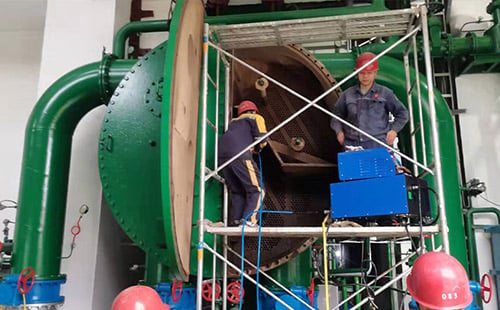
When hard scale, rust deposits, or severe blockage occur in condenser tubes and conventional high-pressure water flushing cannot effectively remove them, mechanical physical cleaning can be considered. The basic method is to use a motor to drive a flexible shaft, transmitting rotational power to an alloy cutting tool inside the tube. Mechanical cutting and breaking loosen the hard scale, and cleaning brushes combined with water or air flushing discharge the fouling. For hard blockages in power plant condensers that are difficult to handle with high-pressure water, the KT-206 Intelligent Model Blocked Tube Bundle Pipe Unclogging Machine can be a key equipment option for evaluation.
Condensers have large numbers of tubes with relatively small diameters. Once long-term hard scale forms inside the tubes, cleaning becomes difficult, and some tubes may become completely blocked or remain ineffective after repeated flushing. During equipment selection, it is not enough to consider only power unit wattage. It is also necessary to check whether the flexible shaft matches the tube diameter, whether the cutting tool suits the deposit, whether torque control is reasonable, and whether broken debris can be effectively discharged.
1. Why Is Condenser Tube Scaling Difficult for Ordinary Cleaning Equipment?
During long-term operation of power plant condensers, cooling water continuously passes through the tube bundles. Minerals, suspended solids, corrosion products, and microorganisms in the water may deposit on the tube walls.
As operating time increases, some deposits gradually compact, crystallize, or combine with corrosion products to form relatively hard attached layers.
In actual maintenance, common difficult-to-clean conditions mainly include:
1. Firmly attached scale
Some inorganic scale has formed a dense scale layer after long-term deposition, and ordinary water flow can hardly wash it off directly.
2. Mixed hard scale and rust
Tubes may simultaneously contain scale, rust, and other deposits, forming composite fouling that a single cleaning method cannot address.
3. Localized complete tube blockage
As fouling accumulates, the effective flow area continuously decreases, and in severe cases the tube may become completely blocked. Water then cannot enter the blockage core, and conventional flushing effectiveness is limited.
4. Large tube bundle counts and time-consuming tube-by-tube cleaning
Condensers typically consist of large numbers of heat exchange tubes, requiring tube-by-tube treatment during maintenance. If cleaning tools are inefficient or repeated flushing still cannot remove hard scale, overall maintenance time increases.
Therefore, for condenser hard scale and severe blockage, a cleaning method that can act directly on the blockage location should be selected based on deposit hardness and tube condition.
2. How Should Condenser Scale, Hard Scale, and Blockages Be Treated?
Not all condenser fouling requires mechanical cutting tools. Determining the deposit characteristics first, then selecting the cleaning method, is generally more reasonable.
|
Fouling Type |
Main Characteristics |
Cleaning Methods to Consider |
|
Loose mud fouling |
Easily loosened, weak adhesion |
Water flushing, brushing |
|
Biological slime |
Strong adhesion, may contain impurities |
Water flushing, mechanical brushing, and water quality management |
|
Ordinary mineral scale |
Inorganic deposition, varying hardness |
Chemical cleaning or mechanical descaling |
|
Hard scale |
Long-term deposition, firmly attached |
Mechanical descaling or evaluated chemical treatment |
|
Rust scale |
May be related to tube corrosion |
Select cleaning tools based on tube material and wall condition |
|
Severe blockage |
Effective flow area significantly reduced or completely blocked |
Mechanical unclogging, assisted debris discharge |
If the tube contains only loose mud fouling, there is no need to use strong cutting tools from the start. For hard scale, severe blockage, and tubes that high-pressure water cannot handle, mechanical cleaning is more worthy of priority consideration.
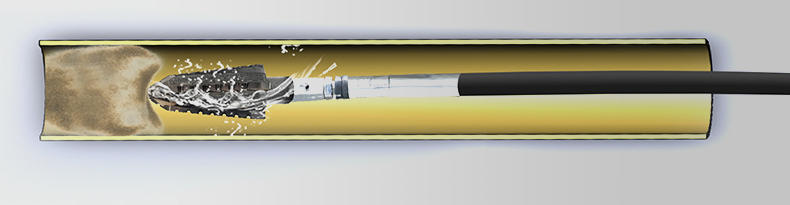
3. What Is the Working Principle of Mechanical Descaling for Condenser Tubes?
The core of mechanical physical cleaning is transmitting motor power into the tube, causing a cutting tool or cleaning brush to rotate inside the tube.
Unlike methods relying solely on water impact, mechanical cleaning can act directly on hard fouling attached to the tube wall.
The basic process can be divided into four steps:
Step 1: Select the flexible shaft and cleaning accessories.
Based on condenser tube inner diameter, length, bend condition, and deposit characteristics, select a suitable flexible shaft, alloy cutting tool, or cleaning brush.
Step 2: Feed the cleaning tool into the tube.
The power unit drives the flexible shaft to rotate, transmitting power to the cutting tool inside the tube. Operators control the advancement process based on blockage location and tube condition.
Step 3: Mechanical breaking and brushing.
The cutting tool cuts, breaks, and loosens hard fouling. For residual deposits on the tube wall requiring further cleaning, the corresponding cleaning brush can be installed for brushing.
Step 4: Discharge loosened fouling.
Depending on whether water introduction is permitted on site, water or air flushing is used to assist debris discharge, preventing mechanically broken fouling from remaining inside the tube.
This method is particularly suitable for industrial tube bundles requiring treatment of hard deposits and blockages that high-pressure water struggles to remove.
4. What Are the Features of the KT-206 Condenser Tube Cleaning Solution?
The KT-206 Intelligent Model Blocked Tube Bundle Pipe Unclogging Machine is a mechanical unclogging device designed for hard scale, rust scale, crystalline materials, and complete blockage in boilers, air preheaters, power plant condensers, heat exchangers, condensers, and other industrial tube bundles.
The equipment uses a 3000W motor to drive a flexible shaft, performing mechanical breaking, descaling, and cleaning inside tubes through alloy steel cutting tools or cleaning brushes. It supports both water flushing and air flushing modes.
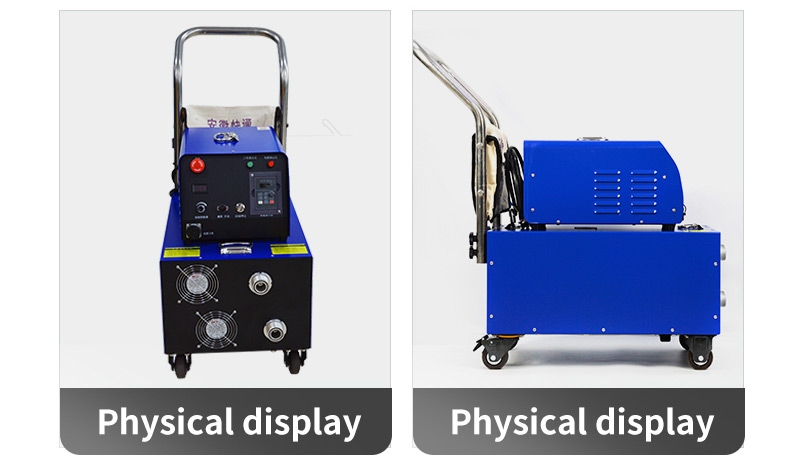
4.1 3000W Power Output for Hard Scale and Severe Blockage
The KT-206 uses a 3000W motor with a speed range of 0–2800 rpm. Speed can be adjusted based on flexible shaft specifications, tube material, deposit hardness, and construction stage.
For hard scale, rust scale, and blockages that high-pressure water struggles to handle, power can be transmitted through the flexible shaft into the tube, and an alloy cutting tool can perform mechanical breaking and unclogging.
4.2 Multiple Cutting Tools for Different Deposits
Deposits in condenser tubes are not all the same, and a single cutting tool cannot cover all conditions.
The KT-206 can be configured with:
Alloy steel heavy-duty unclogging tools
Patented stepped (pyramid-type) tools
Alloy descaling tools
Three-jaw expansion tools
Gear-type descaling tools
Sprocket tools
Wire brushes and cleaning brushes
Pipe polishing brushes
For hard blockages, suitable mechanical breaking accessories can be selected. For wall-attached deposits, descaling or brushing accessories can be selected based on tube material and deposit characteristics.
It should be noted that accessories are not necessarily better when harder or larger. Condenser tubes vary in material and allowable cleaning intensity. Tube material and wall condition should be confirmed first, then cutting tools selected.
4.3 Multiple Flexible Shaft Specifications for Different Tube Diameters and Configurations
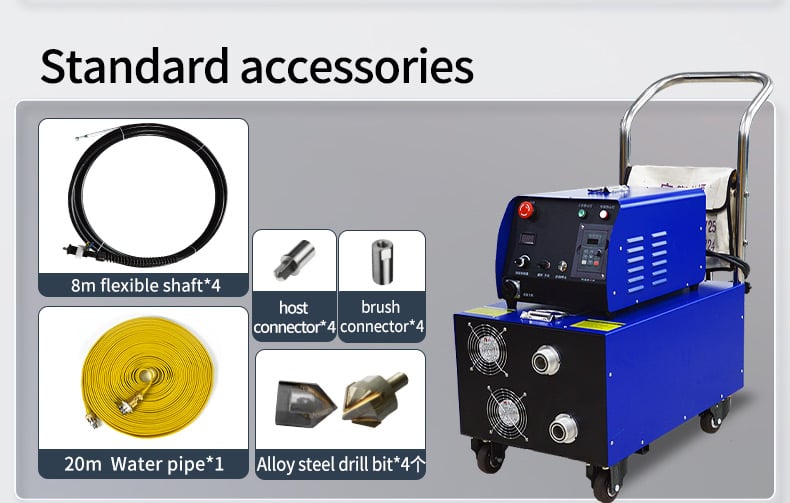
The KT-206 is compatible with flexible shaft specifications including 6 mm, 8 mm, 10 mm, 12 mm, 16 mm, 18 mm, 22 mm, and 27 mm. Heavy-duty unclogging shafts, bendable shafts, steel-belt dry cleaning shafts, and stainless steel drill rods can be configured.
Among these, heavy-duty unclogging shafts are mainly used for straight tubes and heavy blockages. Bendable shafts are more flexible and can be used for some S-shaped, L-shaped, and U-shaped tubes.
Different flexible shafts have different load-bearing capacity, bending capability, and applicable conditions. Selection cannot be based solely on tube diameter; tube length, bend severity, and deposit resistance must also be considered.
4.4 Dual-Shaft Parallel Operation to Improve Tube Bundle Efficiency
Condensers typically contain large numbers of heat exchange tubes, and tube-by-tube cleaning consumes considerable maintenance time.
Depending on site configuration, the KT-206 power unit can use dual flexible shafts for simultaneous operation, allowing two tubes to be cleaned in parallel. For work areas with large tube bundle counts and similar tube configurations, this can reduce waiting time from tube-by-tube treatment.
During dual-shaft operation, operating parameters should still be set reasonably based on flexible shaft specifications and tube resistance, and both accessory sets and operating conditions should be confirmed as compatible.
4.5 Intelligent Torque Adjustment to Reduce Shaft Damage Risk
During mechanical descaling, when the cutting tool encounters hard fouling or localized jamming, the flexible shaft may experience significant instantaneous load.
The KT-206 supports intelligent torque adjustment, allowing corresponding torque ranges to be set based on flexible shaft specifications. Combined with flexible shaft core protection structure, it reduces the risk of shaft kinking, deformation, and breakage.
The equipment also features parameter saving, voice prompts, and recall of commonly used parameters, helping reduce repeated debugging.
4.6 Dual Modes: Water Flushing and Air Flushing for Debris Removal
The KT-206 supports both water flushing and air flushing modes.
For condenser tubes where water introduction is permitted, water flow can assist in discharging mechanically broken fouling. For special pipelines not suitable for water introduction, air flushing can be selected based on site conditions.
The equipment also supports direct water feed at the front end of the flexible shaft, allowing mechanical cleaning and water flushing to work together and reducing the possibility of broken fouling accumulating inside the tube.
5. What Are the Main Technical Parameters of the KT-206?
The following are KT-206 Intelligent Model product parameters. Specific supply configuration should be based on the actual selected version.
|
Parameter Item |
KT-206 Technical Parameter |
|
Product Model |
KT-206 Intelligent Model |
|
Product Type |
Blocked Tube Bundle Pipe Unclogging Machine |
|
Rated Voltage |
380V |
|
Motor Power |
3000W |
|
Speed Range |
0–2800 rpm |
|
Applicable Tube Diameter Range |
6.35–800 mm |
|
Quick-Connect Water Hose |
20 m |
|
Power Unit Weight |
80 kg |
|
Power Unit Dimensions |
660 × 420 × 400 mm |
|
Control Cabinet Weight |
15 kg |
|
Control Cabinet Dimensions |
450 × 320 × 260 mm |
|
Working Modes |
Water flushing, air flushing |
|
Operation Methods |
Manual, remote control |
|
Flexible Shaft Specifications |
6/8/10/12/16/18/22/27 mm |
|
Standard Flexible Shaft |
Four 8 m shafts |
|
Cutting Tool Specifications |
6.5–50 mm |
|
Applicable Tube Types |
Straight tubes and some S-shaped, L-shaped, and U-shaped bent tubes |
Note: 6.35–800 mm is the overall applicable tube diameter range of the product. It does not mean the same flexible shaft and cutting tool can cover all tube diameters. Actual condenser tube bundle cleaning should configure accessories based on individual tube inner diameter, tube material, and deposit conditions.
6. What Key Issues Should Be Confirmed When Selecting Condenser Cleaning Equipment?
Before equipment procurement, it is recommended not to provide only the information that "condenser tubes are scaled." The following information directly affects equipment and accessory selection.
1. Condenser tube material
Confirm whether the tubes are copper alloy, stainless steel, or titanium. Different materials have different requirements for cutting tool hardness, contact pressure, and cleaning method.
2. Tube inner diameter
Provide the actual inner diameter, not just the outer diameter or tube bundle specification. Flexible shafts and cutting tools must be matched to the tube inner diameter.
3. Tube length
Tube length affects flexible shaft selection and construction method. Whether bends exist and whether the flexible shaft can smoothly reach the location requiring cleaning must also be confirmed.
4. Deposit type and hardness
Is it ordinary scale, rust scale, crystalline material, or mixed hard scale? Samples or internal tube photos can help determine cleaning accessories.
5. Whether completely blocked
For completely blocked tubes, the blockage location, length, and blockage characteristics must be confirmed to determine whether the cutting tool has entry conditions.
6. Whether water introduction is permitted
If water introduction is permitted, mechanical cleaning combined with water flushing can be considered. If water cannot be introduced, dry cleaning or air flushing solutions should be evaluated.
7. Under What Conditions Is the KT-206 Suitable for Condenser Tube Cleaning?
|
On-Site Problem |
Whether KT-206 Should Be Prioritized for Evaluation |
Main Reason |
|
Loose mud fouling inside tubes |
Evaluate as appropriate |
Ordinary water flushing or brushing may already be sufficient |
|
Firmly attached hard scale on tube walls |
Yes |
Mechanical cutting tools can break and descale |
|
Repeated high-pressure water flushing ineffective |
Yes |
Mechanical tools can act directly on hard fouling |
|
Some tubes completely blocked |
Yes |
Heavy-duty unclogging shafts and alloy cutting tools can be evaluated |
|
Crystalline materials inside tubes |
Yes |
Accessories can be configured based on crystal hardness |
|
Tube walls severely corroded or thinned |
Evaluate cautiously |
Remaining wall thickness and mechanical cleaning risk should be confirmed first |
|
Tube inner diameter and configuration unclear |
Not yet determined |
Dimensions and passage conditions must be confirmed first |
The KT-206 is better suited for industrial tube bundle cleaning conditions requiring mechanical descaling, unclogging, and multi-accessory coordination. For light scaling or projects requiring only simple flushing, mechanical blockage removal equipment may not be necessary.
8. Frequently Asked Questions (FAQ) About Condenser Tube Cleaning
Q1: What should be done when condenser tube scaling is severe and high-pressure water cannot remove it?
First determine the deposit type and tube material. If it is hard scale, rust scale, or dense blockage, mechanical breaking using a flexible shaft driving an alloy cutting tool can be evaluated, followed by water or air flushing to discharge debris.
Q2: Can the KT-206 clean power plant condensers?
The KT-206 can be considered as one selection option for power plant condenser tube bundle cleaning. It includes power plant condenser application scenarios and primarily targets tube bundle hard scale, rust scale, crystalline materials, and severe blockage. Specific suitability requires confirmation of condenser tube material, inner diameter, and blockage conditions.
Q3: Can the KT-206 handle completely blocked tubes?
The KT-206 uses a flexible shaft to drive an alloy steel cutting tool for mechanical breaking and unclogging and is designed for severe blockage conditions. However, for completely blocked tubes, blockage length, blockage hardness, tube inner diameter, and tube wall condition still need to be confirmed. It cannot be guaranteed that all blockage conditions can be directly treated.
Q4: Can the KT-206 clean two condenser tubes simultaneously?
Depending on site configuration, a dual flexible shaft parallel operation method can be used to clean two tubes simultaneously. The power unit configuration, flexible shaft specifications, and supporting accessories need to be confirmed.
Q5: Is the KT-206 suitable for copper and titanium tubes?
Accessories need to be selected based on specific tube material, inner diameter, wall thickness, and deposit type. Different materials cannot directly use cutting tools of the same intensity. Compatibility should be assessed first, and trial cleaning may be necessary.
Q6: Can the KT-206 only use water flushing?
No. The equipment supports both water flushing and air flushing modes. For tubes where water introduction is permitted, water flushing can assist debris discharge. For conditions not suitable for water introduction, air flushing can be evaluated based on site requirements.
Q7: What other equipment tubes can the KT-206 be used for?
In addition to power plant condensers, it can be used for tube bundle cleaning and unclogging in boilers, air preheaters, primary gas coolers, heat exchangers, wastewater evaporators, condensers, and other industrial equipment.
9. Conclusion: For Condenser Hard Scale Cleaning, Equipment and Accessory Matching Is More Important Than Simply Increasing Pressure
The treatment method for condenser tube scaling should be determined based on deposit hardness, tube material, and blockage severity. Loose mud fouling can be addressed with water flushing and brushing. Some inorganic scale can be evaluated for chemical cleaning. For hard scale, rust scale, and severe blockage that high-pressure water struggles to handle, mechanical physical cleaning can be considered.
The KT-206 uses a 3000W motor to drive a flexible shaft and alloy cutting tool, combined with 0–2800 rpm speed control, intelligent torque control, multiple flexible shaft specifications, different cleaning accessories, and dual water/air flushing modes, providing an equipment option for descaling, unclogging, and cleaning of condensers and other industrial tube bundles.
To confirm whether condenser tubes are suitable for the KT-206, it is recommended to provide tube inner diameter, material, length, deposit photos, and blockage conditions so that technical personnel can assist in selecting flexible shaft and cutting tool configurations.
Anhui Kuaitong Pipeline Cleaning Technology Co., Ltd., established in 2009, is a technology-oriented enterprise specializing in the R&D, manufacturing, and sales of pipeline cleaning, unclogging, and inspection equipment. The company is a National High-Tech Enterprise, a Technology-Based SME, a Training Base of the China Industrial Cleaning Association, and an Anhui Province Specialized and Sophisticated Enterprise. It has provided solutions to more than 23,000 domestic and international enterprises.
Website: www.kuaitonggroup.com
Technical Consultation (Phone/WhatsApp/WeChat): +86 18226181287
This document is compiled by the technical team of Anhui Kuaitong Pipeline Cleaning Technology Co., Ltd.