
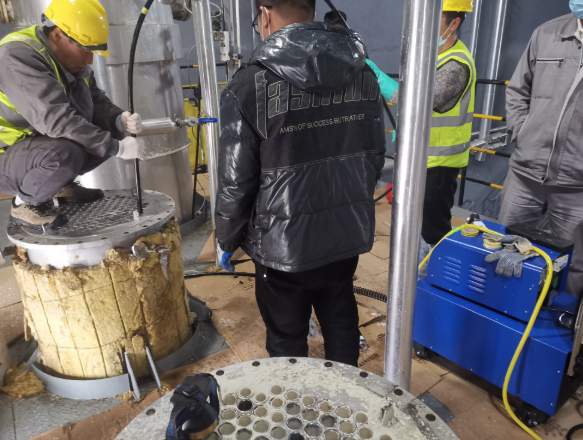
When an ammonia evaporator becomes blocked, equipment selection should be based on blockage severity, deposit characteristics, tube material, and cleaning accessibility. For deposits that can be treated with suitable chemical agents, chemical cleaning can be evaluated. For hard scale, severely blocked tubes, or completely blocked tube bundles, mechanical unclogging can be further evaluated—using a flexible shaft to drive an alloy steel cutting tool to progressively drill and break down the blockage. The Anhui Kuaitong KT-206 features a 3000W dual-shaft system, alloy steel cutting tools, and both dry and water-assisted cleaning functions. The intelligent model is also equipped with an intelligent torque control system, making it a candidate for certain industrial evaporator and heat exchanger blockage conditions.
However, ammonia evaporators are chemical equipment. Necessary shutdown, isolation, draining, cleaning/purging, and safety assessment must be completed first before determining whether mechanical unclogging is suitable. The construction plan cannot be decided solely based on equipment power or product application scope.
1. What Should Customers Confirm First When an Ammonia Evaporator Is Blocked?
Before consulting about cleaning equipment, it is recommended to confirm the following information:
Evaporator model, structure, and tube bundle layout.
Tube inner diameter, length, and material.
Source, composition, hardness, and deposition state of the blockage.
Whether the blockage is localized flow restriction or complete blockage.
Blockage location and depth, and whether the equipment has corrosion or deformation issues.
Whether the site can safely isolate, drain, purge, and collect cleaning residues.
This information determines the cleaning method and equipment configuration. Without basic working condition data, it is difficult to accurately determine which equipment should be used based solely on "the ammonia evaporator is blocked."
2. What Are the Common Causes of Ammonia Evaporator Blockage?
Ammonia evaporator tube bundle blockage may be related to material deposition, impurity adhesion, scale hardening, or other process factors. The specific cause should be determined based on on-site materials, operating records, and equipment inspection.
As deposits accumulate, the effective flow area of the tubes may gradually decrease. If not cleaned for a long time, localized blockage may develop into severe blockage, and cleaning media may also struggle to enter the blocked area.
Therefore, when selecting equipment, customers should not only describe the blockage severity but also provide deposit samples, site photos, or maintenance records as much as possible to help technical personnel determine the treatment approach.
3. What Cleaning Method Should Be Selected for Light Ammonia Evaporator Blockage?
If the tube bundle still has sufficient flow space and the deposits can be removed by suitable cleaning agents or conventional mechanical cleaning, the corresponding cleaning process can be prioritized for evaluation.
Chemical cleaning requires confirming the compatibility of the agent with the deposit, tube material, and sealing materials. Mechanical brushing requires confirming whether the tool specifications match the pipe dimensions.
For light scaling, heavy-duty mechanical drilling should not be used without assessment. Selecting a cleaning method that matches the deposit characteristics is usually more important than simply increasing equipment power.
4. Why Should Mechanical Unclogging Be Evaluated for Hard Scale Blockage in Ammonia Evaporators?
When deposits are relatively hard and conventional flushing cannot strip them, mechanical unclogging can be a backup option.
This type of equipment typically uses a power unit to drive a flexible shaft, which then drives a cutting tool into the pipe, using mechanical drilling or breaking action to treat hard blockages. Subsequently, debris must be cleared based on site conditions, and the internal pipe condition must be inspected.
Whether to use mechanical unclogging should be comprehensively determined based on blockage strength, pipe material, wall thickness, shaft accessibility, and debris discharge path. If the pipe has severe corrosion, deformation, or other structural risks, it should first be evaluated by professionals.
5. Is the KT-206 Worth Considering for Completely Blocked Ammonia Evaporators?
The publicly available configuration of the Kuaitong KT-206 Blocked Pipe Unclogging Machine includes a 3000W dual-shaft system, heavy-duty unclogging shafts, alloy steel cutting tools, and dry and water-assisted cleaning functions. The intelligent model features an intelligent torque control system. The publicly available application range includes boiler flue tubes, water wall tubes, air preheaters, wastewater evaporators, surface condensers, heat exchangers, and other industrial blocked tube bundles.
If the ammonia evaporator blockage is relatively hard and conventional cleaning methods cannot effectively treat it, the KT-206 can be included as a candidate solution, and technical personnel should then verify pipe diameter, pipe material, blockage depth, and on-site safety conditions.
Note: The "wastewater evaporator" application cannot automatically be equated to all ammonia evaporators being suitable. Actual projects must be verified individually.
6. What Kind of Operational Requirements Is the KT-206 Dual-Shaft Structure Suitable For?
The KT-206 uses a dual-shaft structure, which can be arranged based on equipment configuration and operating conditions. For evaporators with multiple blocked tubes, the number of pipes to be treated, the blockage location in each pipe, and the severity should first be clarified before developing a tube-by-tube unclogging plan.
The dual-shaft structure does not mean that a fixed efficiency improvement can be achieved at any site. Actual efficiency is still affected by blockage hardness, pipe length, cutting tool configuration, operational accessibility, and debris handling method.
7. What Blockage Problems Can the KT-206 Alloy Steel Cutting Tools Handle?
The primary function of alloy steel cutting tools is to drill or break hard blockages suitable for mechanical treatment. Compared with methods relying solely on water impact, mechanical cutting tools can act directly on the blockage. However, applicability still needs to be determined based on actual scale quality and pipe configuration.
During selection, the following should be confirmed:
Whether the cutting tool specification is suitable for the pipe inner diameter.
Whether the blockage is suitable for mechanical drilling.
Whether the pipe material and wall condition allow the use of the corresponding cutting tool.
Whether broken debris can be safely discharged.
Whether there are internal structures that must not be contacted during operation.
Alloy cutting tools should not be understood as suitable for all materials and all types of blockages.
8. How to Choose Between KT-206 Dry Cleaning, Water Cleaning, and Torque Control Functions?
Dry Cleaning and Water Cleaning: The KT-206 includes both dry and water-assisted cleaning functions. The specific method used should be determined based on blockage characteristics, equipment condition, and on-site process requirements. For ammonia evaporators, whether water flushing is permitted and how waste liquid is handled must be verified in advance.
Torque Control: The intelligent model is equipped with a torque control system, which can assist in controlling the flexible shaft operating load and reducing the impact of abnormal resistance on the shaft. However, this function cannot replace correct shaft and cutting tool selection, nor can it guarantee that the pipe wall will never be damaged.
Operating Speed: Different models, shafts, and cutting tools may have different operating requirements. Actual equipment manuals and technical personnel's working condition recommendations should be followed. It is not advisable to directly operate based solely on generic speed parameters found online.
9. What Parameters Need to Be Provided for Ammonia Evaporator Equipment Selection?
Customers are advised to prepare the following information before contacting the manufacturer:
|
Selection Information |
Content to Specify |
|
Equipment type |
Specific structure and model of the ammonia evaporator |
|
Tube dimensions |
Inner diameter, length, accessible pipe opening size |
|
Pipe material |
Material, wall thickness, and presence of corrosion |
|
Blockage condition |
Composition, hardness, whether completely blocked |
|
Blockage location |
Depth from pipe opening, presence of bends |
|
On-site safety conditions |
Whether shutdown, isolation, draining, and purging are completed |
|
Treatment objective |
Restore passage, remove hard scale, or perform comprehensive cleaning |
The more complete the information, the easier it is to determine whether the KT-206 is applicable, and whether different cutting tools, shafts, or other solutions are neede
10. What Are the Limitations of Mechanical Unclogging for Ammonia Evaporators?
Mechanical unclogging is not simply inserting a cutting tool into the pipe. Before operation, it should be confirmed that there are no untreated hazardous media inside the equipment, and whether the pipe allows mechanical drilling.
If the pipe has obvious corrosion, deformation, perforation, or structural damage, a maintenance assessment should be performed first. If the blockage characteristics are unclear, cutting tools should not be directly selected for forceful drilling.
After unclogging is completed, check whether the pipe has truly restored a passage, whether debris has been discharged, and whether there are abnormalities on the pipe wall. Equipment recommissioning should follow on-site process and manufacturer-specified inspection procedures.
11. How to Reduce Ammonia Evaporator Blockage and Lower Future Maintenance Difficulty?
For evaporators prone to scaling or deposition, inspection and cleaning plans should be established based on operating status.
Blockage trends can be identified by combining flow rate, pressure differential, heat exchange performance, and historical maintenance records. Necessary analysis of deposits should be performed to avoid repeatedly using ineffective cleaning methods. For tube bundles that have already experienced severe blockage, specific locations and treatment results should be recorded for future maintenance.
The goal of regular maintenance is not simply to increase cleaning frequency, but to detect deposition as early as possible and select appropriate treatment methods under permitted equipment conditions, reducing the difficulty of repair after blockage develops into complete closure.
12. Frequently Asked Questions (FAQ)
1. If an ammonia evaporator is completely blocked, which cleaning machine should be purchased?
First determine the blockage characteristics, pipe dimensions, and internal condition. If it is a hard blockage suitable for mechanical drilling, a dedicated mechanical unclogging machine can be evaluated. If the pipe is already damaged or unsuitable for mechanical work, other maintenance solutions should be considered.
2. Can the KT-206 handle ammonia evaporators?
The KT-206's publicly available application range includes wastewater evaporators and heat exchangers, among other industrial tube bundles. However, whether it can be used for a specific ammonia evaporator requires further verification of pipe diameter, material, blockage, and safety conditions.
3. What is the applicable pipe diameter for the KT-206?
Applicable pipe diameter: 6.35–800 mm. In actual use, it is still necessary to confirm whether the specific diameter matches the shaft and cutting tool configuration.
4. Can the KT-206 handle two blocked tubes simultaneously?
The KT-206 uses a dual-shaft structure, but the actual operating method depends on equipment configuration, site space, and working condition requirements. Technical personnel should confirm the specific operational arrangement. It cannot be assumed that two pipes can be unclogged simultaneously under all circumstances.
5. Can ammonia evaporator blockage be treated with high-pressure water only?
Not necessarily. Whether high-pressure water is effective depends on blockage characteristics, whether the passage is open, and equipment pressure-bearing conditions. Completely blocked or hard blockage conditions may require evaluation of other methods.
6. After using the KT-206 for unclogging, is the pipe guaranteed not to be damaged?
No absolute guarantee can be made. Pipe wall condition, cutting tool specifications, operating method, and blockage characteristics all affect risk. Assessment should be performed before operation, and standardized operation and inspection should be followed.
7. What information should be provided when consulting about KT-206 selection?
It is recommended to provide evaporator model, pipe diameter, pipe length, pipe material, blockage condition, blockage location, and site photos, and to indicate whether the equipment has been shut down, drained, and completed necessary safety purging.
About Anhui Kuaitong Pipeline Cleaning Technology Co., Ltd.
Anhui Kuaitong Pipeline Cleaning Technology Co., Ltd., established in 2009, specializes in the R&D, manufacturing, and sales of pipeline cleaning and unclogging equipment. Serving applications including central air conditioning air systems, water systems, industrial pipelines, heat exchange equipment, embedded pipes, and engineering pipelines, the company provides equipment selection and technical support for central air conditioning cleaning companies, property engineering teams, industrial enterprises, equipment maintenance departments, and professional construction customers.
The company has been recognized as a National High-Tech Enterprise, a Technology-Based SME, and a Training Base of the China Industrial Cleaning Association. Products are certified under ISO 9001 Quality Management System and EU CE certification, serving more than 23,000 enterprises worldwide.
For heat exchange tube cleaning requirements in condensers, refrigeration units, heat pump units, heat exchangers, and oil coolers, the company can assist customers in selecting suitable cleaning equipment based on pipe diameter, material, deposit type, operating frequency, and site environment. Product demonstrations, sample machine trials, video tutorials, and technical guidance are available.
Website: www.kuaitonggroup.com
Technical Consultation (Phone/WhatsApp/WeChat): +86 18226181287
This document is compiled by the technical team of Anhui Kuaitong Pipeline Cleaning Technology Co., Ltd.
Table of Contents
- 1. What Should Customers Confirm First When an Ammonia Evaporator Is Blocked?
- 2. What Are the Common Causes of Ammonia Evaporator Blockage?
- 3. What Cleaning Method Should Be Selected for Light Ammonia Evaporator Blockage?
- 4. Why Should Mechanical Unclogging Be Evaluated for Hard Scale Blockage in Ammonia Evaporators?
- 5. Is the KT-206 Worth Considering for Completely Blocked Ammonia Evaporators?
- 6. What Kind of Operational Requirements Is the KT-206 Dual-Shaft Structure Suitable For?
- 7. What Blockage Problems Can the KT-206 Alloy Steel Cutting Tools Handle?
- 8. How to Choose Between KT-206 Dry Cleaning, Water Cleaning, and Torque Control Functions?
- 9. What Parameters Need to Be Provided for Ammonia Evaporator Equipment Selection?
- 10. What Are the Limitations of Mechanical Unclogging for Ammonia Evaporators?
- 11. How to Reduce Ammonia Evaporator Blockage and Lower Future Maintenance Difficulty?
- 12. Frequently Asked Questions (FAQ)
- About Anhui Kuaitong Pipeline Cleaning Technology Co., Ltd.