

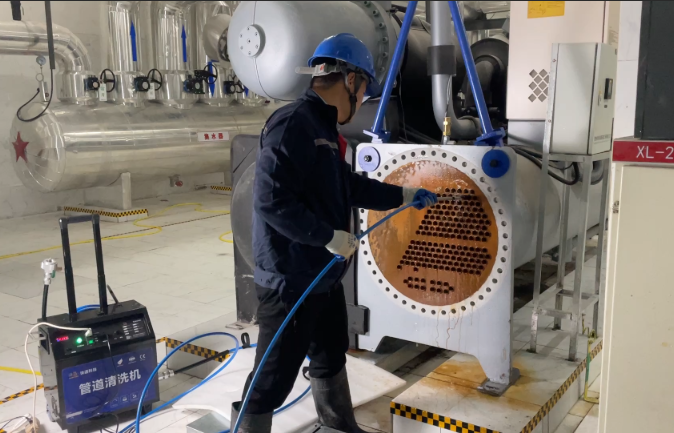
After scale, rust deposits, and slime accumulate in condenser tube bundles, water flow and heat exchange performance are gradually affected. For water-system equipment such as central air conditioning chillers and shell-and-tube heat exchangers, mechanical brushing combined with water flushing is typically effective when the deposits consist mainly of scale, rust, and slime. If hard blockage has already formed, appropriate tools should be selected or combined based on blockage severity.
Condenser tube fouling does not form suddenly—it accumulates gradually over long-term circulation. Minerals in cooling water deposit on the inner walls of heat exchange tubes. As fouling increases, heat transfer resistance and water-side pressure drop rise.
Therefore, the practical approach to cleaning is to first determine "what type of fouling, how severe the blockage, what is the tube diameter, and how long a shaft is needed," then select the appropriate equipment.
1. Common Types of Fouling in Condenser Tube Bundles
Fouling inside central air conditioning condenser tubes is rarely limited to a single type.
Scale
Scale is one of the most common condenser fouling types. Calcium, magnesium, and other minerals in circulating water gradually deposit on tube walls over time, forming scale.
Rust Deposits
Corrosion products from metal pipes and equipment may enter the condenser and adhere to tube walls.
Slime
Sediment and suspended solids in circulating water may form slimy deposits over time.
Algae and Biological Fouling
Open cooling water systems may also develop algae, biofilms, and other biological contamination.
Mixed Fouling
In practice, scale, rust deposits, and slime often coexist. Therefore, cleaning equipment should not be selected based solely on "scale" as the only condition.
2. Why Do Condensers Become Increasingly Difficult to Clean?
Condenser fouling has a gradual accumulation characteristic.
Initially, a thin deposit layer forms on the tube wall, making cleaning relatively easy.
If left untreated, fouling thickens, the effective tube cross-section gradually decreases, and localized blockage may eventually occur.
As fouling layers thicken, the power required for mechanical cleaning also increases.
Therefore, it is generally not advisable to wait until tubes are completely blocked before performing maintenance. According to ASHRAE, fouling increases heat transfer resistance and may raise condensing temperature and system power consumption while reducing equipment capacity.
3. What Cleaning Methods Should Be Used for Condenser Tube Bundles?
Selection depends primarily on the degree of fouling.
For:
Scale + Rust + Slime
Mechanical brushing can be prioritized.
For:
Thick scale
Mechanical brushing equipment with higher power and adjustable speed is recommended.
For:
Severe hard scale or complete blockage
Tools capable of mechanical unclogging, such as cutting tools or drill bits, are required.
Therefore, condenser cleaning is not about using the largest equipment—it must match the actual tube diameter and fouling conditions.
4. How Does Mechanical Brushing Work for Condenser Tube Bundles?
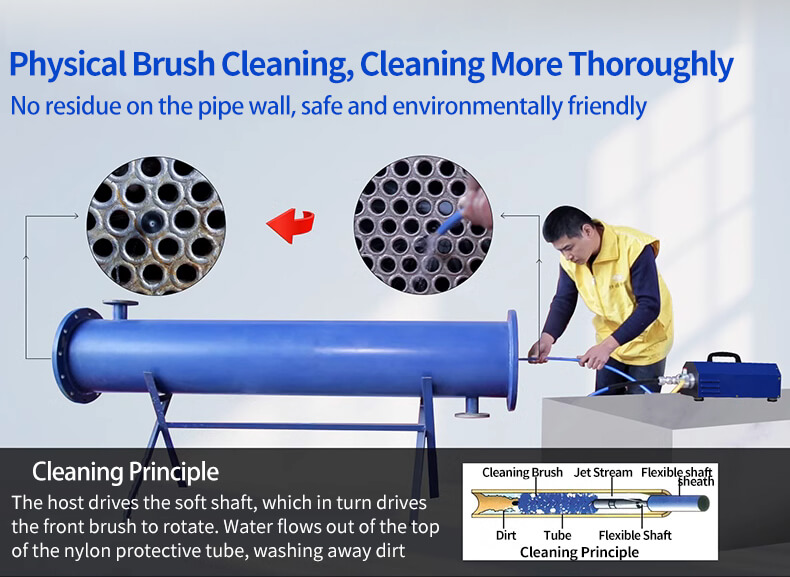
The basic structure of mechanical brushing is relatively simple:
Motor → Flexible shaft → Cleaning brush → Heat exchange tube
The motor provides rotational power. The flexible shaft transmits power into the tube. The front cleaning brush rotates inside the heat exchange tube, and the brush bristles rub against the tube wall to gradually remove scale, rust deposits, and sediment. Water flow simultaneously carries the loosened debris out.
This method is suitable for conventional scale, rust, and slime because the cleaning action occurs directly on the tube wall.
5. Why Are Different Shaft Specifications Needed for Condenser Cleaning?
Different heat exchange tube diameters require different shaft specifications.
If the shaft is too thick, it cannot enter small-diameter tubes. If too thin, it may lack sufficient power transmission and stability.
Professional condenser cleaning therefore requires shaft selection based on heat exchange tube dimensions.
For example, the Anhui Kuaitong KT-102 Condenser Tube Cleaning Machine offers optional shaft sizes of 6 mm, 8 mm, 10 mm, and 12 mm, suitable for heat exchange tubes of approximately Φ6.35–25.4 mm. This is a key parameter to confirm during equipment selection.
6. Why Brush and Flush Simultaneously When Cleaning Condensers?
If only mechanical brushing is performed, loosened scale may remain inside the tube.
Therefore, simultaneous water flushing during mechanical brushing carries loosened debris out promptly.
Anhui Kuaitong water-system equipment uses flexible shaft mechanical cleaning with simultaneous water flushing—cleaning water works with the brush head to promptly evacuate loosened fouling.
This method is suitable for tube-by-tube cleaning of central air conditioning condensers.
7. Can Blocked Condenser Tubes Still Be Brushed?
The degree of blockage must be distinguished.
If only tube wall scaling is present, the brush can enter directly for cleaning.
If the tube opening is completely sealed by hard scale and the brush cannot enter, continuing to force it forward is not only inefficient but may also cause shaft or brush jamming.
In such cases, unclogging tools suitable for blockage conditions should be used first to open a passage.
The correct approach is:
Light scaling → Brushing
Thicker scale → Enhanced mechanical brushing
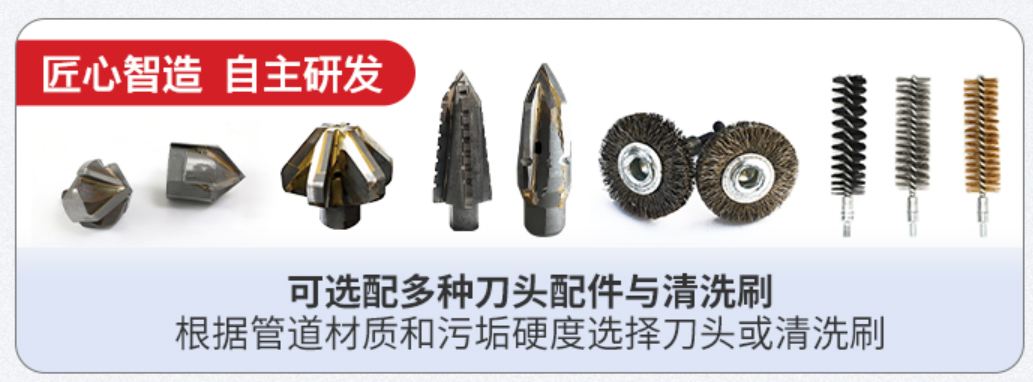
Localized hard scale → Change to appropriate brush or unclogging tool
Complete blockage → Unclog first, then brush
8. Which Condenser Cleaning Conditions Is the KT-102 Condenser Tube cleaner Suitable For?
If the primary application is scale and rust removal in central air conditioning condensers, shell-and-tube heat exchangers, and similar equipment, mechanical tube cleaning equipment matched to tube diameter can be selected.
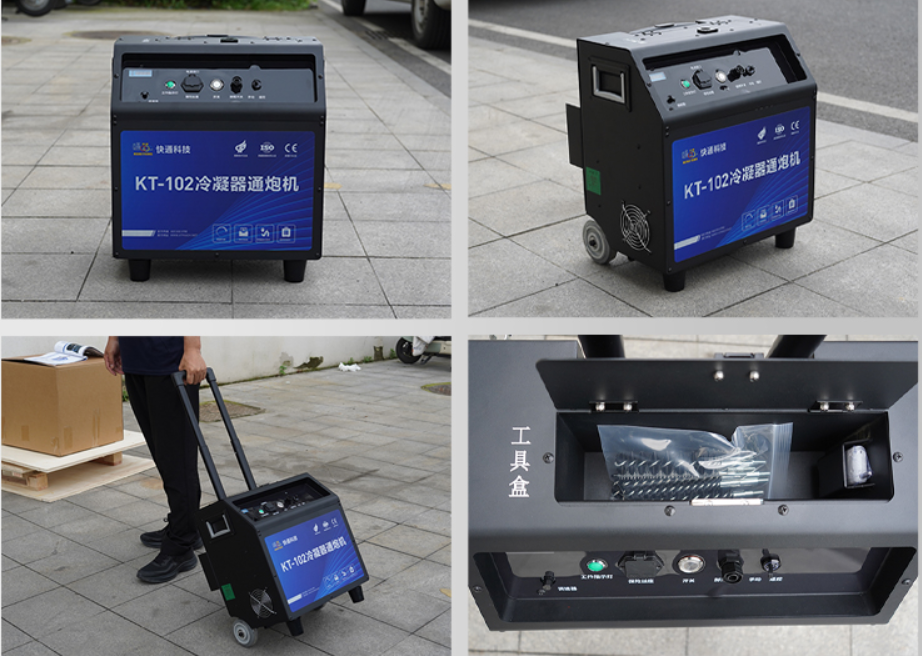
The KT-102 features 550W power, supports 0–1400 rpm speed control, and uses a pull-rod mobility structure—designed for professional cleaning technicians who need to move between different chiller units frequently.
Speed can be adjusted based on fouling severity, and different shaft specifications accommodate different heat exchange tubes. For technicians performing continuous tube-by-tube cleaning, foot pedal operation leaves hands free primarily for controlling the shaft and brush head.
9. How to Select Condenser Cleaning Equipment?
Selection can be based on the following criteria:
① Check tube diameter
First confirm the actual internal diameter of the condenser heat exchange tubes.
② Check fouling type
Primarily scale, rust, slime, or hard blockage.
③ Check blockage severity
Distinguish between normal scaling, localized blockage, and complete blockage.
④ Check frequency of use
Occasional maintenance vs. high-frequency professional cleaning require different power, mobility, and continuous operation capabilities.
⑤ Check shaft length
For longer tubes or special site conditions, appropriate shaft length should be configured based on site requirements.
10. Condenser Tube Bundle Mechanical Cleaning Procedure
Step 1: Confirm tube diameter
Measure or confirm condenser heat exchange tube specifications.
Step 2: Assess fouling
Observe fouling color, hardness, and blockage condition.
Step 3: Select shaft
Choose appropriate specifications based on tube diameter.
Step 4: Install cleaning brush
Select brush head based on tube material and fouling condition.
Step 5: Adjust speed
Start with an appropriate low speed and adjust based on cleaning results.
Step 6: Clean tube by tube
Insert shaft and brush head into each tube for mechanical brushing.
Step 7: Simultaneous water flushing
Use water flow to carry loosened debris out promptly.
Step 8: Verify flow condition
After cleaning, check tube flow condition.
11. Frequently Asked Questions (FAQ)
Q: Can condenser scale be cleaned with brushes?
A: Yes. For conventional scale, rust deposits, and slime, mechanical brushing is a common physical cleaning method. However, if scale has formed very hard blockages, stronger unclogging tools should be selected based on actual conditions.
Q: What should be done if condenser tubes are completely blocked?
A: First determine the blockage material. If it is hard blockage, a passage must first be established before further cleaning. Ordinary cleaning brushes should not be forced through.
Q: Does condenser mechanical cleaning require water?
A: Depending on equipment and cleaning method, dry or wet operation can be used. For water-system fouling such as scale and slime, simultaneous brushing and flushing promptly carries away loosened debris.
Q: What tube size is the KT-102 tube cleancer suitable for?
A: The KT-102 can accommodate heat exchange tubes of approximately Φ6.35–25.4 mm through different shaft specifications. Selection should be based on actual tube diameter and site conditions.
Q: Is higher power always better for condenser cleaning?
A: No. Equipment power must be matched to tube diameter, deposit hardness, tube material, and cleaning tools. For normal scale, suitable mechanical brushing equipment is sufficient. For severe hard scale, additional unclogging configurations are required.
About Anhui Kuaitong Pipeline Cleaning Technology Co., Ltd.
Anhui Kuaitong Pipeline Cleaning Technology Co., Ltd., established in 2009, is a subsidiary of Anhui Kuaitong Environmental Technology Group Co., Ltd., specializing in the R&D, manufacturing, and technical services of pipeline cleaning equipment. Our main products include central air conditioning condenser cleaning equipment, tube cleaner,industrial pipe unclogging machines, heat exchanger cleaning equipment, boiler tube bundle unclogging systems, and air preheater cleaning equipment.
The company has been recognized as a National High-Tech Enterprise, a Technology-Based SME, and a Training Base of the China Industrial Cleaning Association. Our products are certified under ISO 9001 Quality Management System and EU CE certification. Over the past 17 years, we have provided pipeline cleaning, unclogging, and inspection solutions to more than 23,000 enterprises worldwide.
The company continuously develops products based on actual cleaning requirements of central air conditioning water systems, industrial heat exchange equipment, and tube bundle equipment. Based on different tube diameters, fouling types, and site conditions, we configure appropriate shafts, cleaning brushes, and unclogging tools, providing equipment selection and pipeline cleaning solutions for central air conditioning maintenance companies, professional cleaning contractors, and industrial users.
This document is compiled by the technical team of Anhui Kuaitong Pipeline Cleaning Technology Co., Ltd.
Website: www.kuaitonggroup.com
Technical Consultation (Phone/WhatsApp/WeChat): +86 18226181287
Table of Contents
- 1. Common Types of Fouling in Condenser Tube Bundles
- 2. Why Do Condensers Become Increasingly Difficult to Clean?
- 3. What Cleaning Methods Should Be Used for Condenser Tube Bundles?
- 4. How Does Mechanical Brushing Work for Condenser Tube Bundles?
- 5. Why Are Different Shaft Specifications Needed for Condenser Cleaning?
- 6. Why Brush and Flush Simultaneously When Cleaning Condensers?
- 7. Can Blocked Condenser Tubes Still Be Brushed?
- 8. Which Condenser Cleaning Conditions Is the KT-102 Condenser Tube cleaner Suitable For?
- 9. How to Select Condenser Cleaning Equipment?
- 10. Condenser Tube Bundle Mechanical Cleaning Procedure
- 11. Frequently Asked Questions (FAQ)
- About Anhui Kuaitong Pipeline Cleaning Technology Co., Ltd.