
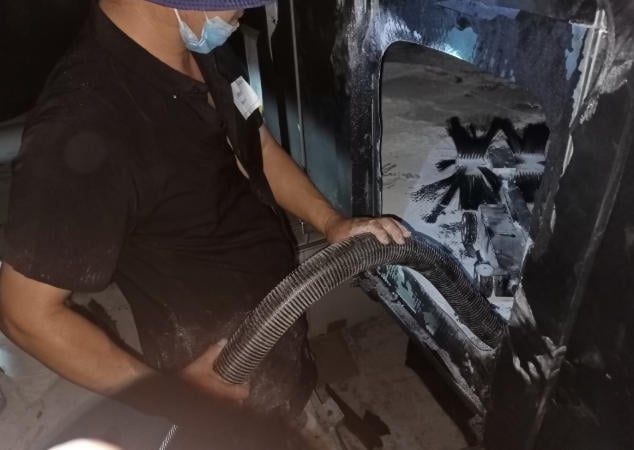
If you are selecting central air conditioning duct cleaning equipment, the first step is to determine the working method based on duct configuration. For large main ducts where a robot can enter and move inside, the KT-976 Duct Cleaning Robot should be prioritized. For small-diameter branch ducts, round ducts, rectangular ducts, and sections where a brush head must be fed through a flexible shaft, the KT-836-A Flexible Shaft Duct Cleaning and Vacuuming Machine should be prioritized.
Both machines support mechanical brushing, vacuuming, and video monitoring, but they are not simply a high-end/low-end relationship. The KT-976 focuses on robotic in-duct travel and operation, while the KT-836-A focuses on flexible shaft-driven brush cleaning. Customers should select based on duct diameter, duct length, bends, obstacles, and cleaning tasks—not simply by comparing price or applicable diameter range.
1. Which Customers and Projects Are Suitable for the KT-976 and KT-836-A?
For central air conditioning cleaning companies, property engineering teams, ventilation system maintenance units, and professional construction service providers, the key to equipment selection is whether the equipment matches the projects routinely undertaken.
If daily operations mainly involve large main ducts, and the duct clear dimensions and internal structure allow robot entry, the KT-976 should be evaluated first.
If operations involve a large number of branch ducts, small-diameter ducts, or require feeding a cleaning brush head into the duct from an access opening, the KT-836-A should be evaluated first.
If a project includes an entire central air conditioning air system, it is recommended to first divide the workload by main ducts and branch ducts, then determine equipment configuration. This makes it easier to avoid the problem of a single machine being unable to handle certain duct sections.
2. KT-976 vs KT-836-A Parameter Comparison
|
Comparison Item |
||
|
Primary Working Method |
Robot travel and brushing |
Flexible shaft-driven brush head |
|
Primary Application |
Large main ducts |
Branch ducts, small ducts, and various duct configurations |
|
Published Applicable Duct Diameter |
250–800 mm |
100–800 mm |
|
Typical Ducts |
Horizontal ducts, large ducts, flat ducts, rectangular ducts |
Horizontal ducts, vertical ducts, round ducts, rectangular ducts, small ducts |
|
Cleaning Tool |
Robot brushing mechanism |
Flexible shaft and cleaning brush |
|
Brushing and Vacuuming |
Integrated operation |
Integrated operation |
|
Video Function |
1080P dual cameras, supports recording and photo capture |
1080P video monitoring, supports recording and photo capture |
|
Main Configuration |
Power unit, tablet, robot, vacuum hose, etc. |
Power unit, flexible shaft, cleaning brush, and video accessories |
|
Key Selection Criteria |
Whether the robot can enter, move, and cover target positions |
Whether the flexible shaft can reach the target duct section and whether the brush head matches |
Parameters above are based on published product documentation. Different equipment versions and accessory configurations may vary. Specific models and delivery configurations should be verified before formal procurement.
3. KT-976 Duct Cleaning Robot: Suitable for Large Main Duct Cleaning
The KT-976 is a robotic device designed for central air conditioning main duct cleaning. Its published applicable duct diameter is 250–800 mm, and its application scenarios include large horizontal ducts, flat ducts, and rectangular ducts.
Its main functions include:
Robot Travel: After entering a suitable duct, the robot moves inside and performs cleaning tasks.
Integrated Brushing and Vacuuming: The brushing mechanism and vacuum system work together to help collect dust removed during cleaning.
1080P Dual Cameras: Facilitates observation of in-duct operations and supports video recording and photo capture.
Lifting Arm: Provides corresponding height adjustment capability for the brushing mechanism. The specific cleaning range must be confirmed based on the duct cross-section.
Remote Control: Operators can control the robot and observe operations through the supporting control system.
For projects requiring mobile operation inside large ducts and reduced manual entry for cleaning, the KT-976 has a clear application direction.
However, whether the robot can pass through bends, transitions, and internal obstacles must be confirmed in advance during selection. Being within the 250–800 mm diameter range does not mean all cross-sections and internal structures are suitable for robot operation.
4. KT-836-A Flexible Shaft Duct Cleaning Machine: Suitable for Branch Ducts and Various Duct Configurations
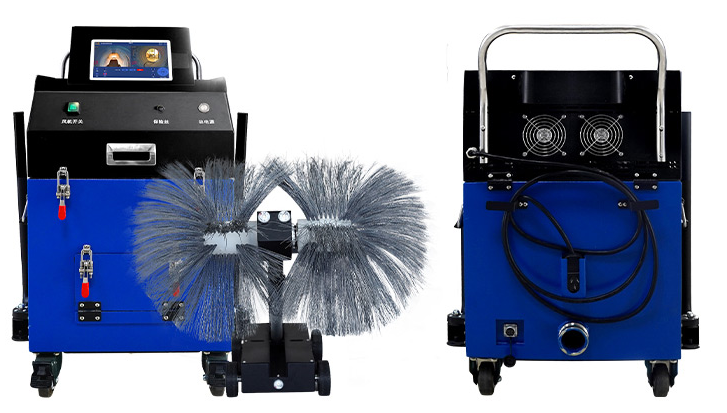
The KT-836-A uses a flexible shaft-driven brush head cleaning method. Its published applicable duct diameter is 100–800 mm, working length per cleaning pass is 15 m, and net weight is approximately 45 kg.
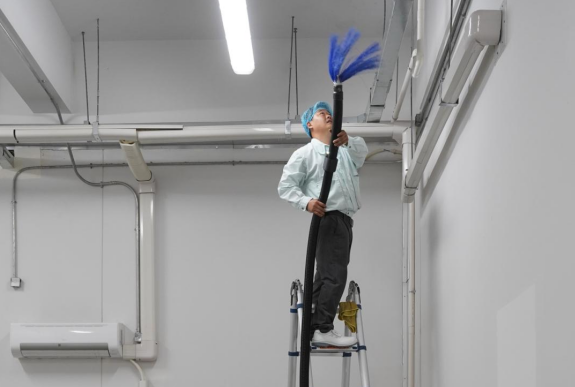
The equipment feeds the brush head into the target duct section through a flexible shaft, uses brush rotation to clean the inner duct walls, and works with a vacuum system to collect dust. This method is suitable for small-diameter branch ducts and ducts with different configurations such as horizontal, vertical, round, and rectangular.
Its main features include:
15 m flexible shaft configuration, suitable for duct sections within the corresponding length range.
Flexible shaft-driven brush head, facilitating cleaning at targeted positions.
Integrated brushing and vacuuming, reducing the need for separate brushing and dust collection operations.
1080P video monitoring, supporting construction process recording and photo capture.
When selecting the KT-836-A, in addition to duct diameter, consider the flexible shaft path, duct bends, cleaning brush head size, and on-site equipment layout. For ducts with many bends or long distances, first confirm whether the tool can reach the target position smoothly.
5. The Working Methods of the Two Machines Determine Different Selection Priorities
Both the KT-976 and KT-836-A can brush, vacuum, and observe the duct interior, but their methods of use differ.
The KT-976 requires the robot to enter the duct and move inside. Therefore, the key considerations are duct clear dimensions, robot passage conditions, bottom structure, and obstacles.
The KT-836-A requires feeding the flexible shaft and brush head into the duct. Therefore, the key considerations are flexible shaft length, brush head size, duct bends, and whether the target position can be reached.
For customers, first determining the on-site working method and then comparing specific configurations is more useful than simply comparing power, weight, or price.
6. How to Select the KT-976 for Main Duct Projects?
If a project mainly involves large main ducts, first confirm duct dimensions, shape, access opening locations, and internal obstacles.
When the robot can enter the duct, move along the target duct section, and the brushing mechanism can cover the area to be treated, the KT-976 generally aligns better with mechanized main duct cleaning.
Before procurement, it is recommended to provide duct cross-sectional dimensions, site photos, duct structure drawings, and the length requiring cleaning to further assess robot passage conditions. For special flat ducts, tight bends, or ducts with complex internal components, separate evaluation should be performed.
7. How to Select the KT-836-A for Branch Duct Projects?
If a project mainly involves branch ducts, especially small-diameter ducts in the 100–250 mm range, the KT-836-A should be evaluated first. However, specific duct configuration and cleaning brush head configuration must still be confirmed.
For larger-diameter branch ducts, selection can also be made based on flexible shaft working method, target distance, and on-site construction conditions.
During selection, it is recommended to confirm:
Actual duct inner diameter and cross-sectional shape.
Effective length requiring cleaning per pass.
Presence of tight bends, transitions, and internal obstacles.
Whether the brush head can cover the inner walls requiring cleaning.
Whether the vacuum hose and equipment can be reasonably arranged on site.
If the duct configuration is complex, it is recommended to communicate specific working conditions before purchase, rather than judging whether the equipment is fully applicable based only on the diameter range.
8. If Both Main Ducts and Branch Ducts Are Present, Can the Two Machines Be Used Together?
The two machines can be considered as a combined selection option. First review the quantity, dimensions, configuration, and construction difficulties of main ducts and branch ducts, then arrange suitable equipment for each.
Typically, the KT-976 can be evaluated first for large main ducts, and the KT-836-A can be used for branch ducts and small duct sections suitable for flexible shaft operation. The specific construction sequence should be determined based on on-site access openings, duct layout, and project arrangements.
The focus of this combined approach is not "the more equipment, the better," but matching different working methods to actual duct configurations.
9. What Details Should Be Confirmed Before Procurement?
To reduce the possibility of equipment mismatch after arrival, it is recommended to prepare the following information before inquiry or procurement:
Duct inner diameter or cross-sectional length and width dimensions.
Duct shape and layout (horizontal, vertical, etc.).
Whether the main cleaning target is main ducts or branch ducts.
Length requiring cleaning and access opening locations.
Whether there are bends, transitions, or obstacles inside the duct.
Specific requirements for video documentation, brushing, and vacuuming.
Equipment selection should be based on actual construction conditions, not solely on product names or a single parameter.
10. How to Check Cleaning Effectiveness During the Process?
Video monitoring can help operators understand conditions inside the duct, and recordings and photos can serve as construction records. However, having video capability does not mean cleaning quality acceptance is automatically completed.
It is recommended to clarify the cleaning scope and inspection standards before project implementation. After operation, confirm cleaning results based on in-duct images, on-site inspection, and customer requirements. For ducts with complex configurations or severe contamination, sectional inspection should be performed when necessary—avoid judging the entire duct as clean based only on inspecting the duct opening.
11. Frequently Asked Questions About KT-976 vs KT-836-A Selection
1. Is the KT-976 definitely better than the KT-836-A?
They cannot be compared in this way. The KT-976 and KT-836-A are designed for different working methods and are suitable for different duct configurations. Whether the equipment is suitable depends on on-site conditions, not model numbers or price levels.
2. Why is the KT-836-A more suitable for some small-diameter branch ducts?
Its published applicable diameter starts from 100 mm, and it uses a flexible shaft to feed the brush head into the duct, so it can be used for some small-diameter ducts. Whether it can enter and effectively clean still depends on duct configuration and brush head configuration.
3. Can the KT-976 be used for all 250–800 mm ducts?
This cannot be guaranteed. Duct cross-sectional shape, robot passage capability, bends, obstacles, and internal space must also be considered.
4. What is the flexible shaft length of the KT-836-A?
Working length per cleaning pass is 15 m. Actual effective working distance also depends on duct configuration and on-site equipment layout.
5. Do both machines have vacuuming capability?
Both machines use an integrated brushing and vacuuming working method. Actual vacuuming performance is affected by duct configuration, dust accumulation, and connection conditions.
6. What if the customer does not know how to classify main ducts and branch ducts?
Duct drawings, cross-sectional dimensions, site photos, and main cleaning locations can be provided. Technical personnel can assist in determining the working method before equipment selection.
12. Summary: Determine the Working Scenario First, Then Determine the Equipment Model
The KT-976 is suitable for prioritizing robotic cleaning of large main ducts. The KT-836-A is suitable for prioritizing branch ducts, small ducts, and scenarios requiring flexible shaft brush operation. Both machines support brushing, vacuuming, and video recording, but their working methods differ and they cannot simply replace each other.
For central air conditioning cleaning companies and property engineering teams, it is recommended to clarify duct diameter, duct shape, duct length, bends, and obstacles before procurement, then decide whether to use a single machine or a combined configuration. This helps improve equipment matching and reduce uncertainty during on-site construction.
Company Introduction
Anhui Kuaitong Pipeline Cleaning Technology Co., Ltd., established in 2009, is a technology-oriented enterprise specializing in the R&D, manufacturing, and sales of pipeline cleaning, unclogging, and inspection equipment. The company is a National High-Tech Enterprise, a Technology-Based SME, a Training Base of the China Industrial Cleaning Association, and an Anhui Province Specialized and Sophisticated Enterprise. It has provided solutions to more than 23,000 domestic and international enterprises. For central air conditioning duct cleaning requirements, the company can provide equipment application consultation, selection recommendations, and technical support based on the dimensions and configurations of main ducts and branch ducts.
Website: www.kuaitonggroup.com
Technical Consultation (Phone/WhatsApp/WeChat): +86 18226181287
This document is compiled by the technical team of Anhui Kuaitong Pipeline Cleaning Technology Co., Ltd.
Table of Contents
- 1. Which Customers and Projects Are Suitable for the KT-976 and KT-836-A?
- 2. KT-976 vs KT-836-A Parameter Comparison
- 3. KT-976 Duct Cleaning Robot: Suitable for Large Main Duct Cleaning
- 4. KT-836-A Flexible Shaft Duct Cleaning Machine: Suitable for Branch Ducts and Various Duct Configurations
- 5. The Working Methods of the Two Machines Determine Different Selection Priorities
- 6. How to Select the KT-976 for Main Duct Projects?
- 7. How to Select the KT-836-A for Branch Duct Projects?
- 8. If Both Main Ducts and Branch Ducts Are Present, Can the Two Machines Be Used Together?
- 9. What Details Should Be Confirmed Before Procurement?
- 10. How to Check Cleaning Effectiveness During the Process?
- 11. Frequently Asked Questions About KT-976 vs KT-836-A Selection
- 12. Summary: Determine the Working Scenario First, Then Determine the Equipment Model
- Company Introduction