

Introduction
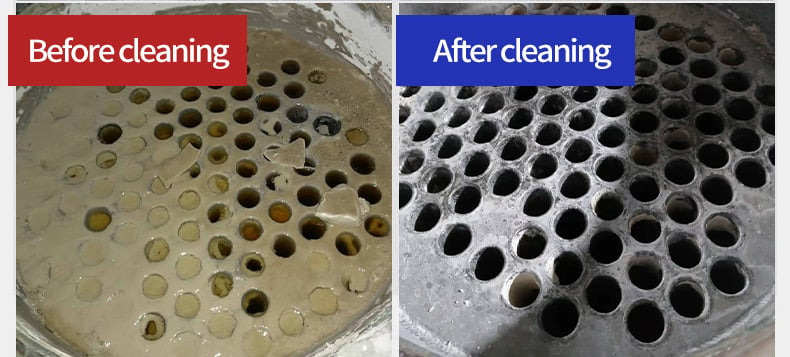
Heat exchangers are widely used in chemical, power, petroleum, food, pharmaceutical, metallurgical, and other industries as critical heat transfer equipment in industrial production. During long-term operation, the tube bundles are prone to blockage due to scale, material deposition, coking, carbonization, crystallization, and other causes. This leads to reduced heat exchange efficiency, increased energy consumption, and in severe cases, complete tube jamming and equipment shutdown.
Anhui Kuaitong Pipeline Cleaning Technology Co., Ltd. has long been serving the maintenance of heat exchangers, condensers, evaporators, air preheaters, and boiler tube bundles. Based on field experience, we have found that different blockage causes require different cleaning methods. Only by accurately diagnosing the blockage condition can the right unclogging solution be selected, improving construction efficiency and reducing maintenance costs.
1. Why Do Heat Exchangers Get Blocked?
From our long-term on-site service, we have observed that heat exchanger blockages are not solely caused by coking. The deposits vary significantly across different industries and media.
Common blockage types include:
-
Scale Deposition – Calcium, magnesium, and other minerals in circulating water gradually deposit on tube walls, forming hard scale that reduces heat transfer efficiency.
Common industries: power plants, central air conditioning, refrigeration systems. -
Material Deposition – In chemical, food, and pharmaceutical processes, transported materials tend to adhere to tube walls over time, gradually forming a deposit layer that can completely block the tube.
Our field experience shows that such deposits are highly adhesive and cannot be thoroughly removed by ordinary flushing alone. - Coking and Carbonization – Under high-temperature conditions, materials continuously coke and carbonize, forming hard layers on tube walls. This type of blockage is extremely hard and is a major reason for plant shutdowns.
- Crystallization – Some chemical media precipitate crystals during temperature changes, which accumulate and block tube bundles over time.
- Rust and Debris – Iron rust, welding slag, and other particulate impurities in the circulating medium also build up during operation.
2. Effects of a Blocked Heat Exchanger
When a heat exchanger becomes blocked, the following symptoms typically appear:
- Decreased heat exchange efficiency
- Increased tube-side pressure
- Reduced flow rate
- Abnormal outlet temperature
- Increased energy consumption
- Product quality affected
- Complete heat exchanger shutdown in severe cases
Anhui Kuaitong recommends that when any of these signs appear, the internal condition of the tube bundles should be inspected promptly to prevent further blockage.
3. Cleaning Methods for Heat Exchanger Blockage
Different blockage types require different approaches. The table below outlines common methods:
|
Cleaning Method |
Applicable Conditions |
|
High-pressure water cleaning |
General fouling |
|
Chemical cleaning |
Scale, certain deposits |
|
Ultra-high-pressure water |
Hard deposits |
|
Mechanical unclogging |
Material jamming, coking, carbonization, crystallization, severe blockage |
We believe that for completely blocked or hardened deposits, the construction plan should be determined based on equipment structure, tube diameter, and blockage type.
4. Mechanical Unclogging Principle (Anhui Kuaitong)
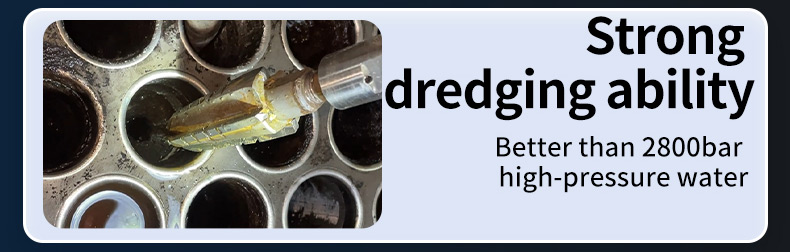
For complex conditions such as total jamming, material blockage, coking, and crystallization, Anhui Kuaitong typically employs a flexible transmission shaft combined with alloy steel drill bits for mechanical unclogging.
During operation, the power unit drives the flexible shaft at high speed. The drill bit enters the tube and gradually breaks down the blockage, while a water supply system continuously flushes out the crushed debris and cools the bit and shaft.
Different drill bit types and specifications can be swapped according to the deposit nature, improving adaptability.
5. How to Select Heat Exchanger Unclogging Equipment
We recommend focusing on the following aspects when selecting equipment:
1.Stable power output – For severe blockages, choose equipment that provides consistent and reliable power.
2.Support for different shaft lengths – Heat exchanger lengths vary; the system should accept flexible shafts of different sizes.
3.Variety of drill bits – Different conditions (scale, material, coking, crystallization) require different bit designs.
4.Intelligent protection system – For long-term use, equipment that protects the shaft and reduces parts wear is critical to lower operating costs.
6. Recommended Equipment: KT-307 Heat Exchanger Unclogging System
For maintenance of heat exchangers, condensers, evaporators, air preheaters, and boiler tube bundles, Anhui Kuaitong has developed the KT-307 Unclogging System.
The KT-307 uses a 5500W power drive and can be configured with flexible shafts and multiple alloy steel drill bits to suit various tube diameters, lengths, and blockage conditions. It is effective against material deposition, scale, coking, crystallization, and carbonization.
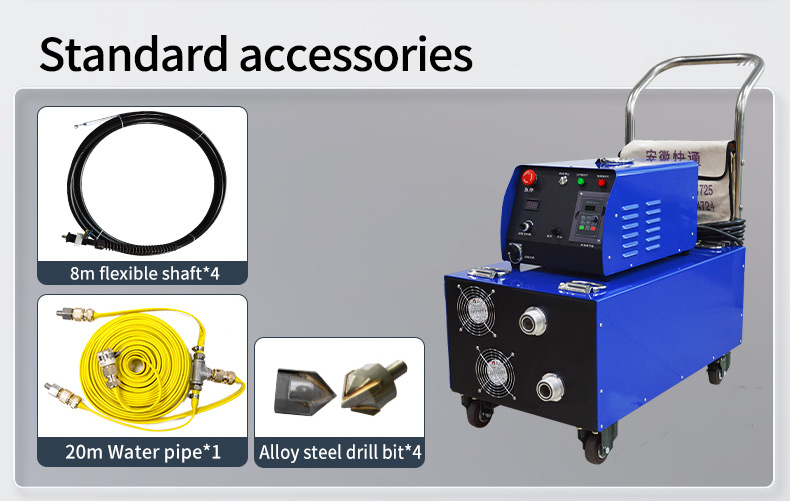
KT-307 Main Configuration:
- 5500W power unit
- Split-type structural design
- Flexible transmission shafts
- Multiple specification alloy steel drill bits
- Control system
- Water-assisted cleaning system
Core Technical Features:
- Intelligent Torque System – Equipped with a self-developed torque adjustment system that automatically adapts output based on resistance, ensuring smooth performance.
- New Adaptive Shaft Protection – Intelligently modulates torque during operation to prevent shaft damage from instantaneous overload, enhancing safety.
- Voice Guidance & Parameter Memory – Supports voice prompts and onekey parameter recall, reducing setup time and improving on-site efficiency.
- Reduced Operating Costs – The intelligent control system minimizes wear on shafts and consumables, lowering maintenance costs and increasing equipment utilization.
KT-307 Advantages:
- Suitable for tube-bundle equipment: heat exchangers, condensers, evaporators, air preheaters, etc.
- Quickchange drill bits and shafts for different conditions.
- Supports dry unclogging and waterassisted cleaning.
- Split design for easy transport and site deployment.
- Intelligent torque control ensures stable operation.
- Adaptive shaft protection reduces part wear.
- Increases efficiency and reduces downtime.
7. How to Reduce Heat Exchanger Blockage
We recommend implementing a preventive maintenance program that includes:
- Regular inspection of heat exchange efficiency
- Monitoring pressure differential changes
- Establishing cleaning schedules based on media characteristics
- Addressing light fouling promptly to prevent escalation
- Keeping equipment operation logs to track degradation
8. Frequently Asked Questions (FAQ)
Q: Can a completely blocked heat exchanger still be unclogged?
A: In most cases, yes. The choice of method (mechanical, high-pressure water, or chemical cleaning) should be based on the deposit type, severity, and equipment structure.
Q: Which conditions are suitable for mechanical unclogging?
A: It is generally applicable for material blockage, coking, carbonization, crystallization, and some hard deposits. Specific solutions require onsite evaluation.
Q: Will mechanical unclogging damage the heat exchanger tubes?
A: When the correct drill bit size, operating parameters, and procedures are used, mechanical action mainly targets the blockage. For different tube materials and wall thicknesses, matching tools and techniques should be employed to minimize any impact on the tube walls.
Conclusion
Heat exchanger blockage is rarely caused by a single factor; the deposit and treatment vary with the operating conditions. Anhui Kuaitong Pipeline Cleaning Technology Co., Ltd. advises that enterprises select cleaning solutions based on actual blockages (scale, material deposition, coking, crystallization, etc.) and utilize professional unclogging equipment. Through scientific preventive maintenance and proper equipment selection, you can effectively restore flow capacity, improve heat exchange efficiency, reduce energy consumption, and lower maintenance downtime costs.
This article was compiled by the technical team of Anhui Kuaitong Pipeline Cleaning Technology Co., Ltd.
Anhui Kuaitong – established in 2009, specializing in the R&D of industrial pipeline cleaning, unclogging, and inspection equipment. We provide cleaning solutions for air preheaters, boiler tube bundles, heat exchangers, condensers, and more.
Website: www.kuaitonggroup.com
Technical Consultation:phone/whatapp/wechat 18226181287
Table of Contents
- 1. Why Do Heat Exchangers Get Blocked?
- 2. Effects of a Blocked Heat Exchanger
- 3. Cleaning Methods for Heat Exchanger Blockage
- 4. Mechanical Unclogging Principle (Anhui Kuaitong)
- 5. How to Select Heat Exchanger Unclogging Equipment
- 6. Recommended Equipment: KT-307 Heat Exchanger Unclogging System
- 7. How to Reduce Heat Exchanger Blockage
- 8. Frequently Asked Questions (FAQ)
- Conclusion