EN
 AR
 HR
 CS
 NL
 FI
 FR
 DE
 EL
 HI
 IT
 KO
 PT
 RO
 RU
 ES
 TL
 ID
 LV
 LT
 SR
 VI
 ET
 HU
 TH
 AF
 MS
 HY
 AZ
 KA
 BN
 GU
 LO
 MN
 MY
 KK
 MG
 KY

What Equipment Is Used to Clean Blocked Corrugated Ducts in Precast Beams? KT-309 Concrete Unclogging Machine Selection
1. What Equipment Is Used to Clean Completely Blocked Corrugated Ducts in Precast Beams?
When a precast beam corrugated duct is blocked by concrete or hardened cement slurry and ordinary duct mandrels and flushing methods cannot resolve the problem, a mechanical concrete unclogging machine can be considered based on the internal condition of the duct. The basic principle is to transmit power into the pipe through a flexible shaft, use a front-end alloy steel cutter to drill and break the hardened blockage, and then use water or air flushing to assist debris removal.
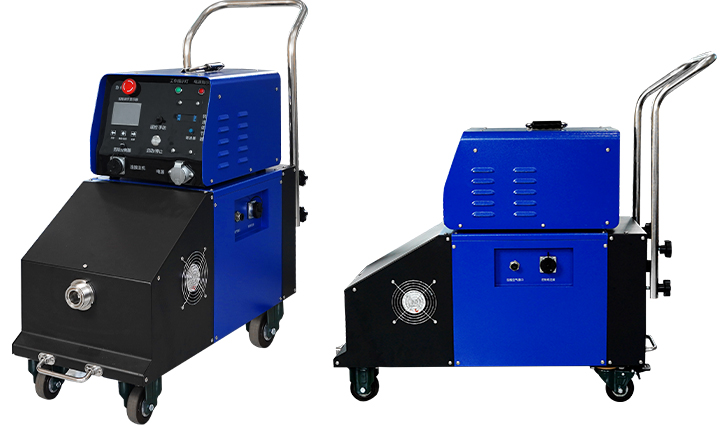
The KT-309 Concrete Blocked Pipe Unclogging Machine from Anhui Kuaitong Pipeline Cleaning Technology Co., Ltd. is mainly designed for hard blockage conditions formed by concrete, cement slurry, and cement debris. The equipment uses a 7500W motor, 22 mm / 27 mm / 30 mm flexible shafts, alloy steel cutters, and an intelligent torque adjustment system. Configuration can be selected base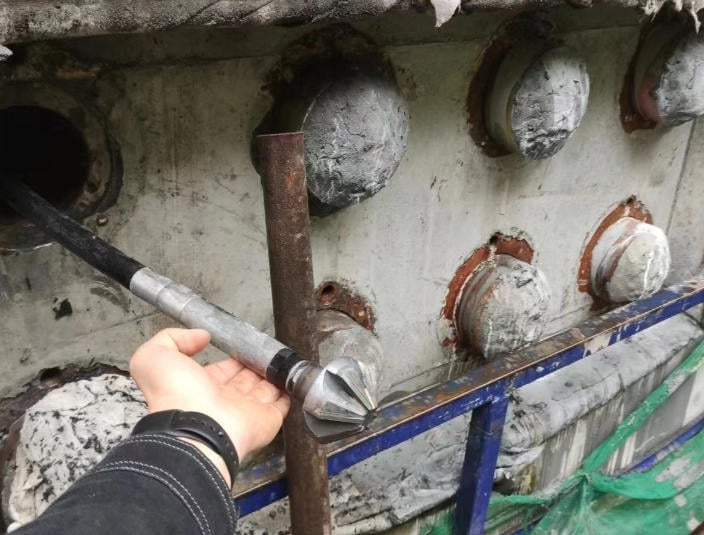 d on pipe size, blockage conditions, and site requirements.
However, prestressed corrugated ducts in precast beams are different from ordinary conduit pipes. Before using the equipment, it is first necessary to confirm whether steel strands have already been threaded into the duct, whether the corrugated duct is deformed, and whether the cutter has sufficient working space. Mechanical drilling cannot be carried out simply because "the pipe is blocked."
2. What Problems Are Commonly Encountered When Precast Beam Corrugated Ducts Are Blocked?
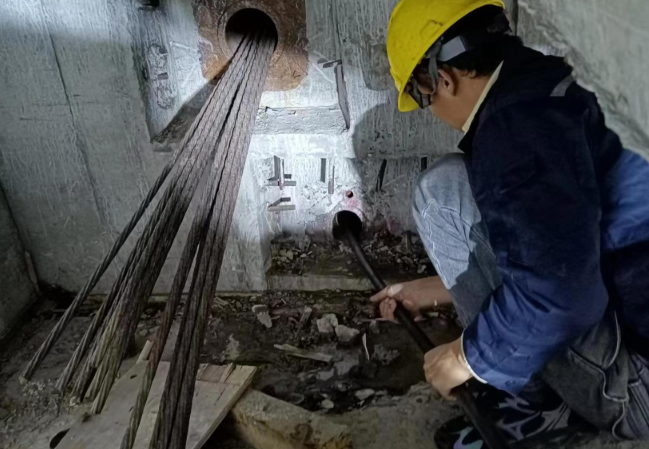
In the construction of precast box girders, T-girders, and other prestressed concrete members, corrugated ducts must be installed in advance and fixed in the designed position. After concrete pouring is completed, if the duct is found to be blocked, the following situations are often encountered on site.
Situation 1: Cement slurry enters the corrugated duct and forms hard blocks after setting.
Improper sealing of the pipe opening, inadequate joint sealing, or damage to the corrugated duct may allow slurry to enter the duct. It may be easy to clean when it first enters, but after setting and hardening, it may form a hard localized blockage.
Situation 2: The corrugated duct is completely blocked locally or over a long section.
If a large amount of cement slurry enters, continuous blockage may form. Ordinary duct clearing tools cannot pass through, and simple water flushing may not allow water to enter the interior of the blockage.
Situation 3: The duct has bends, making it difficult for unclogging tools to reach the blockage.
Prestressed ducts are usually laid along designed curves, and some positions have curved bends. Rigid rods may not pass through, while flexible shafts need to be selected according to bend conditions.
Situation 4: Steel strands have already been threaded, increasing treatment risk.
This situation cannot be treated directly as an empty duct blockage. The mechanical cutter rotates inside the pipe. If it contacts steel strands, it may damage the prestressing tendons. Therefore, the internal condition and construction boundary must first be confirmed.
3. Why Are Ordinary Unclogging Methods Not Always Effective for Precast Beam Corrugated Duct Blockage?
Before selecting equipment, the nature of the blockage must first be distinguished.
|
Blockage Type |
Common Treatment Approach |
Main Limitation |
|
Loose debris |
Duct mandrel, manual cleaning |
Suitable for light blockage |
|
Not yet hardened cement slurry |
Timely inspection, flushing, and unclogging according to construction requirements |
Requires proper timing |
|
Partially cured mortar |
Select mechanical or flushing methods based on hardness and pipe condition |
Blockage severity must be assessed |
|
Hardened cement blocks |
Evaluate mechanical drilling |
Requires matching flexible shaft and cutter |
|
Dense concrete blockage |
Dedicated mechanical breaking equipment |
High requirements for power, cutter, and operation control |
|
Corrugated duct flattened or deformed |
Structural condition assessment and special treatment |
Not a simple hard blockage |
Ordinary high-pressure water cleaning mainly relies on water flow scouring, stripping, and discharging impurities. For hardened concrete, water flow can hardly replace a mechanical cutter in drilling and breaking.
Therefore, for hardened concrete blockage, the treatment approach is usually to perform mechanical breaking first, then clean debris according to site conditions, rather than simply increasing water pressure continuously.
4. How Does the KT-309 Handle Hardened Concrete in Corrugated Ducts?
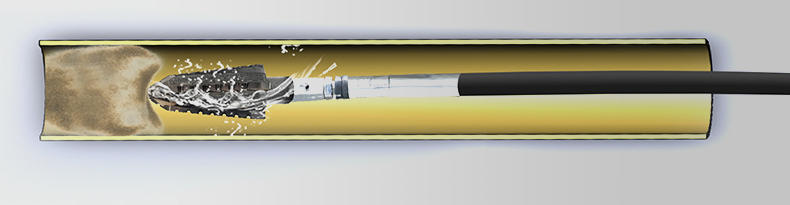
The KT-309 Concrete Blocked Pipe Unclogging Machine is mechanical concrete blockage removal equipment. It does not directly crush concrete with high-pressure water. Instead, a motor drives a flexible shaft to rotate and transmits power to an alloy steel cutter inside the pipe.
After the cutter contacts the blockage, it drills, cuts, and progressively breaks the hardened cement slurry blocks or concrete through rotation, forming debris and a passage that can be cleaned.
The working process can be summarized as:
Power output → Flexible shaft transmission → Alloy cutter drilling → Progressive breaking of blockage → Water or air flushing assisted debris removal → Patency inspection.
4.1 7500W Power for Hardened Concrete Blockage
The KT-309 uses a 7500W motor and is mainly designed for hardened concrete, cement slurry, and cement debris blockages that ordinary unclogging tools cannot handle.
For precast beam corrugated ducts, configuration must be selected based on actual pipe inner diameter, cutter specifications, and blockage location. High power does not mean pipe wall protection can be ignored or that the tool can be forced forward directly.
4.2 0–2800 rpm Speed Adjustment
Different blockage hardness and different flexible shaft specifications require different working conditions.
The KT-309 supports 0–2800 rpm speed adjustment. During operation, the cutter can first contact the blockage at low speed. After confirming cutter force and flexible shaft operation status, speed can be adjusted according to actual breaking conditions.
4.3 Intelligent Torque Adjustment to Reduce Shaft Overload Risk
During mechanical drilling, the cutter may encounter locally extremely hard concrete blocks or suddenly jam due to debris accumulation.
If the flexible shaft continuously bears excessive torque, it may kink, deform, or even break.
The KT-309 can set the corresponding torque working range based on flexible shaft specifications. Combined with flexible shaft core protection design, it reduces the risk of damage caused by abnormal stress.
4.4 Special Stepped Cutter for Progressive Cutting of Hard Blockages
The stepped (pyramid-type) cutter uses a progressive cutting structure, allowing it to contact and break the blockage gradually from small to large.
Compared with forcing a larger cutter forward from the beginning, progressive cutting is more conducive to controlling cutter contact status and advancement resistance.
In actual use, the cutter still needs to be selected based on pipe inner diameter, blockage size, and pipe wall material. The same cutter cannot be used for all corrugated ducts.
4.5 Water Flushing and Air Flushing for Assisted Debris Removal
After concrete is broken, debris remains inside the pipe and must be cleaned promptly.
The KT-309 supports two working modes: water flushing and air flushing.
- Water flushing mode: Water is supplied to the front end of the flexible shaft through a quick-connect water hose. While the cutter breaks the blockage, loosened cement debris is flushed out.
- Air flushing mode: For pipes not suitable for water introduction on site, airflow can be used according to conditions to assist debris discharge.
Note that water flushing and air flushing are mainly used to assist debris removal, not to replace mechanical breaking. The specific method should be determined based on pipe structure, debris discharge outlet, and on-site safety conditions
5. How Should the KT-309 Be Configured for Precast Beam Corrugated Duct Cleaning?
The KT-309 can be configured with different specifications of flexible shafts and cutters. Actual selection cannot be based only on the equipment model; corrugated duct inner diameter, length, and blockage location must also be considered.
5.1 How to Select the Flexible Shaft?
The flexible shaft specifications listed in product documentation include 22 mm, 27 mm, and 30 mm.
Heavy-duty unclogging shaft: Has stronger power transmission capability and is mainly used for heavy straight-pipe blockage and hardened concrete drilling.
Bendable shaft: Has relatively greater flexibility and can be used for curved pipes and some U-shaped, S-shaped, and L-shaped pipes. However, actual passage capability depends on bend radius, number of bends, pipe diameter, and flexible shaft configuration.
Precast beam ducts usually have curves. It cannot simply be assumed that all flexible shafts can pass through all curved positions.
5.2 How to Select the Cutter?
For concrete and hardened cement slurry blockage, dedicated alloy steel cutters or stepped cutters usually need to be considered.
If subsequent tasks also involve pipe descaling, rust removal, and inner wall cleaning, corresponding cutters or cleaning brushes can be replaced based on pipe material and deposit type.
However, for prestressed corrugated ducts, cutter size, shape, and cutting range are particularly important. Selection must balance blockage breaking capability with corrugated duct wall protection. Oversized cutters cannot be used blindly just to enlarge the passage.
5.3 How to Determine Flexible Shaft Length?
The standard flexible shaft length in KT-309 documentation is 8 m, with two shafts in the standard configuration. The specific shaft type and specification need to be determined based on working conditions.
If the blockage is deep, the actual pipe length, distance between equipment and pipe opening, and transmission resistance of the flexible shaft in the curved duct must be verified.
The flexible shaft cannot be selected only by the total length of the corrugated duct. Equipment layout position and actual effective working distance must also be considered.
6. KT-309 Product Technical Parameters
|
Parameter Item |
Technical Data |
|
Product Model |
KT-309 Intelligent Model |
|
Product Type |
Concrete Blocked Pipe Unclogging Machine |
|
Rated Voltage |
380V |
|
Motor Power |
7500W |
|
Operating Speed |
0–2800 rpm, adjustable |
|
Applicable Pipe Diameter |
6.35–800 mm |
|
Flexible Shaft Specifications |
22 mm, 27 mm, 30 mm |
|
Standard Flexible Shaft Length |
8 m |
|
Standard Flexible Shaft Quantity |
2 pieces |
|
Power Unit Weight |
Approx. 92.5 kg |
|
Power Unit Dimensions |
800×336×346 mm |
|
Control Cabinet Weight |
Approx. 17 kg |
|
Control Cabinet Dimensions |
440×310×258 mm |
|
Quick-Connect Water Hose |
20 m |
|
Working Modes |
Water flushing, air flushing |
|
Operation Methods |
Manual, remote control |
|
Equipment Structure |
Split-type power unit and control cabinet |
Selection reminder: 6.35–800 mm is the overall applicable pipe diameter range of the product. It does not mean that the 22 mm, 27 mm, and 30 mm flexible shafts and all cutters are suitable for every corrugated duct within this range. For precast beam ducts, actual inner diameter, cutter outer diameter, pipe wall material, bend conditions, and blockage length should be verified.
7. What Information Must Be Confirmed Before Cleaning Precast Beam Corrugated Ducts?
For engineering units preparing to purchase equipment or commission cleaning work, the following information should be prepared before determining the configuration:
- Corrugated duct inner diameter: Provide design dimensions and actual passable inner diameter.
- Duct length: Including total length and accessible end or ends of the equipment.
- Blockage location: Approximately how many meters from the pipe opening, and whether it can be approached from the other end.
- Blockage type: Cement slurry, mortar, hardened cement blocks, or dense concrete.
- Blockage length: Localized blockage or continuous blockage over a longer range.
- Corrugated duct material: Metal corrugated duct or plastic corrugated duct, and whether there is damage or deformation.
- Steel strand status: Whether strands have already been threaded, and whether the steel strands are located in the blockage area.
- On-site construction conditions: Whether 380V power is available, whether water introduction is permitted, and where debris is discharged.
This information directly affects the selection of flexible shafts, cutters, and working methods.
For ducts already threaded with steel strands, the project technical personnel must first clarify the internal position and permitted construction boundary. For ducts that have completed grouting and where the slurry has hardened, they cannot be treated directly as empty duct blockage without strands.
8. Which Precast Beam Corrugated Duct Blockage Problems Are Not Recommended for Direct KT-309 Treatment?
8.1 The Corrugated Duct Is Already Flattened or Obviously Deformed
If the blockage is caused by the pipe itself being compressed and deformed, mechanical drilling cannot solve the pipe structural problem. Forced advancement may further increase damage.
8.2 Steel Strand Position Is Unclear
The rotating cutter may damage steel strands. The internal condition of the duct must be confirmed first. Blind operation is not permitted.
8.3 Corrugated Duct Inner Diameter Does Not Match the Flexible Shaft or Cutter
The nominal pipe diameter range of the equipment cannot replace specific configuration verification. The flexible shaft and cutter must have sufficient passage space.
8.4 The Blockage Is Difficult to Distinguish from the Corrugated Duct Wall
If the concrete blockage is tightly bonded to the corrugated duct wall, mechanical cutting may also act on the pipe wall. Treatment risks must be evaluated first.
8.5 Grouting Has Been Completed or Existing Prestressed Structure Is Involved
Such cases may involve grouting compactness and prestressed structural condition. Professional technical personnel should develop inspection, evaluation, and repair plans. Conventional blockage removal methods cannot be directly used.
9. Frequently Asked Questions About Precast Beam Corrugated Duct Cleaning
Q: Can the KT-309 handle a precast beam corrugated duct completely blocked by concrete?
The KT-309 is designed for heavy blockages such as hardened concrete and cement slurry. It uses 7500W power, a flexible shaft, and an alloy cutter for mechanical drilling. Whether it is suitable for a specific corrugated duct requires verification of actual inner diameter, blockage location, pipe material, and internal steel strand condition.
Q: If the corrugated duct inner diameter is relatively small, can the KT-309 enter?
The flexible shaft and cutter must be selected based on actual inner diameter. It is not enough to look only at the equipment-marked 6.35–800 mm range. Flexible shaft diameter, cutter outer diameter, and effective internal passage of the duct must also be confirmed.
Q: If the corrugated duct has bends, can the flexible shaft pass through?
The equipment can be configured with bendable shafts for some curved, U-shaped, S-shaped, and L-shaped pipes. However, whether it can actually pass depends on bend radius, pipe diameter, number of bends, and blockage location. It is recommended to verify the duct routing first.
Q: Can the KT-309 operate without water?
Water must be used. Concrete hardness is high, and water is necessary for cooling and debris removal.
Q: Can the equipment handle C60 concrete blockage?
The KT-309 product can be used for C60 concrete blocked pipe conditions. For precast beam corrugated ducts, pipe material, inner diameter, cutter size, and internal prestressing tendon conditions must also be considered. Product parameters cannot replace specific engineering construction evaluation.
10. Equipment Supply and Technical Selection Support
Anhui Kuaitong Pipeline Cleaning Technology Co., Ltd. provides the KT-309 Concrete Blocked Pipe Unclogging Machine and corresponding flexible shaft and cutter configurations. Based on the actual blockage conditions of precast beam corrugated ducts, bridge prestressed ducts, tunnel embedded pipes, railway crossing conduits, and other engineering pipes, the company can provide equipment selection recommendations.
The KT-309 supports direct supply, customization, and retail. Configurations can be determined after confirming requirements for different pipe diameters, flexible shaft lengths, cutter specifications, and on-site working conditions.
The company can provide free trial operation, demonstration videos, video tutorials, and on-site technical guidance to help users understand the equipment's working method and applicable scope.
About Anhui Kuaitong Pipeline Cleaning Technology Co., Ltd.
Anhui Kuaitong Pipeline Cleaning Technology Co., Ltd., established in 2009, is a technology-oriented enterprise specializing in the R&D, manufacturing, and sales of pipeline cleaning, unclogging, and inspection equipment. The company is a National High-Tech Enterprise, a Technology-Based SME, a Training Base of the China Industrial Cleaning Association, and an Anhui Province Specialized and Sophisticated Enterprise. It has provided solutions to more than 23,000 domestic and international enterprises.
The company continuously carries out equipment R&D and technical upgrading for engineering pipelines, industrial pipelines, municipal pipelines, and central air conditioning systems, providing customers with equipment selection, product customization, and technical services.
Website: www.kuaitonggroup.com
Technical Consultation (Phone/WhatsApp/WeChat): +86 18226181287
This document is compiled by the technical team of Anhui Kuaitong Pipeline Cleaning Technology Co., Ltd.