

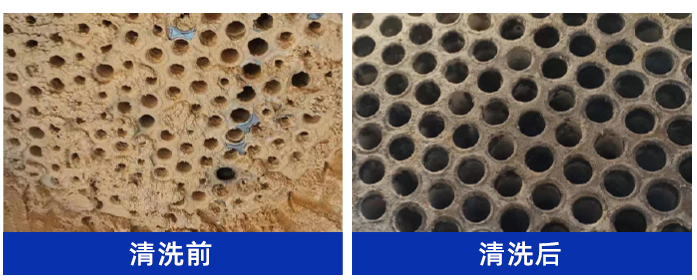
When a multi-effect evaporator heat exchanger experiences material blockage, the first step is to determine whether the blockage is ordinary deposition, crystallization scaling, or material that has hardened and completely sealed the heat exchange tubes. For tubes that still allow water flow or brush entry, brushing, water cleaning, or chemical cleaning can be prioritized. If the heat exchange tubes have severe diameter reduction or are completely blocked, mechanical breaking and unclogging should be the primary consideration.
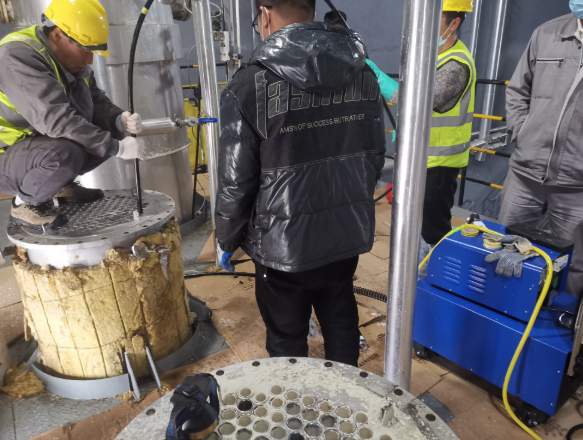
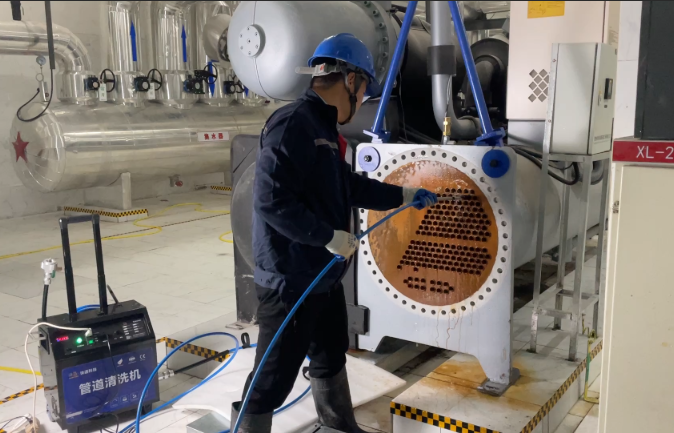
For such conditions, the Anhui Kuaitong KT-307 Heavy-Duty Blocked Tube Bundle Unclogging Machine can use 5500W power to transmit rotational force through a flexible shaft into the tube, then use an appropriate alloy cutting tool to drill and break hardened material, with water-assisted cleaning and debris discharge based on site conditions.
Therefore, when facing "multi-effect evaporator heat exchanger material blockage," the most critical question is not "what cleaning agent should be used?" but rather:
Does the tube still have a passage? What exactly is the blockage material?
1. Why Do Multi-Effect Evaporator Heat Exchangers Become Blocked by Material?
Multi-effect evaporators continuously concentrate materials during operation.
As water evaporates, the concentration of salts, solids, and other non-volatile substances in the material increases.
These substances may gradually:
Adhere to the tube wall → Form deposits → Crystallize or harden → Reduce tube diameter → Block → Completely block
Particularly for equipment operating continuously over long periods, if heat exchange tube condition is not inspected in time, some tubes may gradually develop from initial light deposition into severe blockage.
2. How to Determine Whether It Is "Scaling" or "Material Blockage"?
When selecting equipment, customers can first assess three aspects.
1. Check whether the tube still has flow passage
If water or other cleaning media can still pass through normally, the tube still has some passage. If completely impassable, physical blockage should be prioritized.
2. Check whether cleaning tools can enter
If standard flexible shafts and brushes can enter and advance along the tube, there is usually still room for mechanical cleaning. If the tool can only enter a very short distance and quickly encounters hard resistance, internal hard blockage should be assessed.
3. Check blockage hardness
If the material is loose, water cleaning may resolve it. If the material has been compacted, crystallized, or hardened, mechanical breaking should be considered.
3. Why Can't Standard Brushes Necessarily Solve Multi-Effect Evaporator Material Blockage?
The primary function of standard cleaning brushes is to clean tube walls.
They are more suitable for:
Scale
Rust deposits
Slime
Light deposits
Wall-attached fouling
However, when material has formed a thick, hard blockage body, the effectiveness of brushes is limited.
At this point, what is needed is not simply "brushing clean," but:
Breaking the blockage apart.
This is also the biggest application difference between heavy-duty mechanical unclogging equipment and standard heat exchange tube brushing equipment.
4. After Complete Blockage, Why Can't High-Pressure Water Alone Be Relied Upon?
If there is still a passage inside the tube, high-pressure water can enter the blockage area and flush loose material.
However, after complete blockage, water flow can hardly penetrate deep into the blockage body.
Even if water pressure is increased, the problem may not be effectively resolved.
Therefore, if the site has confirmed:
The tube is completely impassable
The blockage material is relatively hard
Standard brushes cannot advance
Water flushing has little effect
Then mechanical breaking and unclogging should be considered.
5. How Does the KT-307 Handle Material-Blocked Tubes?
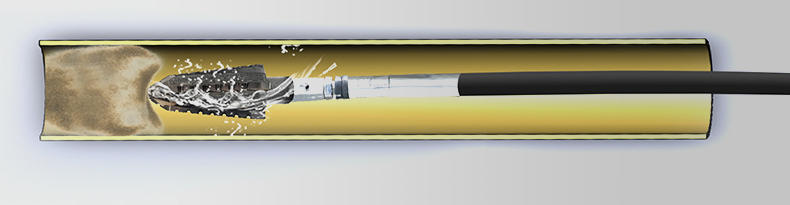
The KT-307 uses a mechanical unclogging method.
Simply put:
Power unit provides power → Flexible shaft enters heat exchange tube → Front-end cutting tool contacts blockage → Rotary drilling/breaking → Passage gradually formed → Debris discharged
This differs from the working logic of standard brushing equipment.
Standard brushing cleans tube walls.
When addressing severe blockage, the KT-307 emphasizes mechanical breaking of the blockage body itself.
Therefore, for hardened materials, crystallized substances, and severe physical blockages, this method is more targeted.
6. Why Is the KT-307 Suitable for Severe Material Blockage?
1. 5500W Power
Hard blockage materials in multi-effect evaporators may present significant mechanical resistance. The KT-307 uses a 5500W power configuration, positioned for severe industrial tube bundle blockage and completely blocked conditions.
2. Flexible Shaft Power Transmission
The equipment does not directly insert the power unit into the heat exchange tube. Instead, it transmits rotational power through a flexible shaft into the tube. This allows the shaft to be configured based on tube diameter and working distance.
3. Alloy Cutting Tools Break Hard Materials
For completely blocked tubes, corresponding alloy cutting tools can be selected based on tube diameter and blockage material. The cutting tool acts directly on the blockage, gradually opening a passage through rotary drilling and breaking.
4. Dry and Water-Assisted Cleaning Can Be Combined Based on Conditions
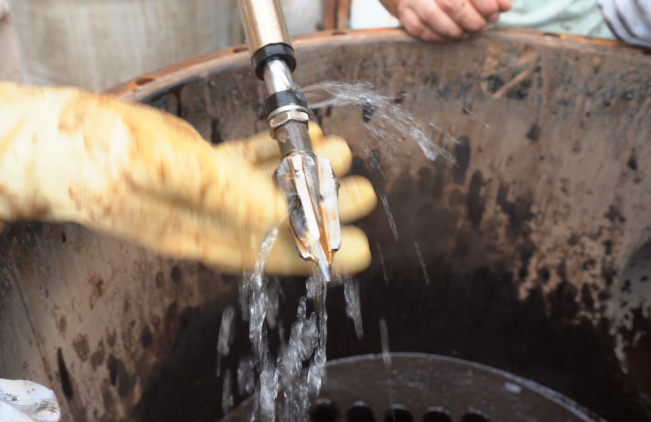
If the blockage material is already dry and hardened, mechanical breaking can be performed first. Where water use is permitted, water flow can then assist in discharging debris. This avoids relying solely on water flushing.
5. Torque Adjustment
After entering the blockage area, resistance may continuously change. The KT-307 features intelligent torque control, allowing parameter adjustment based on shaft, cutting tool, and blockage condition. For blockage materials of different hardness, operating force can be controlled based on site conditions.
7. Why Should You Not Only Pursue "High Power" When Treating Multi-Effect Evaporator Blocked Tubes?
Many customers first ask when selecting equipment:
"How many watts?"
However, in actual operation, power is not the only indicator.
For example, a machine with very high power may still fail to operate normally if the shaft and cutting tool do not match the tube diameter.
Therefore, what truly needs to be considered is:
Power + Flexible shaft + Cutting tool + Tube diameter + Blockage material + Operating method
The advantage of the KT-307 is that these components can be combined, rather than having only a "high-power power unit."
8. How to Select Shafts and Cutting Tools for Multi-Effect Evaporator Heat Exchanger Material Blockage?
Selection mainly depends on three conditions.
Tube diameter
The smaller the tube diameter, the higher the requirements for shaft and cutting tool size.
Blockage hardness
Soft materials and hard crystals require different cutting tools.
Tube configuration
If it is a straight tube, tool advancement is relatively simple. If bent tubes exist, shaft flexibility and cutting tool passage capability must be considered.
Therefore, when consulting about equipment, customers should not only say "the evaporator is blocked."
They should provide as much of the following as possible:
Tube diameter + Tube length + Material + Blockage material + Blockage severity + Tube configuration
9. Actual Treatment Procedure for Multi-Effect Evaporator Material Blockage
The following procedure can be followed in actual operation:
Confirm blockage location – Identify which effect, which tube bundle group, and which specific tubes are blocked.
Confirm tube diameter – Measure the heat exchange tube inner diameter.
Identify blockage material – Determine whether it is material, salt crystallization, hard scale, or composite blockage.
Determine whether completely blocked – Check whether water can pass and whether tools can enter.
Select shaft and cutting tool – Choose tools based on tube diameter and blockage material.
Low-speed trial – Allow the tool to enter first and observe resistance.
Progressive mechanical breaking – Gradually cut and drill when encountering hard blockage.
Discharge debris – Use water flow or other methods based on site conditions to discharge debris.
Inspect tube – After re-establishing a passage, proceed with follow-up cleaning.
10. When Is It Not Recommended to Directly Select the KT-307?
If the condition is only:
Thin scale
Light rust deposits
Loose slime
Ordinary wall-attached fouling
And the heat exchange tubes are still unobstructed, there is no need to directly use heavy-duty blocked tube unclogging equipment.
Such conditions are more suitable for standard mechanical brushing or other conventional cleaning methods.
The KT-307 is more suitable for:
Severe diameter reduction, hard materials, crystallization blockage, and completely blocked tubes.
Therefore, equipment selection should be determined by actual blockage severity, rather than simply pursuing equipment specifications.
11. What Should Customers Provide When Consulting About Multi-Effect Evaporator Unclogging Equipment?
If preparing to consult an equipment manufacturer, the following information can be prepared in advance:
|
Information |
Purpose |
|
Heat exchange tube inner diameter |
Determines shaft and cutting tool |
|
Heat exchange tube length |
Determines shaft length and operating method |
|
Tube material |
Determines tool matching |
|
Blockage material |
Determines cutting tool type |
|
Blockage severity |
Determines equipment power requirements |
|
Tube configuration |
Determines shaft adaptability |
|
Whether water can be introduced |
Determines whether water-assisted cleaning can be used |
|
Site photos/videos |
Assists in assessing working conditions |
If a physical sample of the blockage material can be provided, selection assessment will be more accurate.
12. Equipment Selection Logic for Multi-Effect Evaporator Heat Exchanger Material Blockage
A simple assessment method:
|
Condition |
Recommended Approach |
|
Tube unobstructed |
Conventional cleaning |
|
Light deposits |
Mechanical brushing / water cleaning |
|
Obvious diameter reduction |
Enhanced mechanical cleaning |
|
Hard material blockage |
Mechanical breaking |
|
Complete blockage |
Heavy-duty mechanical unclogging + debris discharge |
Therefore, when material blockage occurs in a multi-effect evaporator heat exchanger, the problem should not be directly understood as ordinary "cleaning."
What truly needs to be solved is:
Allow tools to enter the blockage area, break hardened material, discharge debris, and ultimately restore the effective flow cross-section of the heat exchange tubes.
The advantage of the KT-307 is mainly reflected in this stage. Through 5500W power, flexible shaft transmission, alloy cutting tools, and torque adjustment, it performs mechanized treatment for severe industrial tube bundle blockage conditions, rather than relying only on brushes or water flow to treat wall fouling.
Frequently Asked Questions (FAQ)
What should be done when a multi-effect evaporator has material blockage?
First confirm tube diameter, blockage material, and blockage severity. If it is only light deposition, conventional cleaning can be used. If the material has hardened and completely blocked the tubes, mechanical drilling, breaking, and debris discharge can be considered.
Can a completely blocked multi-effect evaporator still be unclogged?
This depends on tube diameter, blockage length, material hardness, and tube material. For physical hard blockages, mechanical breaking can be used to attempt to re-establish a passage.
Why is material blockage more difficult to treat than ordinary scale?
Because after long-term concentration, deposition, crystallization, or compaction, the material may form a large blockage body. Standard brushes mainly act on the tube wall, while complete blockage first requires breaking the blockage body.
What type of blockage is the KT-307 suitable for?
It primarily targets severe blockage, hard deposits, crystallization blockage, and completely blocked tubes in industrial tube bundles. Light scaling does not necessarily require heavy-duty unclogging equipment.
What parameters should be provided when selecting the KT-307 for a multi-effect evaporator?
At minimum, it is recommended to provide heat exchange tube inner diameter, length, material, blockage material, blockage severity, and tube configuration. If site photos or videos can be provided, equipment and cutting tool selection will be more accurate.
About Anhui Kuaitong Pipeline Cleaning Technology Co., Ltd.
Anhui Kuaitong Pipeline Cleaning Technology Co., Ltd., established in 2009, specializes in the R&D, manufacturing, and sales of pipeline cleaning and unclogging equipment. Serving applications including central air conditioning air systems, water systems, industrial pipelines, heat exchange equipment, embedded pipes, and engineering pipelines, the company provides equipment selection and technical support for central air conditioning cleaning companies, property engineering teams, industrial enterprises, equipment maintenance departments, and professional construction customers.
The company has been recognized as a National High-Tech Enterprise, a Technology-Based SME, and a Training Base of the China Industrial Cleaning Association. Its products are certified under ISO 9001 Quality Management System and EU CE certification, serving more than 23,000 enterprises worldwide.
For material deposition, crystallization blockage, hard material blockage, and similar issues in multi-effect evaporators, industrial heat exchangers, and other equipment, evaporator unclogging machines or heavy-duty heat exchanger unclogging equipment can be selected based on on-site tube diameter and blockage severity.
Website: www.kuaitonggroup.com
Technical Consultation (Phone/WhatsApp/WeChat): +86 18226181287
This document is compiled by the technical team of Anhui Kuaitong Pipeline Cleaning Technology Co., Ltd.
Table of Contents
- 1. Why Do Multi-Effect Evaporator Heat Exchangers Become Blocked by Material?
- 2. How to Determine Whether It Is "Scaling" or "Material Blockage"?
- 3. Why Can't Standard Brushes Necessarily Solve Multi-Effect Evaporator Material Blockage?
- 4. After Complete Blockage, Why Can't High-Pressure Water Alone Be Relied Upon?
- 5. How Does the KT-307 Handle Material-Blocked Tubes?
- 6. Why Is the KT-307 Suitable for Severe Material Blockage?
- 7. Why Should You Not Only Pursue "High Power" When Treating Multi-Effect Evaporator Blocked Tubes?
- 8. How to Select Shafts and Cutting Tools for Multi-Effect Evaporator Heat Exchanger Material Blockage?
- 9. Actual Treatment Procedure for Multi-Effect Evaporator Material Blockage
- 10. When Is It Not Recommended to Directly Select the KT-307?
- 11. What Should Customers Provide When Consulting About Multi-Effect Evaporator Unclogging Equipment?
- 12. Equipment Selection Logic for Multi-Effect Evaporator Heat Exchanger Material Blockage
- Frequently Asked Questions (FAQ)
- About Anhui Kuaitong Pipeline Cleaning Technology Co., Ltd.