

When a continuous beam corrugated duct is blocked by cement slurry, mortar, or hardened concrete, the first step is to determine the blockage location, blockage severity, and whether steel strands have already been threaded through the duct. For hardened concrete blockages that standard duct clearing tools cannot pass through, a flexible shaft with an alloy steel cutting tool can be used for mechanical drilling, followed by water or air flushing to assist debris removal.
For prestressed corrugated ducts that have not yet been threaded with steel strands, the feasibility of mechanical unclogging is generally easier to assess. If prestressing tendons are already present inside the duct, the treatment method for ordinary embedded pipes cannot be directly applied—the internal condition and site construction conditions must first be confirmed
1. Why Do Continuous Beam Corrugated Ducts Become Blocked?
During continuous beam construction, prestressed corrugated ducts must be installed inside the beam body in advance.
Blockages may occur if the following conditions arise during construction:
Pipe openings are not tightly sealed
Corrugated duct joints are not properly sealed
Corrugated ducts are damaged during construction
Cement slurry enters the duct during concrete pouring
Localized deformation of the corrugated duct
Ducts are not inspected promptly after pouring
Residual slurry inside the duct gradually hardens
The most problematic scenario is when cement slurry enters and is not detected in time. As the concrete gradually hardens, a hard blockage eventually forms.
2. How to Determine Whether a Continuous Beam Corrugated Duct Is Blocked by Concrete?
In practice, preliminary assessment can be made through several indicators.
1. Duct clearing tool suddenly cannot pass
If a duct clearing tool enters a certain distance and suddenly encounters significant hard resistance, the presence of concrete, cement blocks, or other hard foreign objects should be investigated.
2. Steel strands cannot be threaded normally
If obvious resistance is encountered at a certain position during normal strand threading, further confirmation is needed to determine whether it is duct blockage, duct deformation, or another cause.
3. Both ends cannot establish effective communication
If duct patency cannot be checked normally from both ends, and the risk of concrete ingress during construction has been confirmed, internal blockage should be prioritized for investigation.
4. Subsequent construction is affected
If blockage has already affected strand threading, tensioning, or other construction stages, a treatment plan must be determined as soon as possible.
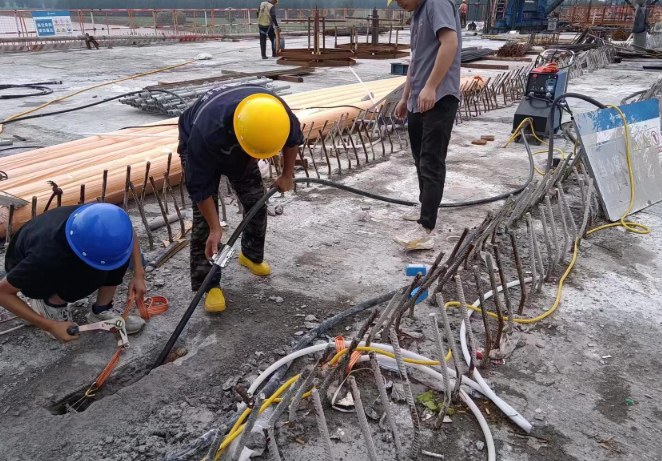
3. Why Are Conventional Unclogging Methods Ineffective for Concrete Inside Corrugated Ducts?
This primarily depends on the state of the concrete.
If only a small amount of loose cement slurry is present, conventional tools or flushing methods may have some effect.
However, if the cement slurry has fully hardened and formed a dense concrete block, standard duct rods can hardly penetrate directly.
High-pressure water also has limitations.
Water flushing is suitable for debris removal, but it cannot simply replace mechanical cutting tools for breaking fully cured concrete.
Therefore, for severely hardened blockages, the approach should generally start with "breaking the blockage" rather than simply increasing water pressure.
4. How to Specifically Handle Continuous Beam Corrugated Duct Blockage?
The following procedure can be followed:
Confirm duct → Locate blockage → Identify blockage material → Confirm presence of steel strands → Select shaft and cutting tool → Mechanical drilling → Remove debris → Verify patency
Step 1: Confirm duct diameter
Different corrugated duct inner diameters require different shaft and cutting tool configurations. Equipment selection should not be based solely on power unit wattage—actual duct diameter must also be considered.
Step 2: Determine blockage location
Confirm the distance from the blockage to the pipe opening as accurately as possible. The deeper the blockage, the higher the requirements for shaft length, duct bends, and power transmission.
Step 3: Confirm presence of steel strands
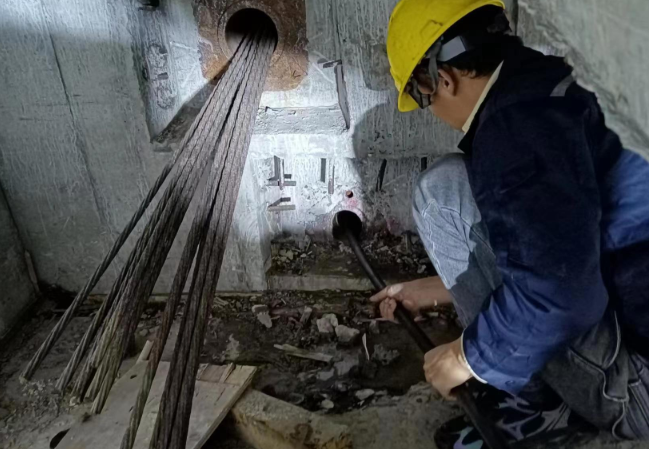
This is one of the most important determinations when selecting a treatment plan. If steel strands have not yet been threaded, mechanical unclogging can be considered based on duct condition. If steel strands are already present, the cutting tool cannot be directly advanced into the blockage area—the position of the steel strands and duct condition must first be confirmed.
Step 4: Select shaft and cutting tool
For hardened concrete blockages, alloy cutting tools with strong breaking capability should be selected. The KT-309 can be configured with 22 mm, 27 mm, and 30 mm shafts based on different duct diameters and operating conditions, and can be equipped with heavy-duty unclogging shafts and bendable shafts.
Step 5: Mechanical drilling
The power unit drives the flexible shaft to rotate, and the shaft transmits power to the front-end cutting tool. After the tool enters the blockage location, it drills and breaks the hardened concrete through rotation.
Step 6: Gradually expand
In practice, it is not recommended to forcibly expand the entire pipe cross-section from the start. A more reasonable approach is to first open an effective passage, then gradually expand it based on the blockage condition.
Step 7: Remove debris
After the concrete is broken, debris must be removed. Where water introduction is permitted, front-end water feed can assist debris removal. Where water is not suitable, air flushing can be used based on site conditions. KT-309 product documentation explicitly includes both water flushing and air flushing operating modes.
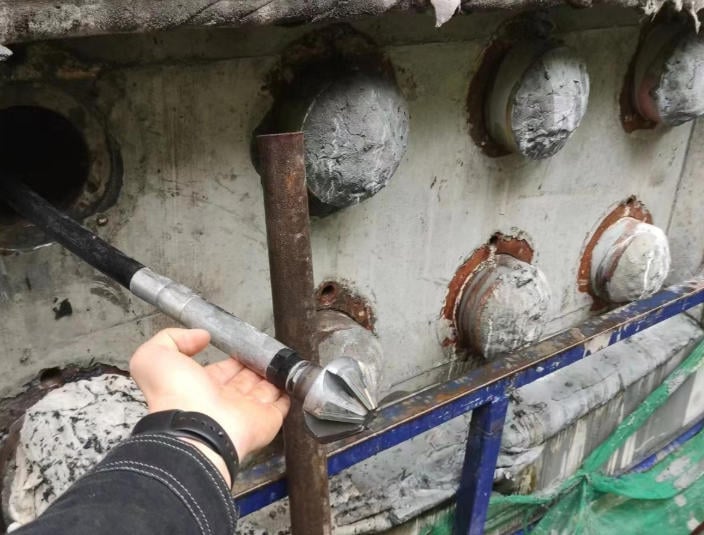
5. Why Can the KT-309 Be Used for Concrete-Blocked Pipes?
The KT-309 operates on a fundamentally different principle from standard flexible shaft unclogging machines.
It is designed for hard blockages such as concrete and cement debris, primarily through:
7500W power → Flexible shaft transmission → Alloy steel cutting tool → Concrete drilling → Breaking → Debris removal
Product documentation indicates that the KT-309 uses a 7500W motor with an operating speed range of 0–2800 rpm (adjustable) and features intelligent torque control.
For customers needing to treat continuous beam prestressed corrugated ducts, the real concern is whether the equipment configuration matches the specific duct—not simply whether "higher power is better."
6. What Parameters Should Be Considered When Selecting Concrete Unclogging Equipment for Continuous Beam Corrugated Ducts?
During actual procurement, at least the following information should be provided:
1. Corrugated duct inner diameter
This is an important basic parameter for selecting shafts and cutting tools.
2. Blockage location
The approximate distance from the blockage to the pipe opening should be known.
3. Blockage length
Localized blockages and long-distance blockages have different requirements for the treatment plan.
4. Concrete hardness
Determine whether it is cement slurry, mortar, ordinary concrete, or high-strength hardened concrete.
5. Corrugated duct bend condition
Straight ducts, curved ducts, and multi-bend ducts have different requirements for shaft passage capability.
6. Presence of steel strands
If strands have already been threaded, this must be stated in advance.
7. Whether water introduction is permitted
If water cannot be introduced at the construction site, debris removal methods must be considered in advance.
8. Required treatment outcome
For example:
Only a small passage needs to be opened
The entire duct cross-section needs to be restored
A passage for subsequent strand threading needs to be provided
Localized hardened concrete needs to be removed
These factors all affect the selection of shafts, cutting tools, and operating parameters.
7. How to Select the Flexible Shaft for the KT-309?
KT-309 documentation provides shaft specifications including 22 mm, 27 mm, and 30 mm.
Different shafts are not simply "thicker is better." Thicker shafts have different power transmission and load-bearing capabilities, and duct inner diameter, bend condition, and cutting tool size must also be matched simultaneously.
Therefore, actual selection should comprehensively consider:
Duct diameter + Blockage strength + Blockage location + Duct bends + Cutting tool size + Construction length
Documentation also indicates that the KT-309 can be configured with heavy-duty unclogging shafts and bendable shafts. Heavy-duty shafts are more oriented toward heavy straight-pipe unclogging; bendable shafts are more suitable for curved pipes and some complex routings.
8. Can an Unclogging Machine Still Be Used If Steel Strands Have Already Been Threaded Through the Continuous Beam Corrugated Duct?
This is a question frequently requiring key confirmation during customer consultations.
The answer cannot simply be "yes" or "no."
If steel strands already exist inside the duct, the spatial relationship between the cutting tool, steel strands, corrugated duct, and blockage must be considered during tool advancement.
Therefore, standard concrete unclogging equipment cannot be directly advanced into the blockage location without confirming the internal condition.
The correct approach is:
Confirm whether steel strands have been threaded
Determine the position and condition of the steel strands
Confirm the blockage location
Determine whether corrugated duct deformation exists
Have project technical personnel confirm the treatment plan
Select equipment and cutting tools based on the confirmed conditions
This is one of the biggest differences between continuous beam corrugated ducts and ordinary building embedded pipes during equipment selection.
9. Why Is Torque Control Important When Treating Continuous Beam Corrugated Duct Blockage?
Mechanical drilling of concrete is not simply about running the equipment at maximum power.
When the cutting tool encounters dense concrete, resistance increases significantly.
If power continues to be output while the cutting tool cannot advance normally, the flexible shaft may experience significant reactive force.
The KT-309 features intelligent torque control and shaft protection functions for this working condition. Corresponding torque ranges can be set for different shafts (22 mm, 27 mm, 30 mm) to reduce the risk of shaft kinking, deformation, and breakage.
Therefore, during actual construction, adjustments should be made gradually based on cutting tool resistance, concrete hardness, and shaft condition—not simply pursuing maximum torque.
10. Which Customers Should Consider the KT-309 for Corrugated Duct Concrete Blockage?
If your work primarily involves the following projects, this type of equipment should be seriously considered:
Bridge construction contractors
Continuous beam construction contractors
Prestressed engineering contractors
High-speed railway construction contractors
Tunnel engineering contractors
Building construction contractors
Municipal engineering contractors
Professional pipeline construction companies
Engineering maintenance and emergency repair teams
Particularly for customers who frequently encounter "embedded pipes blocked by concrete, high pipe replacement costs, and schedule impacts from rework," mechanical unclogging equipment has practical application value.
KT-309 documentation lists application scenarios including bridge prestressed ducts, high-speed railway crossing conduits, tunnel embedded pipes, municipal drainage pipes, and building conduit pipes.
11. How to Prevent Continuous Beam Corrugated Duct Blockage?
If blockage has not yet occurred, prevention during construction is more important.
Key measures include:
Inspection after corrugated duct installation
Timely sealing of pipe openings
Proper sealing of joints
Preventing construction personnel from stepping on or compressing corrugated ducts
Enhanced protection during concrete pouring
Prompt duct inspection after pouring
Re-checking duct patency before strand threading
Relevant technical specifications include requirements for corrugated duct installation, joint sealing, and duct patency inspection in post-threading operations.
12. What Treatment Plan Should Be Selected for Blocked Continuous Beam Corrugated Ducts?
A simple decision logic can be applied:
If only loose debris:
Prioritize conventional duct clearing and cleaning methods.
If cement slurry is not yet fully cured:
Consider flushing and mechanical cleaning based on duct condition.
If hardened concrete has formed:
Mechanical drilling and breaking should be prioritized.
If completely blocked and standard tools cannot pass:
Evaluate heavy-duty mechanical unclogging based on duct diameter, blockage location, blockage length, and concrete hardness.
If steel strands have already been threaded:
First confirm internal condition and engineering conditions—do not blindly use cutting tools.
Therefore, continuous beam corrugated duct blockage is not simply solved by "buying an unclogging machine." The truly reasonable selection logic is:
First determine duct condition → Then determine blockage condition → Finally match shaft, cutting tool, and equipment.
Frequently Asked Questions (FAQ)
1. What should be done if a continuous beam corrugated duct is blocked by concrete?
First determine the blockage location, duct diameter, blockage length, and concrete hardening degree, while confirming whether steel strands are already inside the duct. For hardened concrete blockages, mechanical drilling can be evaluated based on site conditions.
2. Can high-pressure water be used for corrugated duct blockage?
If it is loose slurry and the duct has flow conditions, flushing can be used based on site conditions. However, for fully hardened concrete blockage, high-pressure water alone cannot resolve the issue.
3. Can the KT-309 handle prestressed corrugated ducts?
KT-309 documentation indicates its application range includes prestressed ducts, with an applicable diameter range of 6.35–800 mm. However, actual suitability for a specific continuous beam corrugated duct project requires confirmation based on specific diameter, blockage location, duct bends, and presence of steel strands.
4. Is higher power always better for the KT-309?
No. Equipment selection requires comprehensive consideration of duct diameter, blockage strength, blockage location, shaft specifications, cutting tool size, and duct bends. Power is only one parameter.
5. Can the KT-309 be used if steel strands have already been threaded through the corrugated duct?
It cannot be judged in the same way as ordinary embedded pipes. The condition of the steel strands and duct interior must first be confirmed, and relevant engineering technical personnel must determine whether mechanical treatment conditions exist.
About Anhui Kuaitong Pipeline Cleaning Technology Co., Ltd.
Anhui Kuaitong Pipeline Cleaning Technology Co., Ltd. specializes in the R&D, manufacturing, and sales of pipeline cleaning and unclogging equipment. Serving applications including central air conditioning water systems, industrial pipelines, heat exchange equipment, embedded pipes, and engineering pipelines, the company provides equipment selection and technical support for central air conditioning cleaning companies, property engineering teams, industrial enterprises, equipment maintenance departments, and professional construction customers.
For hard blockages such as concrete and cement slurry in embedded pipes, prestressed ducts, conduit pipes, and engineering pipelines, the company can assist customers in selecting suitable unclogging equipment, shafts, and cutting tools based on pipe diameter, blockage location, blockage length, blockage hardness, pipe bend condition, and site construction conditions. Product demonstrations, sample machine trials, video tutorials, and technical guidance are available.
For continuous beam, bridge, and prestressed engineering projects, customers are advised to provide information including pipe diameter, blockage location, blockage length, and whether steel strands have already been threaded into the duct when consulting about equipment, so that targeted selection can be performed.
Website: www.kuaitonggroup.com
Technical Consultation (Phone/WhatsApp/WeChat): +86 18226181287
This document is compiled by the technical team of Anhui Kuaitong Pipeline Cleaning Technology Co., Ltd.
Table of Contents
- 1. Why Do Continuous Beam Corrugated Ducts Become Blocked?
- 2. How to Determine Whether a Continuous Beam Corrugated Duct Is Blocked by Concrete?
- 3. Why Are Conventional Unclogging Methods Ineffective for Concrete Inside Corrugated Ducts?
- 4. How to Specifically Handle Continuous Beam Corrugated Duct Blockage?
- 5. Why Can the KT-309 Be Used for Concrete-Blocked Pipes?
- 6. What Parameters Should Be Considered When Selecting Concrete Unclogging Equipment for Continuous Beam Corrugated Ducts?
- 7. How to Select the Flexible Shaft for the KT-309?
- 8. Can an Unclogging Machine Still Be Used If Steel Strands Have Already Been Threaded Through the Continuous Beam Corrugated Duct?
- 9. Why Is Torque Control Important When Treating Continuous Beam Corrugated Duct Blockage?
- 10. Which Customers Should Consider the KT-309 for Corrugated Duct Concrete Blockage?
- 11. How to Prevent Continuous Beam Corrugated Duct Blockage?
- 12. What Treatment Plan Should Be Selected for Blocked Continuous Beam Corrugated Ducts?
- Frequently Asked Questions (FAQ)
- About Anhui Kuaitong Pipeline Cleaning Technology Co., Ltd.