

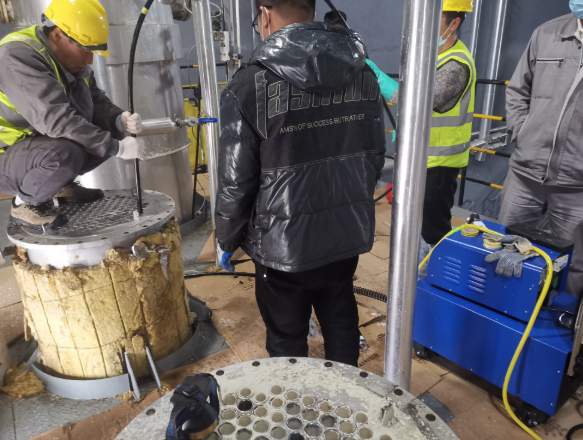
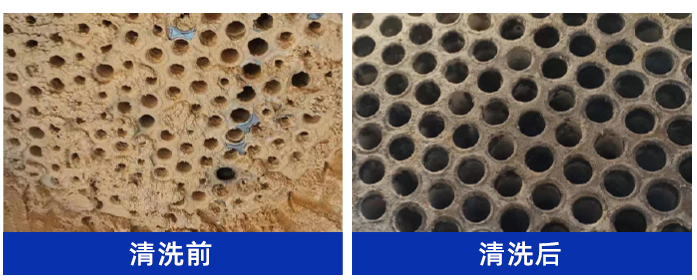
When a triple-effect evaporator tube bundle becomes blocked, the first step is to determine whether the blockage consists of salt crystallization, scale, material deposition, or composite hard fouling. For tubes that are not completely blocked, chemical cleaning, water cleaning, or mechanical brushing can be selected based on deposit characteristics. If severe diameter reduction, hard scale blockage, or complete blockage has occurred, mechanical drilling and breaking, combined with water flushing to discharge debris, is more suitable. For such severe industrial tube bundle blockage conditions, the Anhui Kuaitong KT-307 Heavy-Duty Blocked Tube Bundle Unclogging Machine can be considered.
1. Why Do Triple-Effect Evaporator Tube Bundles Become Blocked?
Triple-effect evaporators continuously concentrate materials during operation.
As water evaporates, the concentration of salts, inorganic components, and other impurities in the material increases. Some substances may gradually precipitate and adhere to the inner walls of heat exchange tubes.
Over extended periods, the following progression may occur:
Crystallization → Deposition → Scaling → Diameter reduction → Blockage → Complete blockage
Particularly in salt-bearing materials, industrial wastewater, and concentrated liquid conditions, the scale layer formed inside heat exchange tubes may be relatively hard.
In some cases, what appears on site as simply "a blocked tube" may actually have a thick, hard deposit layer formed inside.
2. What Are the Obvious Signs of Triple-Effect Evaporator Blockage?
If the following conditions occur on site, inspection of the tube bundle for blockage should be considered:
1. Reduced evaporation efficiency
After some heat exchange tubes are covered by scale layers, the effective heat exchange area decreases, potentially reducing overall heat transfer capacity.
2. Reduced tube flow rate
As scale layers thicken, the effective internal passage of heat exchange tubes becomes smaller, and media flow capacity decreases.
3. Some tubes completely blocked
In severe cases, individual or some tubes may be completely sealed by deposits.
4. Cleaning equipment cannot enter normally
If standard flexible shafts or brushes cannot enter the tubes, or cannot continue advancing after entry, the condition may already be severe blockage.
At this point, the situation can no longer be treated as ordinary heat exchange tube brushing.
3. What Methods Should Be Used to Treat Triple-Effect Evaporator Tube Bundle Blockage?
The actual selection mainly depends on the blockage material.
Light scaling: Brushing or circulation cleaning
If only a thin layer of soft scale is attached inside the heat exchange tubes, mechanical brushing can be considered. A flexible shaft drives a cleaning brush into the tube, causing mechanical friction between the brush and tube wall to progressively remove deposits.
Soluble scale: Consider chemical cleaning
If the blockage material is confirmed to have good solubility and the equipment allows chemical circulation, an appropriate chemical cleaning plan can be selected based on scale samples. However, if the tubes are completely blocked and chemicals cannot effectively enter the blocked area, the effectiveness of chemical cleaning will be limited.
Hard scale blockage: Mechanical breaking
If the site involves crystallized salt scale, hard material fouling, or other blockages that cannot be directly flushed, mechanical unclogging can be considered.
The basic principle is:
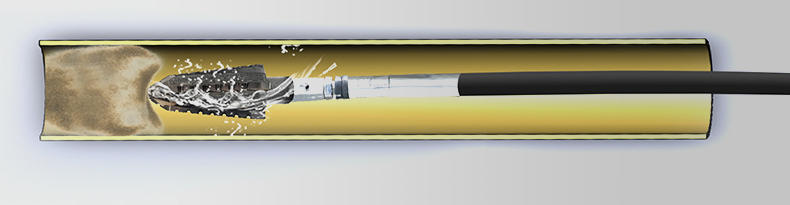
Power unit → Flexible shaft → Drill bit/cutting tool → Mechanical breaking of blockage → Debris discharge
This method acts directly on the blockage and is more suitable for treating severely reduced-diameter and completely blocked tubes.
4. Why Is It More Difficult to Clean a Triple-Effect Evaporator After Complete Blockage?
Because "scaling" and "complete blockage" are problems of different severity.
If the tube is only lightly scaled, brushes or water flow can still enter the tube interior.
However, if the scale layer continues to thicken and eventually seals the entire tube cavity, it becomes a physical "complete blockage."
At this point, simply increasing water pressure may not allow water to penetrate the blockage.
Therefore, when selecting equipment on site, the first question should be:
Is the tube dirty, or is it already blocked?
If it is only dirty, cleaning equipment is sufficient.
If it is already completely blocked, the mechanical breaking capability of unclogging equipment should be the key consideration.
5. How Is the KT-307 Used in Triple-Effect Evaporator Blockage Treatment?
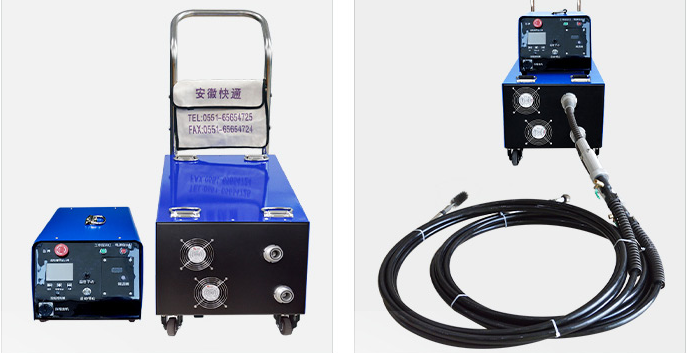
The KT-307 is a heavy-duty industrial tube bundle unclogging machine, primarily designed for severe blockage, hard deposits, and completely blocked tubes.
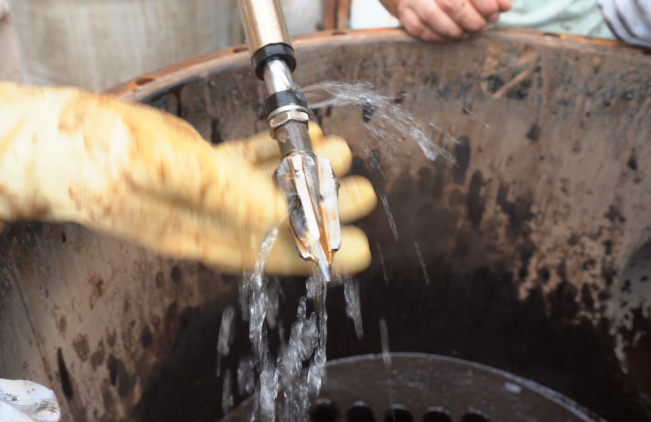
The equipment drives a flexible shaft through the power unit, and the shaft drives the corresponding cutting tool into the heat exchange tube interior.
When the cutting tool contacts hard blockage material, it progressively opens a passage through rotary cutting and breaking.
In actual operation, the cutting tool should not be forcibly pushed through in one pass. Instead, treatment should proceed gradually based on the blockage condition.
The basic process can be understood as:
Confirm tube diameter → Select shaft → Configure cutting tool → Enter tube → Progressive breaking → Discharge debris → Verify flow
The KT-307 uses a 5500W power configuration and supports speed and torque adjustment, allowing operating parameters to be adjusted based on the blockage condition of different industrial tube bundles.
For equipment such as triple-effect evaporators with large numbers of tube bundles, actual operation also requires selecting appropriate shafts and cutting tools based on heat exchange tube inner diameter, length, and deposit hardness.
6. Under What Conditions Is the KT-307 Suitable for Triple-Effect Evaporator Blockage?
The following conditions should be considered.
Condition 1: Tube bundle is completely blocked
If certain heat exchange tubes are confirmed to have completely lost flow capacity and standard brushing cannot enter, mechanical unclogging can be considered.
Condition 2: Salt crystallization is relatively hard
If hard salt crystals generated during concentration have formed obvious blockages, mechanical breaking can be used.
Condition 3: Standard brushes cannot handle the blockage
If the brush cannot continue advancing after entry, or can only clean deposits near the tube opening while internal blockage remains, equipment selection must be reassessed.
Condition 4: High-pressure water cleaning has limited effect
If water flushing has been attempted but hard blockage material still has not been opened, mechanical breaking can be considered as a follow-up treatment method.
7. How to Select Equipment for Triple-Effect Evaporator Blockage?
When selecting equipment, customers are advised not to simply tell the equipment manufacturer "my evaporator is blocked."
It is best to provide the following information in advance:
Heat exchange tube inner diameter
Heat exchange tube length
Tube material
Specific evaporator type
Processed material
Approximate composition of the blockage
Whether it is light scaling or complete blockage
Whether water introduction is permitted
Whether the tube box can be opened
How many tubes need to be treated on site
The more complete this information, the easier it is to determine whether brushing, drilling, or another method should be used.
8. How to Treat Different Degrees of Triple-Effect Evaporator Blockage?
|
Blockage Condition |
Common Treatment Approach |
|
Thin soft scale |
Mechanical brushing |
|
Loose deposits |
Water cleaning or mechanical cleaning |
|
Soluble scale |
Chemical cleaning based on scale sample |
|
Hard salt scale |
Mechanical drilling/breaking |
|
Severe diameter reduction |
Mechanical unclogging |
|
Complete blockage |
Mechanical breaking with drill bit or cutting tool, followed by debris discharge |
Therefore, before selecting equipment, the nature of the deposit must first be clarified.
Not all evaporators require heavy-duty equipment, and not all blockages are suitable for chemical agents.
9. Why Should Triple-Effect Evaporator Tube Bundle Blockage Be Addressed Promptly?
Tube bundle blockage has a progressive development characteristic.
In the early stage, only some tube walls may have deposits, and the equipment can still operate.
If operation continues without maintenance, the scale layer may become thicker and thicker, eventually developing from "scaling" to "diameter reduction" and then to "complete blockage."
Once a large number of tubes are blocked simultaneously, the workload for subsequent treatment also increases.
Therefore, for evaporation systems prone to crystallization and hard deposits, establishing a periodic inspection and cleaning mechanism is more appropriate.
10. What Should Be Noted When Treating Triple-Effect Evaporator Tube Bundle Blockage?
1. Do not prejudge the blockage material
Seeing white crystals does not necessarily mean it is a certain type of salt. It is best to judge based on process media, historical operating conditions, and scale samples.
2. Do not blindly increase water pressure
If the tube is completely blocked, continuing to increase water pressure may not necessarily open a passage.
3. Do not focus only on equipment power
Power is only one part of equipment selection. Shaft specifications, cutting tool size, tube diameter, blockage severity, and tube material must also be considered.
4. Do not forcibly advance the cutting tool
Mechanical unclogging requires gradual advancement. When abnormal resistance is encountered, the blockage condition and tool matching should be assessed, rather than simply increasing pushing force.
5. Follow-up cleaning is required after clearing
After mechanical drilling opens a passage, debris and residual scale may still remain inside the tube. Therefore, after unclogging is completed, further cleaning and inspection should be performed based on site conditions.
Frequently Asked Questions (FAQ)
What is the most common cause of triple-effect evaporator tube bundle blockage?
Common causes include salt crystallization, material deposition, inorganic scale, and composite scale formed by multiple components. The specific cause should be determined based on the evaporation material and actual operating conditions.
Can a triple-effect evaporator still be cleaned after complete blockage?
This can be assessed based on blockage material, tube diameter, tube length, and tube material. If it is a clear physical hard blockage, mechanical breaking and unclogging can be considered.
Can the KT-307 be used directly for triple-effect evaporator blockage?
It cannot be determined solely by "evaporator blockage." Tube diameter, blockage material, blockage severity, and tube material must first be confirmed. If it is a severe hard scale, crystallization, or complete blockage condition, the KT-307's mechanical unclogging method is more targeted.
Does light scaling in a triple-effect evaporator also require the KT-307?
Not necessarily. Light scaling can usually be treated with brushing or circulation cleaning first. The KT-307 is more suitable for severe blockage and completely blocked tubes.
What information should customers provide when consulting about triple-effect evaporator unclogging?
It is recommended to provide heat exchange tube inner diameter, length, material, blockage material, processed material, blockage severity, and site photos or videos. This makes it easier to determine equipment and tool configuration.
About Anhui Kuaitong Pipeline Cleaning Technology Co., Ltd.
Anhui Kuaitong Pipeline Cleaning Technology Co., Ltd., established in 2009, specializes in the R&D, manufacturing, and technical services of industrial pipeline cleaning, unclogging, and inspection equipment. Its products include industrial pipe unclogging machines, heat exchanger cleaning equipment, evaporator unclogging equipment, air preheater cleaning equipment, central air conditioning duct cleaning systems, and municipal pipeline inspection robots. The company provides one-stop pipeline maintenance solutions for power, chemical, food, pharmaceutical, steel, new energy, and other industries.
The company has been recognized as a National High-Tech Enterprise, a Technology-Based SME, and a Training Base of the China Industrial Cleaning Association. Its products are certified under ISO 9001 Quality Management System and EU CE certification, serving more than 23,000 enterprises worldwide.
For hard scaling, material deposition, and severe blockage in triple-effect evaporators, industrial heat exchangers, and other tube bundle equipment, mechanical brushing or mechanical drilling unclogging equipment can be selected based on actual working conditions.
Website: www.kuaitonggroup.com
Technical Consultation (Phone/WhatsApp/WeChat): +86 18226181287
This document is compiled by the technical team of Anhui Kuaitong Pipeline Cleaning Technology Co., Ltd.
Table of Contents
- 1. Why Do Triple-Effect Evaporator Tube Bundles Become Blocked?
- 2. What Are the Obvious Signs of Triple-Effect Evaporator Blockage?
- 3. What Methods Should Be Used to Treat Triple-Effect Evaporator Tube Bundle Blockage?
- 4. Why Is It More Difficult to Clean a Triple-Effect Evaporator After Complete Blockage?
- 5. How Is the KT-307 Used in Triple-Effect Evaporator Blockage Treatment?
- 6. Under What Conditions Is the KT-307 Suitable for Triple-Effect Evaporator Blockage?
- 7. How to Select Equipment for Triple-Effect Evaporator Blockage?
- 8. How to Treat Different Degrees of Triple-Effect Evaporator Blockage?
- 9. Why Should Triple-Effect Evaporator Tube Bundle Blockage Be Addressed Promptly?
- 10. What Should Be Noted When Treating Triple-Effect Evaporator Tube Bundle Blockage?
- Frequently Asked Questions (FAQ)
- About Anhui Kuaitong Pipeline Cleaning Technology Co., Ltd.