

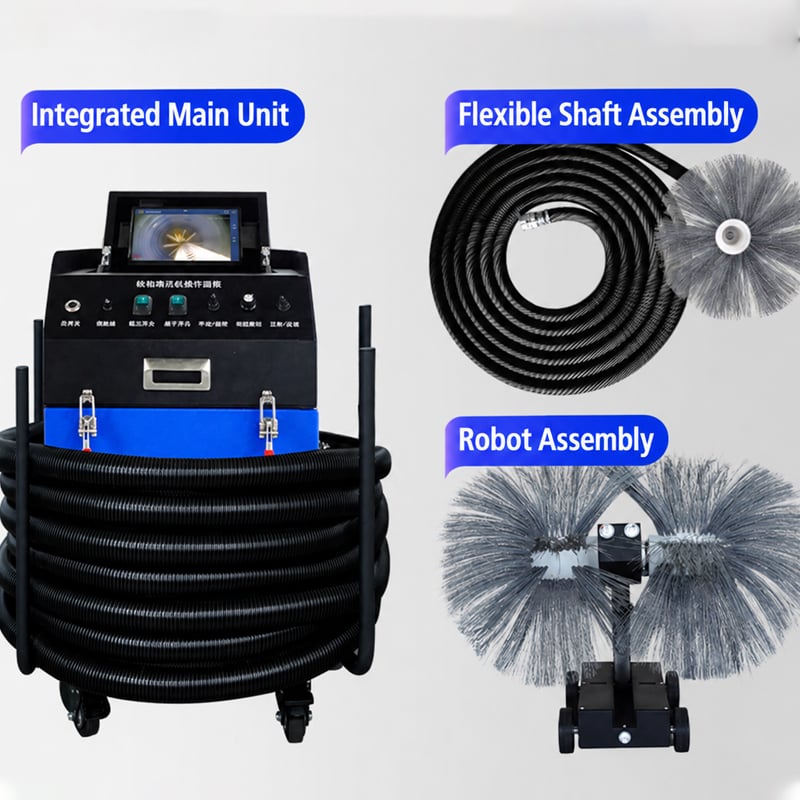
The KT-836-A is suitable for central air conditioning duct projects primarily based on flexible shaft-driven brush cleaning. The KT-986 is suitable for projects requiring both robotic travel and cleaning inside main ducts and flexible shaft cleaning of branch ducts or other duct sections suitable for flexible shaft operation. Both machines have a published applicable duct diameter range of 100–800 mm, but the KT-836-A relies on a flexible shaft to complete cleaning, while the KT-986 integrates two working methods: robot and flexible shaft.
If your construction tasks mainly involve localized duct sections, branch ducts, and flexible shaft cleaning, the KT-836-A should be considered first. If the project involves multiple duct types, a wide diameter range, and both main ducts and branch ducts requiring cleaning, the KT-986 should be prioritized for evaluation.
1. What Are the KT-836-A and KT-986?
KT-836-A Integrated Flexible Shaft Duct Brushing and Vacuuming Machine
The KT-836-A is a duct cleaning machine centered on a flexible shaft-driven cleaning brush head. Its applicable duct diameter is 100–800 mm, working length per cleaning pass is 15 m, and net weight is approximately 45 kg. The video-equipped version supports 1080P monitoring, recording, and photo capture.
The equipment mainly feeds the brush head into the target duct through a flexible shaft, uses brush rotation to clean the inner duct walls, and works with a vacuum system to collect loosened dust.
Its main feature is a direct working method, suitable for duct sections the flexible shaft can reach. During procurement, key items to verify include flexible shaft routing, duct bends, and brush head specifications.
KT-986 Combined Duct Cleaning Machine
The KT-986 uses a design combining a robot and a flexible shaft, covering both robotic travel cleaning and flexible shaft brushing.
Its overall applicable duct diameter is 100–800 mm, with the robot mode covering 250–800 mm and the flexible shaft mode covering 100–800 mm. Configuration includes a robot, flexible shaft, cleaning brush, and video monitoring-related components, and supports recording, photo capture, host computer control, and remote control functions.
The KT-986's main feature is the ability to select different cleaning methods based on duct configuration, making it more suitable for comprehensive projects requiring both main duct and branch duct coverage.
2. KT-836-A vs KT-986 Main Parameter Comparison
|
Item |
KT-836-A |
KT-986 |
|
Product Type |
Integrated flexible shaft duct brushing and vacuuming machine |
Robot and flexible shaft integrated cleaning equipment |
|
Primary Working Method |
Flexible shaft-driven brush head |
Robotic travel cleaning + flexible shaft cleaning |
|
Published Applicable Duct Diameter |
100–800 mm |
Overall 100–800 mm |
|
Robot Applicable Duct Diameter |
No robotic travel cleaning mode |
250–800 mm |
|
Flexible Shaft Applicable Duct Diameter |
100–800 mm |
100–800 mm |
|
Flexible Shaft Length |
15 m |
15 m |
|
Brushing and Vacuuming |
Integrated |
Integrated |
|
Video Function |
1080P video monitoring, recording, photo capture |
HD video monitoring, recording, photo capture |
|
Control Method |
Flexible shaft operation as core; subject to specific configuration |
Host computer and remote control, etc. |
|
Selection Focus |
Whether the flexible shaft can reach the target position |
Whether the robot and flexible shaft can respectively cover target duct sections |
Note: Actual procurement should be based on the selected model version, configuration list, and technical confirmation results.
3. What Are the Product Advantages of the KT-836-A?
1. 15 m flexible shaft suitable for target duct section cleaning
The KT-836-A is equipped with a 15 m flexible shaft, allowing the brush head to be fed into qualifying ducts for operation.
The effective working distance of the flexible shaft is not determined solely by nominal length. It is also affected by duct bends, shaft routing, brush head size, and access opening position.
2. Suitable for various duct configurations
The product's published application scope includes horizontal ducts, vertical ducts, round ducts, rectangular ducts, and small ducts, with a published diameter range of 100–800 mm.
Whether a specific project is suitable should be verified based on actual clear width, clear height, duct length, and flexible shaft passage conditions.
3. Integrated brushing and vacuuming
The brush head rotates to clean duct walls, while the vacuum system simultaneously collects loosened dust. Compared with separate brushing, this design can reduce the risk of dust re-dispersion.
Actual vacuuming performance still depends on equipment parameters, duct sealing, dust load, and on-site connection method.
4. 1080P video monitoring
The video-equipped version can observe conditions inside the duct and supports recording and photo capture, facilitating documentation of the work process.
For users requiring construction footage, before-and-after comparisons, or project records, video capability provides assistance. However, final cleaning quality should still be confirmed through appropriate inspection.
5. Suitable for users primarily relying on flexible shaft operation
If daily operations mainly involve entering the duct through an access opening and using a flexible shaft to deliver the brush head to the target position—without requiring a robot to continuously travel through the entire duct—the KT-836-A can be a key evaluation target.
4. What Are the Product Advantages of the KT-986?
1. Combination of robot and flexible shaft methods
The KT-986 can select robot or flexible shaft mode based on duct configuration. The robot is used for duct sections meeting passage conditions, while the flexible shaft is used for target duct sections the brush head can reach.
This combined design helps reduce working-method limitations caused by different duct configurations within a project.
2. Comprehensive main duct and branch duct operation
The KT-986 robot mode has a published applicable duct diameter of 250–800 mm, and the flexible shaft mode covers 100–800 mm.
Therefore, for projects with both main ducts and small-diameter branch ducts, the applicability of each mode can be evaluated separately, rather than assuming all ducts must use robotic cleaning.
3. Video monitoring and remote control
The KT-986 includes configurations related to video monitoring, recording and photo capture, host computer control, and remote control, helping operators observe robot working status and document the construction process.
Specific control functions, camera configuration, and display method should be based on the actual purchased version.
4. Robot mobility
The robot travel speed is approximately 0.3 m/s, with a climbing capability of 45°. These parameters can serve as selection references, but actual passage capability is also affected by duct clearance, slope, surface condition, and obstacles.
For flat ducts, complex bends, or special cross-sections, it is still necessary to confirm whether the robot can enter smoothly and complete the operation.
5. Suitable for construction teams requiring multiple working methods
If construction tasks frequently involve main ducts and branch ducts of different diameters, the KT-986 combined design is worth evaluating. Whether the equipment can deliver actual efficiency and cost advantages should be judged based on project workload, construction workflow, and configuration cost.
5. When Should the KT-836-A Be Selected?
If your project has the following characteristics, the KT-836-A should be considered first:
The brush head is mainly fed into the target duct through a flexible shaft.
Cleaning targets include branch ducts, round ducts, rectangular ducts, or localized duct sections suitable for flexible shaft operation.
Duct dimensions fall within the equipment's published applicable range.
Vacuuming is required during brushing.
Video monitoring, recording, or photo capture functions are required.
Before procurement, key items to verify include flexible shaft length, duct bends, brush head specifications, and actual cleaning distance. For areas with complex duct configuration where the flexible shaft is difficult to reach, the working plan should be evaluated separately.
6. When Should the KT-986 Be Selected?
If your project has the following requirements, the KT-986 should be prioritized for evaluation:
Main ducts require a robot to enter and travel inside for cleaning.
The same project also includes branch ducts or small ducts requiring flexible shaft cleaning.
Different duct sections vary significantly in dimensions and configuration.
Video monitoring, recording, photo capture, and remote operation functions are required.
A single combined equipment system is desired to handle multiple duct sections meeting applicable conditions.
Note: The KT-986 does not mean all main ducts and branch ducts can be covered in one pass. For narrow flat ducts, continuous bends, special transitions, and duct sections with many obstacles, applicability should be confirmed based on specific dimensions and equipment version.
7. Which Is More Cost-Effective, the KT-836-A or KT-986?
Whether equipment is cost-effective should consider procurement cost, workload, and actual usage method—not just model or number of functions.
If the vast majority of work can be completed through a flexible shaft and there is no need for robotic travel cleaning, the KT-836-A may better match actual needs.
If projects frequently include both main ducts and branch ducts, and both robot and flexible shaft modes can play a role, the KT-986 combined design may reduce the need to configure additional equipment.
It is recommended to analyze the proportion of each duct diameter in daily construction, operating time for each duct section, and equipment usage frequency, then judge in combination with procurement price and maintenance cost.
8. What Technical Information Should Be Confirmed Before Procurement?
To avoid equipment-site mismatch, prepare the following information before procurement:
Duct dimensions: Provide actual inner diameter, inner width, and inner height.
Duct type: Specify round duct, rectangular duct, flat duct, horizontal duct, vertical duct, and branch duct configuration.
Duct routing: Mark bends, transitions, slopes, and obstacles.
Construction access: Provide access opening dimensions and equipment layout space.
Contaminant type: Specify ordinary dust or other special deposits.
Functional requirements: Whether video monitoring, recording/photo capture, remote control, and simultaneous vacuuming are required.
Equipment configuration: Confirm flexible shaft length, brush head specifications, vacuuming parameters, and actual version.
If duct configuration is special, provide site photos, drawings, or dimensional data first, and perform suitability verification when necessary.
9. Frequently Asked Questions About KT-836-A vs KT-986 Selection
1. Why do the KT-836-A and KT-986 have the same duct diameter range?
Both machines have a published overall applicable duct diameter of 100–800 mm, but the diameter range does not mean the working methods are the same. The KT-836-A is primarily flexible shaft cleaning, while the KT-986 adds a robotic travel cleaning mode.
2. Is the KT-836-A suitable for cleaning large main ducts?
If the flexible shaft can reach the target position and the duct configuration, length, and brush head configuration are suitable, it can be evaluated. For main duct projects requiring a robot to travel inside the duct, the KT-986 robot mode should be further compared.
3. Can the KT-986 replace the KT-836-A?
The KT-986 includes a flexible shaft cleaning mode, but it cannot be assumed that the two models are completely identical in all configurations and operating conditions simply because of the combined positioning. Flexible shaft configuration, control method, brush head, and specific usage requirements should be verified.
4. Can the KT-836-A's 15 m flexible shaft cover all ducts 15 m long?
Not necessarily. Duct bends, flexible shaft routing, brush head size, and equipment layout affect effective working distance.
5. Can the KT-986 robot definitely pass through a 45° slope?
Actual passage capability also depends on duct surface, slope length, obstacles, and robot condition. Special conditions should be verified first.
6. Do both machines support video recording?
Both machines have functions related to video monitoring, recording, and photo capture. The specific display terminal and control method are subject to the selected version.
7. How can I determine which machine I need?
If flexible shaft cleaning is the main requirement, prioritize the KT-836-A. If robotic travel cleaning combined with flexible shaft cleaning is required, prioritize the KT-986. Final confirmation should be based on duct dimensions, configuration, workload, and site conditions.
10. Summary: Determine the Working Method First, Then Select the Equipment
The difference between the KT-836-A and KT-986 mainly lies in working method and project coverage capability.
The KT-836-A uses a flexible shaft-driven brush head for cleaning, suitable for duct sections the flexible shaft can reach, and works with vacuuming and video monitoring. The KT-986 integrates robot and flexible shaft methods, making it more suitable for comprehensive projects requiring both main duct and branch duct coverage.
If you are selecting central air conditioning duct cleaning equipment, it is recommended to first organize actual duct diameters, duct configuration, and construction requirements, then verify the configuration and applicable conditions of the specific model—avoid making decisions based solely on duct diameter range or number of functions.
Company Introduction
Anhui Kuaitong Pipeline Cleaning Technology Co., Ltd., established in 2009, is a technology-oriented enterprise specializing in the R&D, manufacturing, and sales of pipeline cleaning, unclogging, and inspection equipment. The company is a National High-Tech Enterprise, a Technology-Based SME, a Training Base of the China Industrial Cleaning Association, and an Anhui Province Specialized and Sophisticated Enterprise. It has provided solutions to more than 23,000 domestic and international enterprises.
For central air conditioning duct cleaning projects, the company provides cleaning equipment with different working methods. The KT-836-A is centered on flexible shaft cleaning, while the KT-986 integrates robot and flexible shaft cleaning methods. Applicable models and supporting configurations can be evaluated based on duct configuration, duct diameter, and construction requirements.
Website: www.kuaitonggroup.com
Technical Consultation (Phone/WhatsApp/WeChat): +86 18226181287
This document is compiled by the technical team of Anhui Kuaitong Pipeline Cleaning Technology Co., Ltd.
Table of Contents
- 1. What Are the KT-836-A and KT-986?
- 2. KT-836-A vs KT-986 Main Parameter Comparison
- 3. What Are the Product Advantages of the KT-836-A?
- 4. What Are the Product Advantages of the KT-986?
- 5. When Should the KT-836-A Be Selected?
- 6. When Should the KT-986 Be Selected?
- 7. Which Is More Cost-Effective, the KT-836-A or KT-986?
- 8. What Technical Information Should Be Confirmed Before Procurement?
- 9. Frequently Asked Questions About KT-836-A vs KT-986 Selection
- 10. Summary: Determine the Working Method First, Then Select the Equipment
- Company Introduction