
When purchasing a duct cleaning machine, if the requirement is to complete brushing and vacuuming simultaneously while observing the duct interior via video, the KT-836-A should be considered first. If the main task is long-distance duct cleaning and requires a 22 m or 45 m flexible shaft, trolley-mounted storage, and automatic forward/reverse rotation, the KT-928 should be prioritized. Both machines support forward/reverse rotation; the differences lie in the cleaning function combination, flexible shaft length, and working method.
Anhui Kuaitong Pipeline Cleaning Technology Co., Ltd. specializes in the R&D, manufacturing, and sales of pipeline cleaning, unclogging, and inspection equipment. Based on the product parameters of the KT-836-A and KT-928, this article helps central air conditioning cleaning companies, property service providers, and industrial ventilation maintenance teams select suitable equipment from the perspectives of actual procurement and construction application.
1. Differences Between the Two Machines at a Glance
|
Comparison Item |
KT-836-A |
KT-928 |
|
Product Name |
Integrated duct brushing and vacuuming flexible shaft machine (video model) |
Trolley-mounted duct brushing flexible shaft machine |
|
Applicable Duct Diameter |
100–800 mm |
80–800 mm |
|
Flexible Shaft Length |
15 m |
22 m or 45 m |
|
Speed |
0–1000 rpm |
0–1000 rpm |
|
Rotation Direction |
Forward/reverse |
Forward/reverse/timed automatic forward-reverse |
|
Vacuum Configuration |
Integrated brushing and vacuuming |
Requires pairing with 916 negative-pressure fan for vacuuming |
|
Video Function |
1080P camera, supports recording and photo capture |
Not available |
|
Operation Method |
Manual/remote control |
Manual/remote control |
|
Main Unit Net Weight |
Approx. 45 kg |
Approx. 43 kg |
|
Main Features |
Simultaneous brushing and vacuuming, visual construction |
Long flexible shaft, coil storage, automatic forward/reverse |
Note: Specific product versions, accessories, and optional functions are subject to the technical configuration confirmed at the time of purchase.
2. KT-836-A: Suitable for Customers Requiring Simultaneous Brushing, Vacuuming, and Process Visibility
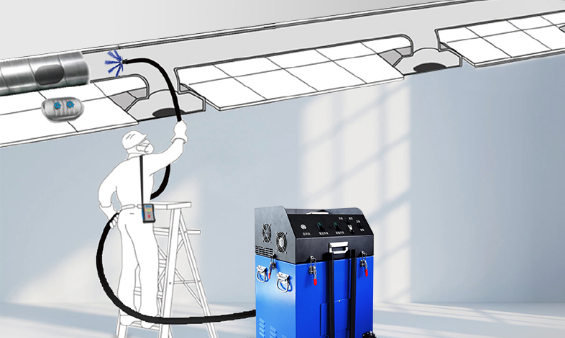
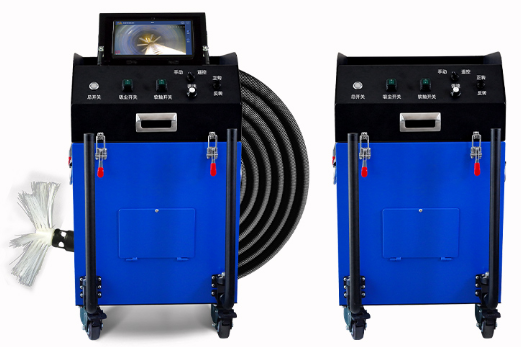
The KT-836-A is not simply a flexible shaft brushing machine. It integrates flexible shaft brushing, simultaneous vacuuming, and video monitoring into one equipment system. For projects that require duct brushing while controlling construction dust and documenting the work process, this integrated approach is worth attention.
2.1 Simultaneous Brushing and Vacuuming
The equipment uses an electric flexible shaft to drive the cleaning brush to rotate, removing dust attached to the inner duct walls, while the vacuum system collects loosened dust. Parameters include 2900W total power, 2400W vacuum system power, and maximum airflow of approximately 2000 m³/h.
Simultaneous vacuuming helps reduce the need to arrange a separate vacuuming process after brushing. However, actual dust collection performance is still affected by duct sealing, dust load, filter system condition, and construction method.
2.2 1080P Video Observation and Recording
The KT-836-A is equipped with a 1080P HD camera system and display terminal, which can be used to observe internal duct conditions and supports video recording and photo capture.
For service providers undertaking duct cleaning projects in hotels, schools, hospitals, office buildings, and industrial plants, video records help demonstrate the construction process to customers. During procurement, it is recommended to also confirm how video files are saved, exported, and delivered so that traceable project documentation can be formed.
2.3 15 m Flexible Shaft and Various Duct Configurations
The KT-836-A has an applicable duct diameter of 100–800 mm and a flexible shaft length of 15 m. It can be used for qualifying horizontal ducts, vertical ducts, round ducts, rectangular ducts, and small ducts.
Particular attention should be paid to the fact that the applicable duct diameter range does not mean all ducts can be passed through smoothly. Actual application should verify in advance the duct clear dimensions, bends, branches, internal obstacles, and cleaning brush specifications.
2.4 Which Customers Should Prioritize the KT-836-A?
Central air conditioning cleaning companies seeking to reduce separate brushing and vacuuming operations.
Project contractors requiring video viewing and cleaning process documentation.
Property and engineering maintenance teams whose duct sections are suitable for 15 m flexible shaft operation.
Customers seeking to reduce the need to separately purchase vacuum equipment and video inspection equipment.
3. KT-928: Suitable for Customers Requiring Long-Distance Cleaning
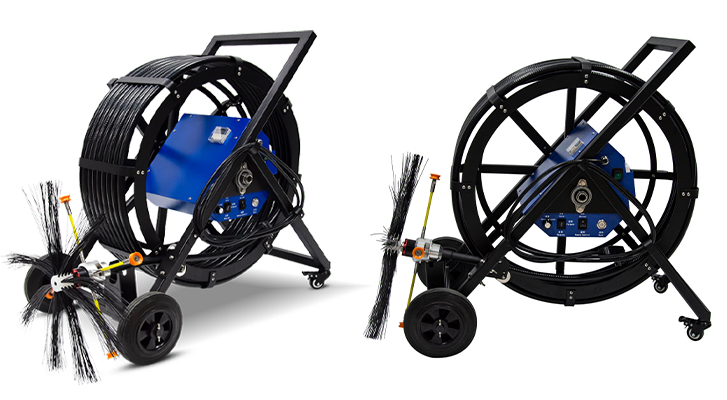
The KT-928 uses a trolley-mounted structure. Its main features are longer flexible shaft options, more convenient storage, and support for timed automatic forward/reverse rotation.
3.1 22 m or 45 m Flexible Shaft Configuration
The KT-928 can be configured with a 22 m or 45 m flexible shaft and is suitable for duct diameters of 80–800 mm. Compared with a 15 m flexible shaft, a longer shaft can cover longer target duct sections where duct configuration permits.
For example, some large commercial buildings or industrial ventilation ducts have long routing. If the duct entry conditions are good and bends are not complex, a long flexible shaft may reduce repeated equipment relocation and some access opening arrangement work.
However, flexible shaft length does not equal actual effective cleaning distance. If the duct has continuous tight bends, diameter reductions, branches, or other obstacles, the flexible shaft may still be unable to reach the target position.
3.2 Trolley-Mounted Coil Structure
Longer flexible shafts require proper deployment and storage; otherwise, dragging, organizing, and on-site layout work may increase. The KT-928 uses a trolley-mounted structure, allowing the flexible shaft to be coiled on the support frame, facilitating management during construction and relocation.
For professional cleaning teams that frequently change work sites, this structure helps improve the storage and mobility experience of long flexible shafts.
3.3 Automatic Forward/Reverse Rotation and Speed Adjustment
The KT-928 supports 0–1000 rpm speed adjustment and supports forward rotation, reverse rotation, and timed automatic forward/reverse rotation. Operators can adjust speed based on dust accumulation, duct material, and brush head specifications, and set rotation direction switching as needed.
Automatic forward/reverse rotation can reduce the need for frequent manual direction switching, but it cannot replace on-site judgment regarding flexible shaft advancement, brush head selection, and cleaning effectiveness.
3.4 Which Customers Should Prioritize the KT-928?
Professional service teams that frequently clean longer ventilation ducts.
Engineering projects requiring a 22 m or 45 m flexible shaft.
Customers with requirements for on-site storage of long flexible shafts and equipment relocation.
Construction teams requiring timed automatic forward/reverse rotation.
Customers who can plan dust collection equipment separately based on project conditions.
4. Both Machines Support Forward/Reverse Rotation—What Else Should Be Considered During Procurement?
Forward/reverse rotation is not the difference between the two machines. The KT-836-A supports forward and reverse rotation; the KT-928 further explicitly supports timed automatic forward/reverse rotation.
During procurement, the following five items should be verified:
First, whether the flexible shaft length matches. 15 m, 22 m, or 45 m should be selected based on the actual pipeline and entry position. Nominal length cannot directly replace on-site cleaning distance.
Second, whether simultaneous vacuuming is required. If the project has requirements for dust dispersion control, the equipment's vacuum configuration and on-site connection plan should be confirmed.
Third, whether video recording is required. If the contract requires before-and-after cleaning images, the camera function, video storage method, and documentation delivery requirements should be confirmed in advance.
Fourth, whether the duct is suitable for flexible shaft operation. Check duct diameter, cross-sectional shape, bends, obstacles, and brush head specifications.
Fifth, the cost of the entire solution. Do not compare only the main unit price. Brush heads, accessories, vacuum equipment, access opening work, relocation, and labor operations should also be included in the evaluation.
5. Parameters and Configurations of the KT-836-A and KT-928
|
Parameter |
||
|
Voltage |
220V |
220V, 110V optional |
|
Total Power |
2900W |
250W |
|
Speed Range |
0–1000 rpm |
0–1000 rpm |
|
Applicable Duct Diameter |
100–800 mm |
80–800 mm |
|
Flexible Shaft Length |
15 m |
22 m/45 m |
|
Main Unit Net Weight |
Approx. 45 kg |
Approx. 43 kg |
|
Main Functions |
Brushing, simultaneous vacuuming, video monitoring |
Long-distance brushing, automatic forward/reverse, flexible shaft storage |
The KT-836-A standard configuration includes the main unit, 15 m integrated brushing, vacuuming, and video flexible shaft, HD tablet, dust collection bag, guide support, cleaning brush, remote control, etc. The KT-928 standard configuration includes the main unit, flexible shaft, cleaning brush, and remote control. During procurement, the specific flexible shaft length, number of brush heads, vacuum accessories, and optional items should be confirmed again.
6. How to Quickly Confirm Whether the Equipment Is Suitable Before Procurement?
Before consulting about equipment, prepare the following information:
Duct dimensions: Round duct diameter or rectangular duct width and height.
Duct routing: Approximate length, number of bends, branches, and diameter reduction locations.
Contamination conditions: Ordinary floating dust, thicker dust accumulation, or other special contaminants.
Construction requirements: Whether simultaneous vacuuming, video monitoring, recording, and photo capture are required.
Work access: Access opening dimensions, locations, and equipment placement space.
Only after providing this information can a more accurate judgment be made as to whether a 15 m flexible shaft integrated machine or a 22 m/45 m long flexible shaft machine should be selected, and whether an additional vacuum system is required.
7. Frequently Asked Questions
1. Which is more suitable for central air conditioning cleaning, the KT-836-A or KT-928?
If the focus is simultaneous brushing and vacuuming plus video monitoring, the KT-836-A should be evaluated first. If the focus is long-distance flexible shaft brushing and automatic forward/reverse rotation, the KT-928 should be evaluated first. Final judgment still needs to be combined with duct configuration.
2. Can the KT-928's 45 m flexible shaft clean a 45 m duct?
45 m is the nominal flexible shaft length and does not mean that 45 m effective cleaning can be achieved under all duct conditions. Bends, duct cross-section changes, and flexible shaft advancement resistance all affect actual distance.
3. Does the KT-836-A have forward/reverse rotation?
Yes. The KT-836-A supports forward and reverse rotation. The KT-928 also supports timed automatic forward/reverse rotation.
4. Does the KT-928 come with vacuuming and video systems?
No. It only has cleaning functions.
5. Can both machines clean rectangular ducts and vertical ducts?
Yes.
6. Can flexible shaft length or brush heads be customized?
Yes. At the same time, the configurations and customization scope available from the manufacturer should be confirmed based on actual project requirements, and the final technical confirmation sheet shall prevail.
8. Summary: Select Based on Construction Tasks, Not Just Price Comparison
The main value of the KT-836-A lies in the integrated design of brushing, simultaneous vacuuming, and video monitoring. The main value of the KT-928 lies in the 22 m or 45 m long flexible shaft, trolley-mounted storage, and timed automatic forward/reverse rotation functions.
For central air conditioning cleaning companies, suitable equipment must not only be able to enter the duct but also match the on-site brushing process, dust handling method, and customer acceptance requirements. Clarifying these conditions before comparing equipment and supporting solutions can help avoid functional mismatch after procurement.
About Anhui Kuaitong Pipeline Cleaning Technology Co., Ltd.
Anhui Kuaitong Pipeline Cleaning Technology Co., Ltd., established in 2009, is a technology-oriented enterprise specializing in the R&D, manufacturing, and sales of pipeline cleaning, unclogging, and inspection equipment. The company is a National High-Tech Enterprise, a Technology-Based SME, a Training Base of the China Industrial Cleaning Association, and an Anhui Province Specialized and Sophisticated Enterprise. It has provided solutions to more than 23,000 domestic and international enterprises.
For different application scenarios such as central air conditioning ducts and industrial ventilation ducts, the company can provide equipment selection recommendations based on duct diameter, cleaning distance, dust handling requirements, and construction method.
Website: www.kuaitonggroup.com
Technical Consultation (Phone/WhatsApp/WeChat): +86 18226181287
This document is compiled by the technical team of Anhui Kuaitong Pipeline Cleaning Technology Co., Ltd.
Table of Contents
- 1. Differences Between the Two Machines at a Glance
- 2. KT-836-A: Suitable for Customers Requiring Simultaneous Brushing, Vacuuming, and Process Visibility
- 3. KT-928: Suitable for Customers Requiring Long-Distance Cleaning
- 4. Both Machines Support Forward/Reverse Rotation—What Else Should Be Considered During Procurement?
- 5. Parameters and Configurations of the KT-836-A and KT-928
- 6. How to Quickly Confirm Whether the Equipment Is Suitable Before Procurement?
- 7. Frequently Asked Questions
- 8. Summary: Select Based on Construction Tasks, Not Just Price Comparison
- About Anhui Kuaitong Pipeline Cleaning Technology Co., Ltd.