
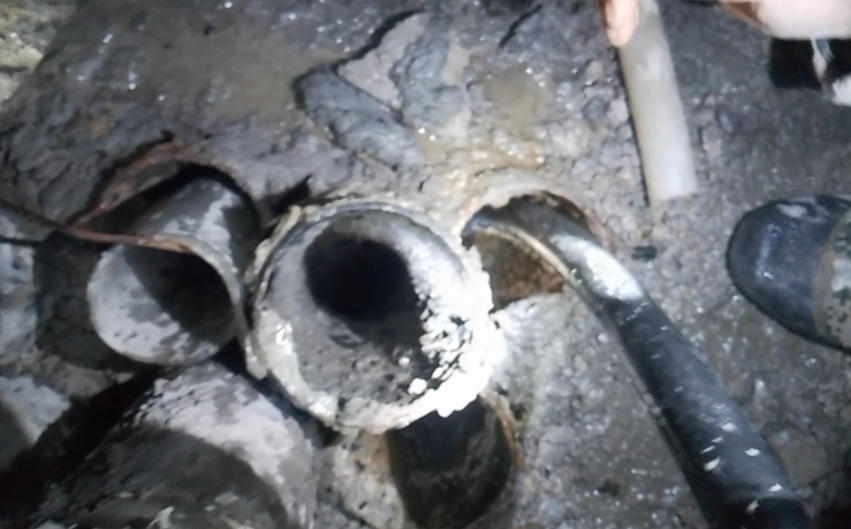
When a tunnel embedded pipe becomes blocked, the first step is to determine whether the blockage is debris, pipe deformation, or hardened concrete/cement slurry. If hard concrete blockage is confirmed and the pipe itself is not severely deformed, mechanical breaking can be considered by entering from the original pipe opening using a flexible shaft + alloy cutting tool, followed by debris removal and pipe patency verification.
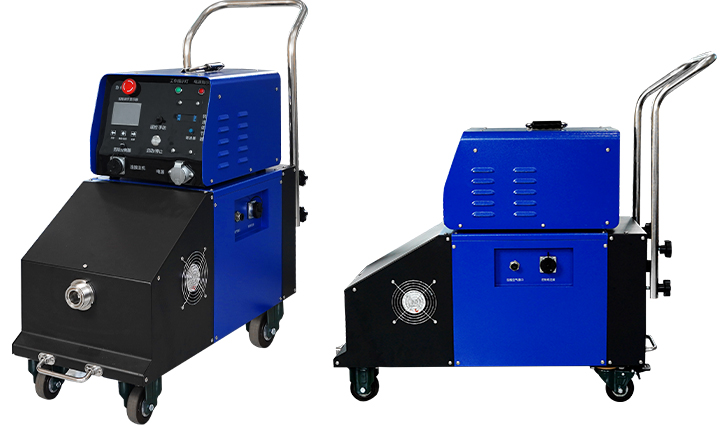
For such engineering pipe blockages, the KT-309 Concrete Blockage Pipe Unclogging Machine uses 7500W power to transmit power through a flexible shaft to an in-pipe cutting tool, drilling and breaking hard blockages such as concrete and cement slurry. It covers an applicable pipe diameter range of Φ6.35–800 mm and can be used for embedded pipes, conduit pipes, crossing conduits, and similar blockages in tunnels, bridges, highways, elevated structures, and other engineering projects.
Therefore, the most important thing when selecting equipment is not to first ask "how much power," but to first clarify: What is the pipe diameter? Where is the blockage? What is the blockage material? Is it completely blocked? Is the pipe itself deformed?
1. Why Do Tunnel Embedded Pipes Become Blocked?
Embedded pipes in tunnels are typically installed in advance during main structure construction.
Subsequently, rebar work, formwork, concrete pouring, and other processes are carried out.
If protection is inadequate, cement slurry may enter the pipe interior.
Once the slurry hardens inside the pipe, cement blocks may form.
Initially, it may only be localized diameter reduction, which gradually develops into:
Partial blockage → Severe diameter reduction → Tools cannot pass → Complete blockage
In addition, pipes may be compressed, struck, or deformed during construction, which can also cause "blockage."
Therefore, after discovering an embedded pipe blockage, the first step is not to immediately select equipment, but to determine the cause.
2. How to Determine What Is Blocking a Tunnel Embedded Pipe?
1. Check how far a cable puller can enter
If it can only enter a few tens of centimeters or a few meters before becoming stuck, localized hard blockage should be assessed.
2. Try to assess conditions from both ends
If both ends of the pipe are accessible, test from each end separately. The entry distance can help determine the blockage location.
3. Determine whether there is a water flow passage
If water cannot pass at all, the blockage severity may be relatively high.
4. Review construction records
If site records confirm that slurry entered the pipe during pouring, the likelihood of concrete blockage is higher.
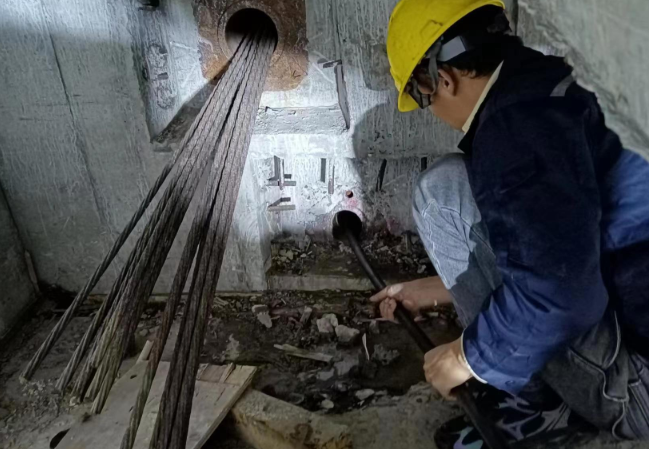
3. Why Can't Standard Cable Pulling Tools Handle Concrete-Blocked Tunnel Embedded Pipes?
Because standard cable pulling tools are primarily designed to "pass through."
Fully cured concrete requires "breaking."
For example, if a dense cement block forms inside the pipe:
When a standard cable puller pushes against it, it only encounters significant resistance.
Continuing to force it forward cannot effectively remove the entire blockage body.
Mechanical unclogging equipment, however, allows the cutting tool to enter the blockage area and drill and break the cement block.
Therefore:
Light blockage = pass through
Hard blockage = break through
This is a very important distinction when selecting equipment.
4. How Does the KT-309 Solve Concrete-Blocked Tunnel Embedded Pipes?
The KT-309's basic working method is:
7500W power unit → Flexible shaft → Alloy steel cutting tool → Contacts concrete → Drilling and breaking → Debris discharge
The KT-309 is equipped with a control cabinet, power unit, heavy-duty unclogging shaft, quick-connect water hose, alloy steel cutting tools, etc. Applicable pipe diameter: 6.35–800 mm.
For tunnel embedded pipes, the core of actual operation is not sending the power unit into the pipe, but using the flexible shaft to deliver power and the cutting tool to the blockage location.
This enables the equipment to perform "entry from the pipe opening, internal blockage breaking" for pipes already embedded in tunnel structures.
5. What Are the Advantages of the KT-309 for Tunnel Embedded Pipes?
1. 7500W power for hard blockages
If it is a hardened cement block, standard pipe clearing tools can hardly generate sufficient breaking capability. The KT-309 uses 7500W power, primarily targeting hard blockages such as concrete.
2. Alloy cutting tool directly breaks
The equipment does not "flush open" concrete through water pressure—it allows the alloy cutting tool to directly contact the blockage. This is the fundamental difference between mechanical blockage breaking and standard flushing.
3. Flexible shaft enters the original pipe
Tunnel embedded pipes are typically already inside concrete structures. If re-excavation is required, the construction workload increases significantly. Using a flexible shaft from the original pipe opening can focus on solving the internal blockage problem.
4. Adjustable torque
During mechanical drilling, blockage hardness and resistance may continuously change. The KT-309 features intelligent torque control, adjustable based on different shafts and site conditions.
5. Debris discharge based on conditions
After the concrete is broken by the cutting tool, debris must be cleared out. The equipment is equipped with a quick-connect water hose, which can assist debris discharge with water flushing where permitted. Whether water can be introduced should be determined based on pipe purpose, material, and site conditions.
6. What Should Be Confirmed Before Selecting the KT-309 for Tunnel Embedded Pipes?
Customers are advised to provide at least the following information:
|
Parameter |
Why It Matters |
|
Pipe inner diameter |
Determines shaft and cutting tool specifications |
|
Pipe length |
Determines shaft length |
|
Pipe material |
Determines mechanical construction method |
|
Pipe purpose |
Determines subsequent construction requirements |
|
Blockage material |
Determines cutting tool selection |
|
Blockage location |
Determines construction distance |
|
Blockage length |
Determines treatment difficulty |
|
Whether completely blocked |
Determines equipment power requirements |
|
Whether pipe is deformed |
Determines whether mechanical unclogging is suitable |
|
Site photos/videos |
Assists in assessing working conditions |
The three most important pieces of information are:
Pipe diameter, blockage material, blockage severity.
7. Under What Conditions Is Mechanical Blockage Breaking Suitable for Tunnel Embedded Pipes?
Typical conditions include:
First: Cement slurry has hardened.
Second: Hardened cement blocks exist inside the pipe.
Third: Standard cable pullers cannot pass through.
Fourth: Water flushing cannot establish a passage.
Fifth: The pipe is already embedded in the tunnel structure and rework is not desired.
These conditions align well with the KT-309's application direction. Tunnels, bridges, highways, and elevated structures are listed as application environments for concrete blockage equipment.
8. When Is Direct Use of Mechanical Cutting Tools Not Suitable?
If the pipe itself is already:
Severely deformed
Flattened
Broken
Dislocated
Structurally damaged
In such cases, determine whether rebar or other metal components have intruded into the pipe. If not, normal unclogging can proceed. If intrusion exists, determine the degree of intrusion to decide whether to isolate and open a hole for unclogging.
9. Tunnel Embedded Pipe Blockage Treatment Procedure
In actual projects, the following sequence can be used:
① Confirm pipe purpose
↓
② Confirm pipe diameter, material, and length
↓
③ Test cable puller entry distance
↓
④ Determine blockage location
↓
⑤ Determine blockage material
↓
⑥ Determine whether fully hardened
↓
⑦ Select standard pipe clearing or mechanical blockage breaking
↓
⑧ Configure shaft and alloy cutting tool
↓
⑨ Progressive drilling and breaking
↓
⑩ Remove debris
↓
⑪ Re-check pipe patency
This approach is more reasonable than directly purchasing equipment from the start.
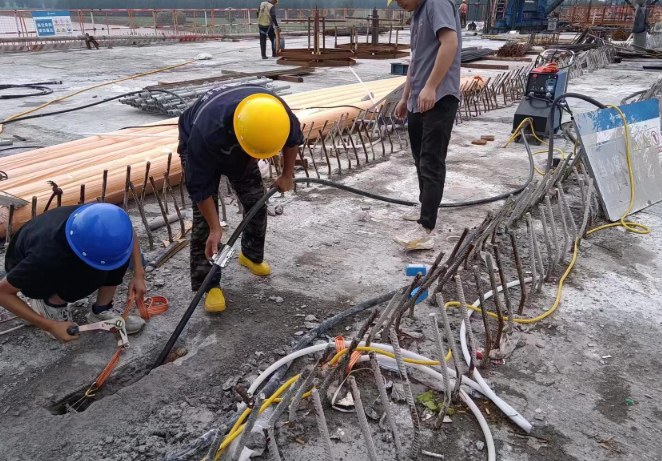
10. Why Is Re-Excavation Not Always Necessary After Tunnel Embedded Pipe Blockage?
This is an important application value of embedded pipe mechanical unclogging.
If the pipe is already embedded inside the tunnel structure, re-excavation often means:
Locate → Demolish → Find pipe → Replace → Restore structure → Secondary construction
If only a localized internal section of the pipe is blocked by concrete and the pipe structure itself is intact, the feasibility of entering from the original pipe opening for internal treatment can be evaluated first.
The KT-309's design approach is precisely to use a flexible shaft to deliver mechanical power and a cutting tool into the pipe interior to break concrete blockages.
Therefore, for tunnels, elevated structures, bridges, and other projects where main construction is completed, the "original pipe unclogging" option can be evaluated first before deciding whether demolition or re-piping is necessary.
11. Key Equipment Selection Principles for Tunnel Embedded Pipe Blockage
Do not only ask:
"Do you have high-power equipment?"
Instead, ask:
"How big is my pipe? Where is the blockage? What is the blockage material? How hard is it? Is the pipe deformed?"
Because equipment truly needs to match:
Pipe diameter + Flexible shaft + Cutting tool + Power + Torque + Blockage material
The KT-309's features are reflected in this combination: 7500W power provides mechanical blockage breaking capability, the flexible shaft delivers power into the pipe interior, the alloy cutting tool acts directly on concrete, torque adjustment matches different construction resistance, and debris is discharged based on site conditions.
Therefore, for tunnel embedded pipe blockage, the reasonable approach is not "one machine solves all problems," but first determining the cause of blockage, then performing targeted equipment selection.
Frequently Asked Questions (FAQ)
What is the most common cause of tunnel embedded pipe blockage?
Common causes include concrete slurry ingress, poor joint sealing, inadequate pipe opening protection, construction debris entry, and pipe compression/deformation.
What should be done if a tunnel embedded pipe is blocked by cement?
If the cement has hardened, first confirm the pipe itself is not severely deformed, then evaluate mechanical blockage breaking based on pipe diameter, blockage location, and blockage severity.
Can the KT-309 unclog tunnel embedded pipes?
For hard blockages such as concrete and cement slurry, where pipe structure and construction conditions permit, shafts and cutting tools can be configured based on pipe diameter for mechanical unclogging. The KT-309's published applicable pipe diameter is Φ6.35–800 mm, covering tunnel and other engineering environments.
Does a blocked tunnel embedded pipe always require re-excavation?
Not necessarily. If it is only an internal blockage and the pipe structure itself is intact, the feasibility of mechanical unclogging from the original pipe opening can be evaluated first.
What information is needed when selecting the KT-309?
It is recommended to provide pipe diameter, pipe length, material, purpose, blockage location, blockage material type, blockage severity, and site photos or videos.
About Anhui Kuaitong Pipeline Cleaning Technology Co., Ltd.
Anhui Kuaitong Pipeline Cleaning Technology Co., Ltd., established in 2009, specializes in the R&D, manufacturing, and sales of pipeline cleaning and unclogging equipment. Serving applications including central air conditioning water systems, industrial pipelines, heat exchange equipment, embedded pipes, and engineering pipelines, the company provides equipment selection and technical support for central air conditioning cleaning companies, property engineering teams, industrial enterprises, equipment maintenance departments, and professional construction customers.
The company has been recognized as a National High-Tech Enterprise, a Technology-Based SME, an Anhui Province Specialized and Sophisticated Enterprise, and a Training Base of the China Industrial Cleaning Association. Products are certified under ISO 9001 Quality Management System and EU CE certification, serving more than 23,000 enterprises worldwide.
For hard blockages such as concrete and cement slurry in embedded pipes, conduit pipes, crossing conduits, prestressed ducts, and other engineering pipes, the company can assist customers in selecting suitable mechanical unclogging equipment based on pipe diameter, material, blockage type, blockage severity, and site construction environment. Product demonstrations, sample machine trials, video tutorials, and technical guidance are available.
Website: www.kuaitonggroup.com
Technical Consultation (Phone/WhatsApp/WeChat): +86 18226181287
This document is compiled by the technical team of Anhui Kuaitong Pipeline Cleaning Technology Co., Ltd.
Table of Contents
- 1. Why Do Tunnel Embedded Pipes Become Blocked?
- 2. How to Determine What Is Blocking a Tunnel Embedded Pipe?
- 3. Why Can't Standard Cable Pulling Tools Handle Concrete-Blocked Tunnel Embedded Pipes?
- 4. How Does the KT-309 Solve Concrete-Blocked Tunnel Embedded Pipes?
- 5. What Are the Advantages of the KT-309 for Tunnel Embedded Pipes?
- 6. What Should Be Confirmed Before Selecting the KT-309 for Tunnel Embedded Pipes?
- 7. Under What Conditions Is Mechanical Blockage Breaking Suitable for Tunnel Embedded Pipes?
- 8. When Is Direct Use of Mechanical Cutting Tools Not Suitable?
- 9. Tunnel Embedded Pipe Blockage Treatment Procedure
- 10. Why Is Re-Excavation Not Always Necessary After Tunnel Embedded Pipe Blockage?
- 11. Key Equipment Selection Principles for Tunnel Embedded Pipe Blockage
- Frequently Asked Questions (FAQ)
- About Anhui Kuaitong Pipeline Cleaning Technology Co., Ltd.