EN
 AR
 HR
 CS
 NL
 FI
 FR
 DE
 EL
 HI
 IT
 KO
 PT
 RO
 RU
 ES
 TL
 ID
 LV
 LT
 SR
 VI
 ET
 HU
 TH
 AF
 MS
 HY
 AZ
 KA
 BN
 GU
 LO
 MN
 MY
 KK
 MG
 KY
How to Unclog a Railway Crossing Pipe Blocked by Concrete: KT-309 Mechanical Unblocking Solution and Equipment Selection
1. How Should a Railway Crossing Pipe Blocked by Concrete Be Unclogged?
If hard concrete, cement slurry, or cement debris has formed inside a railway crossing pipe, ordinary cable pullers usually cannot effectively break the blockage, and high-pressure water flushing alone may not solve the problem.
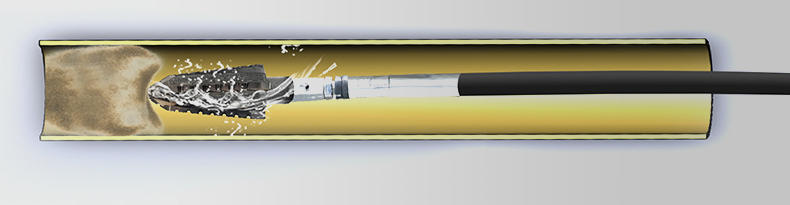
For conditions where the pipe structure is intact, no existing cables or other lines are inside, and entry from the pipe opening is possible, a mechanical unblocking method using a flexible shaft + alloy steel cutter can be considered: feed the cutter into the pipe, progressively break the concrete through rotary drilling, then use water flushing to clean loosened debris, and finally check whether the pipe has restored an effective passage.
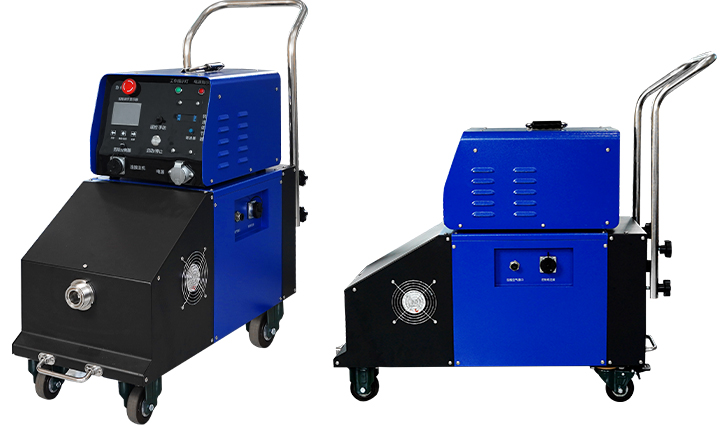
The Anhui Kuaitong KT-309 Concrete Blocked Pipe Unclogging Machine is equipment designed for this type of heavy-duty hard blockage. Its 7500W power, 0–2800 rpm speed adjustment, intelligent torque adjustment, and multi-specification flexible shaft configuration are mainly used to solve concrete blockage problems that ordinary unclogging tools cannot handle.
However, not all railway crossing pipe blockages are suitable for mechanical unblocking. Pipe deformation, damage, existing internal lines, and conditions where debris cannot be discharged all require on-site assessment first.
2. Why Do Railway Crossing Pipes Become Blocked by Concrete?
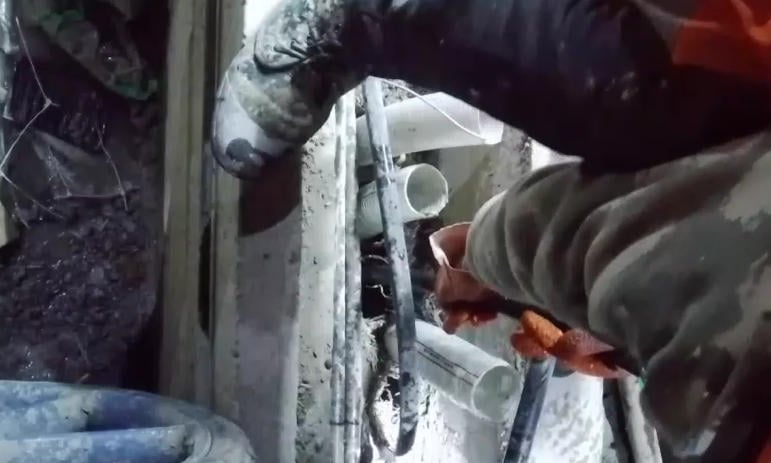
Railway crossing pipes are usually embedded during the main construction of railways, tunnels, bridges, or roads and are later used for laying cables, communication lines, and signal lines.
During construction, if pipe openings are not tightly sealed, gaps exist at joints, or pipes are compressed or damaged, concrete slurry may enter the pipe.
Common situations include:
1. Cement slurry enters the pipe during concrete pouring
This is a typical cause. After entering the pipe, cement slurry gradually deposits and hardens, forming localized blockage or even complete sealing.
2. Pipe joint sealing is inadequate
Gaps exist at connections between multiple pipe sections. Slurry enters the pipe during pouring and later forms a hard blockage.
3. Pipe opening protection fails
During construction, port sealing materials fall off, and crushed stone, mortar, and other construction debris enter the pipe.
4. Pipe is compressed and deformed
During rebar tying, formwork installation, and concrete vibration, the pipe may be subjected to external forces, causing localized diameter reduction or flattening.
Therefore, when a railway crossing pipe is found to be blocked, the first step is to determine whether it is a hard blockage or a problem with the pipe structure itself.
3. How to Determine Whether a Railway Crossing Pipe Is Blocked by Concrete?
Preliminary on-site troubleshooting can be carried out based on the following symptoms.
|
On-Site Symptom |
Possible Cause |
Inspection Direction |
|
Cannot enter near the pipe opening |
Cement slurry hardened at the port or debris blockage |
Inspect the pipe opening |
|
Tool enters a certain distance and suddenly stops |
Localized hard blockage or foreign object |
Record entry distance |
|
Advancement resistance gradually increases |
Diameter reduction, deformation, or internal deposition |
Inspect pipe condition |
|
Neither end can be passed through |
Middle blockage or structural abnormality |
Judge with pipeline records |
|
Pipe can pass air but cannot be threaded |
Localized diameter reduction or residual debris |
Check effective inner diameter |
|
Pipe opening protection failed during construction |
High possibility of concrete ingress |
Verify construction records |
Before selecting equipment, confirm the following information:
Actual pipe inner diameter, not just nominal diameter.
Pipe material: steel pipe, plastic pipe, or other material.
Total pipe length and approximate distance to the blockage location.
Whether the pipe has bends and what the bend radius is.
Whether the blockage is loose debris, cement slurry, partially hardened mortar, or fully hardened concrete.
Whether cables, optical fibers, or other lines have already been installed inside the pipe.
This information determines whether mechanical unblocking can be used and which flexible shaft and cutter should be configured.
4. Why Is Mechanical Drilling Required for Concrete Blockage in Railway Crossing Pipes?
Different blockages require different treatment methods.
For mud, loose debris, and light deposits, conventional pipe clearing tools or suitable brushes can be used.
For not fully hardened cement slurry, flushing or cleaning can be evaluated based on pipe material, slurry condition, and site conditions.
However, if the concrete has fully hardened, the problem is no longer ordinary pipe cleaning but how to break the blockage itself.
4.1 Ordinary Cable Pullers Are Mainly for Passage, Not Concrete Breaking
Cable pullers can help confirm whether a pipe is unobstructed and can guide cables or pull ropes through.
However, when facing hard concrete blockage, cable pullers lack dedicated mechanical breaking capability. Forced advancement may cause bending, jamming, or damage.
4.2 High-Pressure Water Requires an Effective Flow Channel
If there is still some space inside the pipe, high-pressure water can flush loose debris and some deposits.
However, when the pipe is completely sealed by dense concrete, water flow can hardly enter the interior of the blockage. Continuing to increase water pressure may not achieve the desired effect.
4.3 Mechanical Drilling Can Act Directly on Hard Blockages
The basic principle of mechanical unblocking is:
Power unit output → Flexible shaft transmits torque → Alloy cutter rotates → Drills concrete → Gradually forms a passage → Cleans debris.
The core problem it solves is allowing the cutter to directly contact the blockage, rather than relying on water flow impacting from outside the pipe.
5. During Mechanical Unblocking, How Should Heavy-Duty Shafts and Bendable Shafts Be Selected?
The flexible shaft is an important component of mechanical unclogging equipment and is mainly responsible for transmitting power from the power unit into the pipe.
For railway crossing pipes and embedded pipes, not only flexible shaft diameter but also pipe length, bend conditions, and blockage hardness must be considered.
5.1 Heavy-Duty Unblocking Shaft: Focused More on Power Transmission
Heavy-duty unblocking shafts are mainly used for straight pipes and heavy concrete blockages.
When hardened concrete requires continuous drilling, power transmission capability and the shaft’s load-bearing capacity are very important.
The KT-309 can be configured with 22 mm, 27 mm, and 30 mm flexible shafts based on working conditions.
5.2 Bendable Shaft: Focused More on Flexibility
If the railway crossing pipe has curved bends or some complex bends, flexible shaft passage capability must be considered.
The KT-309 can be configured with bendable shafts for evaluating some curved bends and S-shaped, L-shaped, and U-shaped pipelines.
However, a bendable shaft does not mean it can pass through all bends. Bend radius, number of bends, pipe diameter, and cutter size all affect actual passage capability.
5.3 How to Select Flexible Shaft Length?
The standard flexible shaft length is 8 m, and it can be adjusted based on working conditions.
Selection should consider:
How far the blockage location is from the pipe opening
Whether there are bends in the middle of the pipe
Whether the equipment can be placed near the pipe opening
Whether construction is required from both ends
Longer flexible shafts are not always better. As length increases, power transmission, operation, and on-site layout all need to be reconsidered.
6. How Does the KT-309 Concrete Blocked Pipe Unclogging Machine Handle Railway Crossing Pipe Blockage?
The Anhui Kuaitong KT-309 Concrete Blocked Pipe Unclogging Machine uses mechanical rotary breaking and is mainly designed for embedded pipes, conduit pipes, railway crossing pipes, and other hard-blocked pipes in tunnels, bridges, high-speed railways, municipal drainage, and building construction scenarios.
Compared with ordinary flexible shaft unclogging machines, its design focus is not only power output but also flexible shaft protection, cutter adaptability, and debris discharge.
6.1 7500W Power for Hardened Concrete Blockage
The KT-309 Intelligent Model uses a 7500W motor to drive a front-end alloy steel cutter through a flexible shaft, drilling and breaking hardened concrete and cement debris inside the pipe.
The product is designed for C60 concrete blocked pipe conditions.
For heavy blockages that ordinary unclogging equipment cannot handle, this mechanical unblocking method can be evaluated.
6.2 0–2800 rpm Speed Adjustment for Different Construction Stages
The equipment supports 0–2800 rpm speed adjustment.
During actual operation, speed can be adjusted based on pipe diameter, flexible shaft specifications, blockage hardness, and cutter load.
Generally, the cutter should first contact the blockage surface at low speed. After confirming stable cutter operation, adjustments should be made gradually based on breaking results. Maximum speed should not be used blindly from the start.
6.3 Intelligent Torque Adjustment to Reduce Shaft Overload
The flexible shaft bears significant reaction force when breaking hardened concrete.
If torque is set improperly, the shaft may kink, deform, or break.
The KT-309 can set corresponding torque ranges based on 22 mm, 27 mm, and 30 mm flexible shaft specifications. Combined with flexible shaft core protection design, it reduces damage risk caused by abnormal stress.
The practical value of this function is to match power output with shaft load-bearing capacity, rather than simply pursuing greater power.
6.4 Stepped Cutter for Progressive Cutting
The KT-309 can be configured with patented stepped (pyramid-type) cutters and other alloy cutters.
The stepped cutter uses a progressive cutting structure, allowing it to contact and break hard blockages gradually from small to large.
Compared with directly forcing a larger cutter forward from the beginning, progressive breaking helps control the contact process and reduce unnecessary cutter jamming risk.
6.5 Water Flushing Mode to Solve Debris Discharge
After concrete is broken, loosened cement debris still needs to be cleaned out.
The KT-309 supports water flushing mode:
Water flushing mode: For pipes that permit water introduction, water can be delivered to the front end of the flexible shaft to assist flushing out debris while the cutter breaks the blockage.
These modes are not simply additional functions but are intended to adapt to different pipe debris discharge conditions.
6.6 Manual and Remote Operation for Different Construction Environments
The equipment supports manual operation at the control cabinet and remote control operation, and features voice parameter announcements, parameter saving, and one-key recall.
The power unit and control cabinet use a split-type design and can be arranged separately based on the space conditions of the construction area.
For tunnels, equipment pits, and engineering sites with limited space, this structure facilitates equipment placement and operation organization.
7. For Railway Crossing Pipe Blockage Construction, How Should the KT-309 Be Configured?
Equipment selection cannot be based only on power. Flexible shafts and cutters must also be configured according to on-site conditions.
|
On-Site Condition |
Configuration to Prioritize |
Selection Explanation |
|
Straight pipe, hardened concrete blockage |
Heavy-duty unblocking shaft, alloy cutter |
Focus on power transmission and shaft load |
|
Localized hardened cement blocks |
Suitable specification shaft, stepped cutter |
Progressive drilling, control cutter size |
|
Pipe with curved bends |
Bendable shaft and matching cutter |
First confirm bend radius and number of bends |
|
Pipe that permits water introduction |
Water flushing configuration |
Facilitates discharge of broken debris |
|
Long pipe length |
Select shaft length based on blockage distance |
Also consider power transmission and site layout |
KT-309 Main Technical Parameters
|
Parameter Item |
Technical Data |
|
Product Name |
KT-309 Intelligent Model Concrete Blocked Pipe Unclogging Machine |
|
Rated Voltage |
380V |
|
Motor Power |
7500W |
|
Operating Speed |
0–2800 rpm, adjustable |
|
Applicable Pipe Diameter |
6.35–800 mm |
|
Power Unit Weight |
92.5 kg |
|
Power Unit Dimensions |
800×336×346 mm |
|
Control Cabinet Weight |
17 kg |
|
Control Cabinet Dimensions |
440×310×258 mm |
|
Flexible Shaft Specifications |
22 mm, 27 mm, 30 mm, etc. |
|
Standard Flexible Shaft Length |
8 m, adjustable according to working conditions |
|
Operation Methods |
Manual operation, remote control operation |
|
Working Modes |
Water flushing, air flushing |
|
Equipment Structure |
Split-type design with power unit and control cabinet |
|
Quick-Connect Water Hose |
20 m |
Note: The applicable pipe diameter range does not mean that construction can be carried out directly under all pipe diameters, pipe materials, bend configurations, and blockage conditions. Actual configuration must be confirmed based on on-site effective inner diameter, blockage location, and flexible shaft passage conditions.
8. In Which Situations Is Direct Use of the KT-309 for Mechanical Unblocking Not Recommended?
Mechanical unblocking is mainly aimed at hard blockages and should not be treated as a universal method for solving all railway crossing pipe failures.
The following situations require assessment first:
Cables or optical fibers are already inside the pipe. The cutter may damage existing lines. Empty-pipe unblocking operations cannot be carried out directly.
The pipe is flattened or damaged. Mechanical cutters cannot restore the original pipe structure. Structural repair or replacement should be considered.
Pipe material strength is insufficient. The risk of cutter contact with the pipe wall should be confirmed to avoid damaging the pipe material.
Bend conditions are complex. It must be confirmed whether the bendable shaft can reach the blockage location.
Rebar or unknown metal objects exist in the blockage. The nature of the foreign object should be identified first to avoid cutter jamming or damage.
Debris cannot be discharged. A debris discharge path must be planned first to avoid secondary blockage after concrete is broken.
If the pipe condition cannot be confirmed on site, inspection and technical evaluation should be carried out first. Do not directly use maximum power for forced construction.
9. After Railway Crossing Pipe Unclogging, How to Check Whether Cable Installation Requirements Are Met?
After unclogging is completed, it is not enough to check only whether the cutter passes. The actual effective passage must also be inspected.
Key items include:
Whether a continuous passage is formed from one end to the other
Whether the effective inner diameter inside the pipe meets design requirements
Whether sharp concrete fragments and metal shavings remain inside
Whether the pipe is flattened, damaged, or has joint misalignment
Whether subsequent cable laying and pulling requirements are met
For example, ESB Networks' technical documentation for underground cable conduits uses a combination of cleaning brushes, sponges, and duct mandrels for cleaning and passage verification. This indicates that, in engineering practice, conduit cleaning and passage inspection should be completed separately. Specific mandrel dimensions, pulling tension, and other requirements should be based on the corresponding project design and applicable standards.
10. Frequently Asked Questions About Railway Crossing Pipe Unclogging
1. Can the KT-309 handle a railway crossing pipe blocked by C60 concrete?
The KT-309 product is designed for C60 concrete blocked pipe conditions and uses 7500W power and an alloy steel cutter for mechanical drilling. However, actual construction results also need to be evaluated based on blockage length, pipe material, concrete condition, and flexible shaft and cutter configuration.
2. If the railway crossing pipe is only a few tens of millimeters, can the KT-309 be used?
This must be determined based on actual inner diameter, flexible shaft diameter, and cutter size. It is not enough to look only at the product's applicable pipe diameter range; it must also be confirmed that the tool can enter and operate normally inside the pipe.
3. If the railway crossing pipe has bends, can it be unclogged?
Bendable shafts can be evaluated, but not all bends can be passed. Bend radius, number of bends, pipe diameter, and flexible shaft configuration all affect the result.
4. Can the KT-309 use only water flushing without a cutter?
The core unblocking method of the KT-309 is mechanical drilling. For hardened concrete, water flushing mainly serves as auxiliary debris removal and cannot simply replace the mechanical breaking of the cutter.
5. Besides railway crossing pipes, what other pipes can the KT-309 handle?
The equipment can also be used for hard blockages in tunnel embedded pipes, conduit pipes, drainage pipes, elevator shaft pipes, prestressed ducts, and other engineering pipes. Depending on the cutter and cleaning accessories, it can also perform some pipe descaling, rust removal, and inner wall cleaning tasks. Specific applicability still needs to be determined based on pipe material and on-site conditions.
11. KT-309 Equipment Application and Technical Selection Consultation
When a railway crossing pipe is blocked by concrete, what truly needs to be solved is mechanical breaking of hardened blockage, flexible shaft power transmission, debris discharge, and post-unclogging passage verification.
When selecting equipment, do not look only at motor power. Flexible shaft specifications, shaft type, and cutter configuration should be determined based on pipe inner diameter, pipe material, blockage length, bend conditions, and debris discharge conditions.
Anhui Kuaitong Pipeline Cleaning Technology Co., Ltd., established in 2009, is a technology-oriented enterprise specializing in the R&D, manufacturing, and sales of pipeline cleaning, unclogging, and inspection equipment. The company is a National High-Tech Enterprise, a Technology-Based SME, a Training Base of the China Industrial Cleaning Association, and an Anhui Province Specialized and Sophisticated Enterprise. It has provided solutions to more than 23,000 domestic and international enterprises.
For concrete blockage problems in railway crossing pipes, embedded pipes, conduit pipes, and engineering pipes, the company can provide KT-309 equipment configuration recommendations, application guidance, and technical support based on on-site pipe diameter, blockage characteristics, and construction conditions.
Website: www.kuaitonggroup.com
Technical Consultation (Phone/WhatsApp/WeChat): +86 18226181287
This document is compiled by the technical team of Anhui Kuaitong Pipeline Cleaning Technology Co., Ltd.