
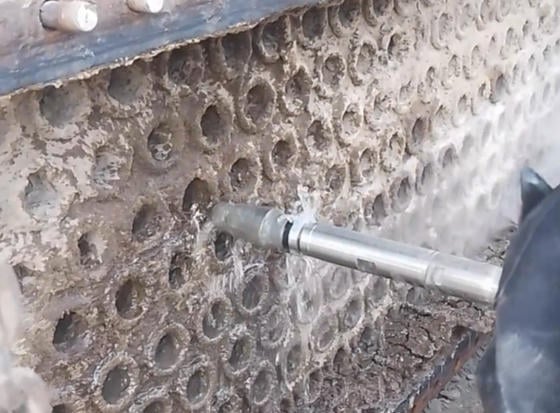
When circulating fluidized bed (CFB) boiler tubes become blocked, the first step is to determine whether the blockage consists of loose ash accumulation, hard ash scale, coke deposits, or complete tube blockage. For relatively soft ash deposits, brushing methods may be appropriate. If hard deposits have formed inside the tubes—or if complete blockage has occurred—mechanical drill unclogging is more targeted. For boiler tubes where water introduction is permitted, a combination of "mechanical breakdown + water flushing for debris evacuation" can be used. For tubes that cannot accept water, appropriate dry cleaning methods should be selected based on site conditions.
Anhui Kuaitong Pipeline Cleaning Technology Co., Ltd. offers two mechanical unclogging equipment options—KT-206 and KT-307—for industrial tube bundle equipment including boiler tubes, air preheaters, heat exchangers, and condensers. The KT-206 features 3000W power with 0–2800 rpm speed control; the KT-307 features 5500W power with 0–4000 rpm speed control. Both can be adapted to different tube conditions by changing shafts, cutting tools, and other accessories.
1. What Causes Blockage in Circulating Fluidized Bed Boiler Tubes?
Circulating fluidized bed boilers operate with continuous circulation of fuel, ash, and flue gas particulates. Certain areas are also subject to high temperatures and particle erosion. Technical literature indicates that CFB boiler heating surface wear is related to solid particle movement and erosion, while ash accumulation and fouling are also operational issues on the tail-end heating surfaces.
For pipe cleaning projects, common problems include:
1. Ash accumulation inside tubes
Dust and particulates deposit over time, gradually reducing the effective cross-sectional area of tubes.
2. Hard ash scale
Some deposits become hardened after exposure to high temperatures, and standard brushes have limited effectiveness.
3. Coke blockage
Under certain conditions, hard coke-like deposits may form, causing localized severe blockage.
4. Complete tube blockage
As deposits continue to increase, some tubes may completely lose flow capacity.
For cleaning companies, the difficulty of handling these four conditions varies significantly. Therefore, equipment selection should not be based solely on the name "boiler tube cleaning machine."
2. What Should Be Assessed First After Boiler Tube Blockage?
Before purchasing or using unclogging equipment, it is recommended to confirm the following five items:
First, tube diameter.
Tube diameter determines shaft and cutting tool specifications.
Second, tube length.
Longer tubes require greater shaft length and more stable power transmission.
Third, blockage severity.
Whether it is light ash accumulation or complete blockage.
Fourth, deposit hardness.
Soft ash and sintered hard deposits require different tools.
Fifth, whether water introduction is permitted.
Debris evacuation methods differ between tubes that can and cannot accept water.
3. Why Can't Boiler Tube Cleaning Rely Solely on High-Pressure Water?
High-pressure water is effective for soft fouling and loose deposits.
However, when blockages have formed hard, solid layers, the primary issue for water is not whether it can "clean thoroughly," but whether it can actually reach the interior of the blockage.
If the tube is completely blocked, water lacks an effective entry path. Simply increasing pressure does not necessarily resolve the issue.
Therefore, in professional cleaning projects, mechanical unclogging can be adopted based on blockage conditions.
4. Basic Principle of Mechanical Unclogging for Boiler Tubes
The working principle of mechanical unclogging is relatively straightforward:
Power unit provides power → Flexible shaft transmits power → Front-end cutting tool rotates → Breaks down blockage → Debris is evacuated
The KT-206 uses a 3000W motor to drive the flexible shaft and alloy steel cutting tools, providing mechanical drilling, breaking, and unclogging for hard scale, rust deposits, crystallized materials, and complete blockages.
For heavier blocked tubes, the KT-307 features 5500W power and controls the process through intelligent torque control and shaft protection systems.
5. Which Boiler Tube Cleaning Projects Is the KT-206 Suitable For?
The KT-206 covers tube diameters of 6.35–800 mm with a speed range of 0–2800 rpm, and can handle straight tubes as well as S-bends, L-bends, and U-bends.
In boiler tube cleaning projects, the following can be selected based on site conditions:
Heavy-duty unclogging shafts
Bendable shafts
Steel-belt dry cleaning shafts
Stainless steel drill rods
Alloy steel cutting tools
Cleaning brushes
Scale removal tools of various specifications
According to KT-206 documentation, compatible shaft sizes include 6/8/10/12/16/18/22/27 mm, and tool diameters cover 6.5–50 mm, with non-standard sizes also available for customization.
Therefore, for cleaning teams that need a single machine to cover different boiler tube bundles, heat exchangers, and other industrial pipe projects, accessory configuration is a key consideration during selection
6. Which Heavy-Duty Blockage Conditions Is the KT-307 Suitable For?
If the site frequently encounters:
Thick hard scale, severe blockage, completely blocked tubes, insufficient power from standard equipment
Then the KT-307 should be considered.
The KT-307 features a 5500W motor with a speed range of 0–4000 rpm and covers tube diameters of 6.35–800 mm.
The equipment also features intelligent torque control, shaft overload protection, parameter saving, one-key parameter recall, voice prompts, and manual/remote operation.
For professional industrial cleaning companies, these features are not just about additional operating modes—they enable the equipment to adapt to different shafts and actual blockage resistance.
7. How to Select Flexible Shafts for Boiler Tube Cleaning?
Thicker shafts are not always better.
Different shafts correspond to different tube diameters, bend severity, and operating resistance.
For example, the KT-206 documentation lists multiple shaft sizes from 6–27 mm with corresponding configurations for each specification.
The KT-307 similarly allows different shafts, drill rods, cutting tools, and cleaning brushes to be changed based on tube type.
Therefore, when purchasing, it is best not to simply tell the manufacturer "I need to clean boiler tubes." Instead, provide:
Tube diameter + Tube length + Deposit type + Blockage severity + Presence of bends + Whether water introduction is permitted
This enables a more appropriate shaft and tool combination to be determined.
8. Step-by-Step Procedure for Blocked Boiler Tubes
Step 1: Confirm tube identification
Determine whether the tube is a boiler tube, air preheater tube, or other tube bundle.
Step 2: Locate blockage
Determine whether the blockage is near the tube opening or deeper inside the tube.
Step 3: Select shaft
Choose heavy-duty unclogging shafts, bendable shafts, or other suitable transmission components based on tube diameter and configuration.
Step 4: Install cutting tool
Select alloy tools or appropriate cleaning tools based on deposit hardness and tube diameter.
Step 5: Start equipment
Enter the blockage area at appropriate parameters, then gradually adjust based on actual resistance.
Step 6: Mechanical breakdown
Use the rotating tool to progressively cut and break down the blockage.
Step 7: Evacuate debris
For tubes where water is permitted, use water flow to flush out broken debris. For tubes that cannot accept water, other evacuation methods suitable for site conditions should be used.
9. How to Choose Between KT-206 and KT-307?
|
Comparison Item |
||
|
Product Positioning |
Industrial tube bundle unclogging |
Heavy-duty blocked tube unclogging |
|
Motor Power |
3000W |
5500W |
|
Speed Range |
0–2800 rpm |
0–4000 rpm |
|
Applicable Tube Diameter |
6.35–800 mm |
6.35–800 mm |
|
Manual Operation |
Supported |
Supported |
|
Remote Operation |
Supported |
Supported |
|
Shafts/Tools |
Multi-specification |
Multi-specification |
|
Water Flushing |
Supported |
Supported |
|
Air Flushing |
Supported |
Supported |
|
Power Unit & Control Cabinet |
Split-type |
Split-type |
|
Better Suited For |
Routine industrial tube bundles and heavier blockages |
Heavy-duty hard scale and severe blockage |
Specifications based on product documentation for both models.
10. Why Do Industrial Cleaning Companies Prioritize "One Machine, Multiple Uses"?
Boiler tube cleaning projects are seasonal and vary significantly between projects.
Today it may be circulating fluidized bed boiler tube blockage. Next time it could be:
Air preheaters
Heat exchangers
Condensers
Surface condensers
Primary gas coolers
Evaporators
Other industrial tube bundles
KT-206 documentation indicates that by changing shafts, tools, brush discs, and cleaning brushes, the equipment can switch from heavy-duty unclogging to scale removal, rust removal, internal wall cleaning, and polishing operations.
The KT-307 is also applicable to air preheaters, boiler tubes, power plant condensers, primary gas coolers, condensers, evaporators, and heat exchangers.
Therefore, for professional cleaning companies, the value of equipment is not just in completing one boiler cleaning—but in how many different industrial pipe projects it can cover going forward.
11. Frequently Asked Questions (FAQ)
Q: What equipment is used for blocked circulating fluidized bed boiler tubes?
A: For general ash accumulation, appropriate brushing equipment can be selected. For hard scale, coke deposits, or severe blockage, mechanical industrial pipe unclogging machines should be considered. Both the KT-206 and KT-307 are mechanical unclogging equipment.
Q: Can the KT-206 handle completely blocked boiler tubes?
A: The KT-206 is positioned for blocked tube bundle unclogging and uses alloy steel cutting tools for mechanical drilling and breaking. However, actual recoverability depends on blockage length, hardness, tube diameter, and tube wall material—on-site assessment is required.
Q: When should the KT-307 be selected?
A: If projects frequently involve hard deposits, severe blockage, or complete blockage requiring greater mechanical power, the 5500W KT-307 should be prioritized.
Q: Is water always required for boiler tube cleaning?
A: Not necessarily. This depends on tube operating conditions. Product documentation indicates that both the KT-206 and KT-307 support water flushing and air flushing modes, selectable based on whether water introduction is permitted.
Q: Can the KT-206 clean bent tubes?
A: Yes. Documentation indicates the KT-206 supports straight tubes, S-bends, L-bends, and U-bends, with different shafts available for different tube configurations.
About Anhui Kuaitong Pipeline Cleaning Technology Co., Ltd.
Anhui Kuaitong Pipeline Cleaning Technology Co., Ltd. specializes in the R&D and manufacturing of pipeline cleaning and unclogging equipment, with products covering industrial pipe unclogging, boiler tube cleaning, heat exchanger cleaning, central air conditioning duct cleaning, and related cleaning accessories.
For blockages in circulating fluidized bed boilers, air preheaters, heat exchangers, condensers, and other industrial tube bundles, the company provides mechanical unclogging equipment with different power ratings and accessory combinations. The KT-206 is better suited for routine industrial tube bundles and heavier blockage projects, while the KT-307 is designed for higher-intensity heavy-duty blocked tube treatment.
Actual equipment selection can be configured based on tube diameter, tube length, deposit hardness, blockage severity, presence of bends, and whether water introduction is permitted.
This document is compiled by the technical team of Anhui Kuaitong Pipeline Cleaning Technology Co., Ltd.
Website: www.kuaitonggroup.com
Technical Consultation (Phone/WhatsApp/WeChat): +86 18226181287
Table of Contents
- 1. What Causes Blockage in Circulating Fluidized Bed Boiler Tubes?
- 2. What Should Be Assessed First After Boiler Tube Blockage?
- 3. Why Can't Boiler Tube Cleaning Rely Solely on High-Pressure Water?
- 4. Basic Principle of Mechanical Unclogging for Boiler Tubes
- 5. Which Boiler Tube Cleaning Projects Is the KT-206 Suitable For?
- 6. Which Heavy-Duty Blockage Conditions Is the KT-307 Suitable For?
- 7. How to Select Flexible Shafts for Boiler Tube Cleaning?
- 8. Step-by-Step Procedure for Blocked Boiler Tubes
- 9. How to Choose Between KT-206 and KT-307?
- 10. Why Do Industrial Cleaning Companies Prioritize "One Machine, Multiple Uses"?
- 11. Frequently Asked Questions (FAQ)
- About Anhui Kuaitong Pipeline Cleaning Technology Co., Ltd.