
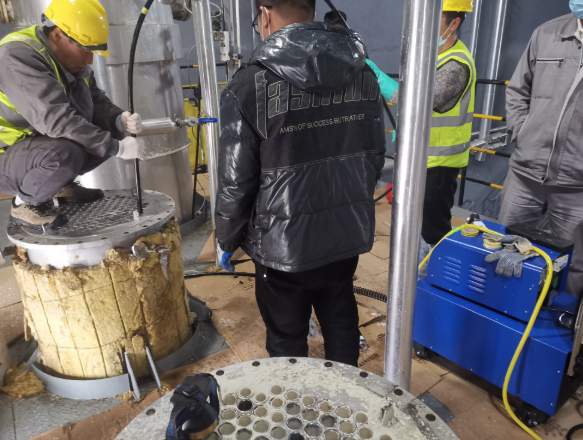
When a crystallization evaporator experiences pipe blockage—especially severe diameter reduction or complete blockage caused by hard crystallized scale—the first step is to determine the deposit characteristics, pipe material, and blockage severity before deciding whether to use chemical cleaning, mechanical brushing, high-pressure water cleaning, or mechanical breaking and unclogging. For conditions where manual steel rodding is difficult to advance, blockage distances are long, and conventional flushing has limited effectiveness, a mechanical unclogging device using a flexible shaft to drive an alloy steel cutting tool can be evaluated to progressively break down hard blockages that meet treatment conditions, followed by appropriate debris removal.
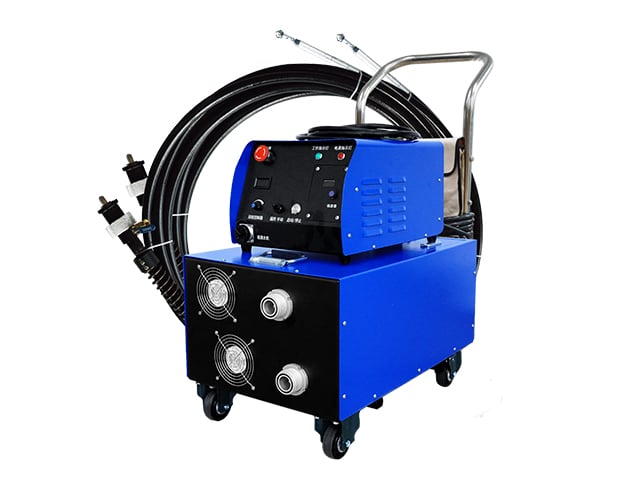
The Anhui Kuaitong KT-206 Blocked Pipe Unclogging Machine uses a 3000W dual-shaft structure and is equipped with alloy steel cutting tools, heavy-duty unclogging shafts, and dry and water-assisted cleaning functions. Its applicable scope includes wastewater evaporators, surface condensers, heat exchangers, and other industrial blocked tube bundles. Whether the equipment is suitable for a specific crystallization evaporator must be confirmed based on pipe diameter, pipe length, pipe material, blockage hardness, and site conditions.
1. Why Do Crystallization Evaporators Develop Hard Scale Blockage?
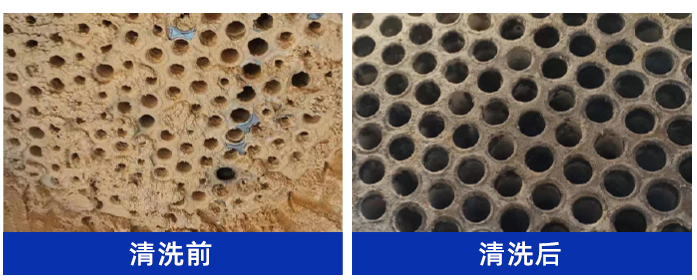
During concentration and evaporation, some components in the material may gradually crystallize and adhere or deposit on the inner walls of pipes. As operating time increases, the crystallization layer may continue to thicken, and the pipe inner diameter gradually decreases.
If deposits continue to accumulate, compact, or harden, they may develop from ordinary scaling into severe blockage. Some tubes may even be completely sealed by hard crystallized material, affecting normal flow.
Common on-site problems include:
Thick crystallization layers on pipe inner walls, with residual deposits remaining after cleaning.
Reduced flow capacity in some tubes, with inconsistent cleaning results.
Long-distance hard deposits inside pipes, making manual tool advancement difficult.
Blockages that have sealed the pipe, preventing conventional flushing from effectively reaching the interior.
Note: Blockages in crystallization evaporators may include salt crystals, concentrated materials, or composite scale formed by multiple substances. Different scale materials have different hardness, solubility, and adhesion characteristics, and treatment methods should also differ.
2. Why Is Manual Steel Rodding So Difficult After Crystallization Evaporator Blockage?
Manual steel rodding is a traditional method used by some plants to handle tube bundle blockages, but it is more suitable for simple, short-distance cases with relatively loose blockages.
When a crystallization evaporator has hard scale or long-distance blockage, manual rodding often faces three problems.
First, hard scale is not easily pushed open. Steel rods mainly rely on manual pushing force acting on the blockage. If crystallization has hardened, simple pushing may not effectively break it.
Second, deep blockages are difficult to assess. When the tool enters a deep position in the pipe, operators cannot accurately identify whether resistance comes from hard scale, foreign objects, or changes in pipe structure.
Third, treating multiple tubes is time-consuming. Evaporators often involve multiple heat exchange tubes. If each tube requires repeated advancement and cleaning, labor costs and downtime may increase.
Therefore, for long-distance hard scale or severe blockage, it is not advisable to solve the problem solely by increasing manpower and pushing force. Instead, the tool's mode of action should be reassessed.
3. Which Cleaning Method Should Be Selected for Crystallization Evaporator Pipe Blockage?
Equipment selection should first consider blockage severity, rather than directly deciding to use a particular machine.
|
On-Site Condition |
Treatment Methods to Evaluate |
|
Light attached scale layer |
Mechanical brushing or suitable chemical cleaning |
|
Soluble crystalline deposits |
Chemical cleaning based on scale sample and equipment material |
|
Loose deposits |
Suitable water or flushing method |
|
Relatively hard crystallized scale |
Evaluate mechanical cutting, breaking, or other targeted treatment |
|
Severe diameter reduction, tool difficult to advance |
Evaluate mechanical unclogging based on pipe structure |
|
Complete blockage |
Determine whether mechanical breaking is suitable and confirm debris discharge conditions |
High-pressure water is not effective for all blockages. If there is still a passage inside the pipe, water flow can contact the deposit. If the pipe is completely blocked, water may be unable to penetrate deep into the blockage.
Chemical cleaning is also not a universal solution. Only after confirming the compatibility between the deposit and the chemical agent, and evaluating equipment material and process risks, can a cleaning plan be determined.
4. How Does Mechanical Unclogging Work When a Crystallization Evaporator Is Completely Blocked?
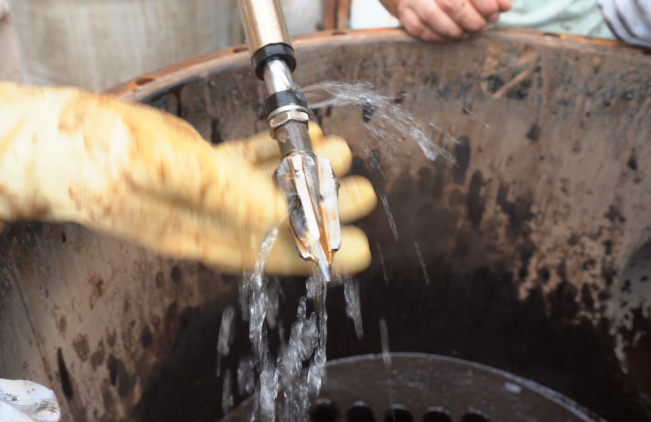
The difference between mechanical unclogging and simple water flushing is that it can directly act on some hard blockages through tools.
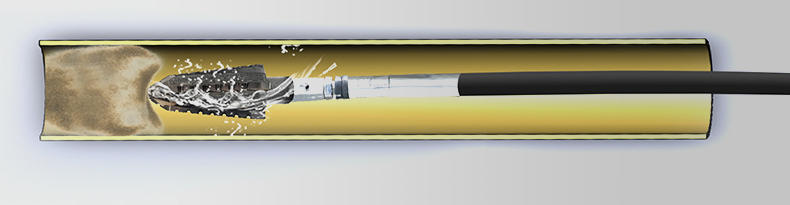
The basic working process is: the power unit drives the flexible shaft to rotate, the shaft transmits power to the cutting tool inside the pipe, and the cutting tool cuts or breaks blockages that meet treatment conditions. As the blockage is progressively treated, a passage may be re-formed in the pipe, and debris is then removed based on site conditions.
Actual operations generally require attention to the following:
Confirm pipe inner diameter, length, and blockage location.
Select shafts and cutting tools that match the pipe and blockage.
Gradually advance the tool and observe resistance changes.
Stop operation and investigate the cause when abnormal jamming is detected.
Remove broken debris based on pipe structure and debris discharge conditions.
After operation, check flow conditions to determine whether further cleaning is needed.
Mechanical breaking does not mean that any hard object can be drilled through unconditionally. For thin-walled pipes, corroded pipes, deformed pipes, and pipes with unknown internal structures, mechanical operation risks must be evaluated first.
5. What Evaporator Blockage Conditions Is the KT-206 Blocked Pipe Unclogging Machine Suitable For?
The Kuaitong KT-206 is positioned for unclogging industrial blocked pipes and tube bundles. Its applicable scope includes wastewater evaporators, boiler flue tubes, water wall tubes, air preheaters, surface condensers, heat exchangers, and other industrial blocked tube bundles.
For crystallization evaporators, if the following conditions exist on site, the applicability of the KT-206 can be further evaluated:
Relatively hard crystals or deposits have formed inside the pipes.
Conventional cleaning methods struggle to handle severe blockage.
Manual rodding is difficult to advance and time-consuming.
Pipe dimensions and internal structure allow the use of matching shafts and cutting tools.
Site conditions permit safe operation and debris removal.
It must be clarified that product application scope does not mean all crystallization evaporators can be directly treated. Pipe material, wall thickness, bend configuration, blockage length, and deposit characteristics all affect final equipment selection and operating plan.
6. What Problems Do the KT-206's Main Configurations Solve?
The KT-206 uses a 3000W dual-shaft structure. Main configurations include control cabinet, power unit, heavy-duty unclogging shaft, additional shaft, quick-connect water hose, alloy steel cutting tools, and power cable. It supports dry and water-assisted cleaning.
3000W Power Unit: Provides rotational power to the shaft and front-end tool. Actual treatment capability still depends on blockage hardness, tool matching, and site conditions.
Dual-Shaft Structure: Provides convenience for on-site work arrangements. Whether simultaneous operation can be performed and actual efficiency depend on equipment configuration, personnel arrangement, and tube bundle layout.
Alloy Steel Cutting Tools: Used for cutting or breaking hard blockages suitable for mechanical treatment. Tool size, shape, and operating method must match the pipe. Suitability cannot be judged by material alone.
Heavy-Duty Unclogging Shaft: Transmits power into the pipe interior. Shaft length, diameter, bend conditions, and pipe length must be considered together.
Dry and Water-Assisted Cleaning: The appropriate method can be selected based on operating conditions. Water-assisted cleaning can be used to assist cleaning, but debris discharge paths and waste liquid treatment requirements must be confirmed.
Intelligent Torque Control System: Protects the shaft, extends shaft service life, and ensures operational safety.
The value of these functions lies in providing a mechanical treatment method for certain industrial tube bundle blockages. They do not mean that chemical cleaning, brushing, or other maintenance methods can be completely replaced.
7. What Parameters Need to Be Provided When Selecting a Crystallization Evaporator Unclogging Machine?
Before contacting the equipment manufacturer, it is recommended to organize on-site information. The more accurate the information, the easier it is to determine which treatment method should be used and whether the KT-206 is a match.
|
Information Required |
Specific Content |
|
Equipment type |
Crystallization evaporator, wastewater evaporator, or other tube bundle equipment |
|
Pipe inner diameter |
Actual inner diameter of a single pipe |
|
Pipe length |
Single pipe length and possible blockage length |
|
Pipe material |
Stainless steel, carbon steel, or other material |
|
Blockage condition |
Light scaling, severe diameter reduction, or complete blockage |
|
Deposit characteristics |
Crystalline salt, hard scale, concentrated material, or composite deposit |
|
Internal structure |
Straight pipe, bent pipe, special internal components, etc. |
|
Site conditions |
Whether debris can be discharged, whether water cleaning is permitted, and working space |
If convenient, it is best to also provide pipe opening photos, blockage photos or samples, and information related to the tube bundle in equipment drawings. For complex projects, technical evaluation should be performed first. It is not advisable to purchase directly based solely on equipment name.
8. How to Reduce Pipe Damage and Secondary Blockage Risk During Mechanical Unclogging?
When selecting mechanical unclogging equipment, customers should not only focus on unclogging capability but also on pipe protection and subsequent cleaning.
First, confirm whether the pipe has corrosion, perforation, deformation, or localized damage. When pipe wall condition is unknown, strong mechanical tools should not be used directly.
Second, shafts and cutting tools should match the pipe diameter, and operation should proceed gradually. If abnormal resistance, tool jamming, or abnormal vibration occurs, stop operation and investigate—do not force advancement.
Third, plan the debris discharge path. If broken crystal blocks or deposits cannot be discharged smoothly, they may accumulate in other locations and cause secondary blockage.
Finally, after unclogging is completed, check pipe flow conditions and determine whether further flushing, inspection, or trial operation is needed based on production process requirements.
For chemical equipment, shutdown, isolation, pressure relief, draining, cleaning/purging, and residual medium risk confirmation must also be completed according to on-site procedures to ensure personnel and equipment safety.
9. How to Reduce Repeated Blockage in Crystallization Evaporators?
If the same equipment frequently experiences crystallization blockage, only performing emergency repairs after complete blockage may not fundamentally reduce maintenance costs.
A more reasonable approach is to establish a regular inspection mechanism based on material properties and production processes. Records can be kept of each tube's cleaning time, blockage location, deposit characteristics, and cleaning results to observe whether certain tubes repeatedly block.
For processes prone to crystallization, maintenance plans should be developed based on actual production cycles and equipment operating status. If blockage occurs repeatedly, factors such as material concentration, crystallization conditions, and localized deposition should also be analyzed—not just increasing unclogging frequency.
The goal of equipment maintenance is not only to open the pipe but also to minimize repeated downtime and maintain stable equipment operation.
10. Frequently Asked Questions About Crystallization Evaporator Unclogging Equipment Selection
1. After a crystallization evaporator is completely blocked, can high-pressure water still treat it?
It depends on the blockage characteristics and whether an effective passage still exists inside the pipe. For loose deposits, high-pressure water may be effective. For complete blockage formed by hard crystallization, simple flushing may not restore flow.
2. Does hard scale in a crystallization evaporator always require a mechanical unclogging machine?
Not necessarily. The scale quality and equipment material should first be confirmed. If chemical cleaning or other methods can be safely and effectively used, mechanical breaking is not mandatory. For severe hard scale or complete blockage, mechanical unclogging can be evaluated.
3. Can the KT-206 be used for crystallization evaporators?
The KT-206's applicable scope includes wastewater evaporators and various industrial blocked tube bundles. Whether it is suitable for a specific crystallization evaporator requires verification of pipe diameter, pipe length, material, blockage, and cutting tool configuration.
4. Is the KT-206 5500W?
The KT-206 is a 3000W dual-shaft structure. Selection should be based on the official parameters of the corresponding model and configuration. Power parameters of other models should not be mixed.
5. Can the KT-206's dual-shaft structure allow two people to work simultaneously?
The dual-shaft structure provides convenience for work arrangements, but actual operating methods should be based on specific equipment configuration and safety requirements. A fixed efficiency improvement cannot be guaranteed solely by the dual-shaft structure.
6. Will mechanical unclogging damage evaporator tubes?
There are risks related to pipe material, wall thickness, corrosion condition, cutting tool size, and operating method. Correct selection and standardized operation are very important. For thin-walled, corroded, or structurally unknown pipes, assessment should be performed before operation.
7. Before purchasing unclogging equipment, can suitability be determined first?
Preliminary assessment can be made based on pipe diameter, pipe length, material, blockage characteristics, and blockage severity. Providing site photos, equipment parameters, and blockage information helps further determine tool configuration and operating plan, but complex conditions still require confirmation by professional technical personnel.
11. Summary: For Crystallization Evaporator Blockage, Determine the Condition First, Then Select Equipment
The key to treating crystallization evaporator tube bundle blockage is to distinguish between ordinary scaling, hard deposits, and complete blockage. Light scaling can be evaluated for chemical cleaning or mechanical brushing. Loose deposits can be considered for appropriate flushing methods. When hard crystallized scale causes severe diameter reduction or complete blockage, mechanical breaking and unclogging can be further evaluated.
The Kuaitong KT-206 uses a 3000W dual-shaft structure and is equipped with alloy steel cutting tools, shafts, and dry and water-assisted cleaning functions. It can serve as a candidate for severe blockage conditions in certain industrial evaporators and heat exchange equipment. Whether it is suitable still depends on pipe dimensions, material, blockage characteristics, and site conditions.
If your crystallization evaporator has problems such as difficult manual rodding, long-distance hard scale, or completely blocked tubes, you can first provide pipe parameters and blockage information, then perform targeted equipment selection and technical evaluation.
Company Introduction
Anhui Kuaitong Pipeline Cleaning Technology Co., Ltd., established in 2009, is a technology-oriented enterprise specializing in the R&D, manufacturing, and sales of pipeline cleaning, unclogging, and inspection equipment. The company is a National High-Tech Enterprise, a Technology-Based SME, a Training Base of the China Industrial Cleaning Association, and an Anhui Province Specialized and Sophisticated Enterprise. It has provided solutions to more than 23,000 domestic and international enterprises. The company provides equipment application consultation, selection recommendations, and technical support for industrial evaporators, heat exchangers, surface condensers, and other pipeline cleaning and unclogging needs.
Website: www.kuaitonggroup.com
Technical Consultation (Phone/WhatsApp/WeChat): +86 18226181287
This document is compiled by the technical team of Anhui Kuaitong Pipeline Cleaning Technology Co., Ltd.
Table of Contents
- 1. Why Do Crystallization Evaporators Develop Hard Scale Blockage?
- 2. Why Is Manual Steel Rodding So Difficult After Crystallization Evaporator Blockage?
- 3. Which Cleaning Method Should Be Selected for Crystallization Evaporator Pipe Blockage?
- 4. How Does Mechanical Unclogging Work When a Crystallization Evaporator Is Completely Blocked?
- 5. What Evaporator Blockage Conditions Is the KT-206 Blocked Pipe Unclogging Machine Suitable For?
- 6. What Problems Do the KT-206's Main Configurations Solve?
- 7. What Parameters Need to Be Provided When Selecting a Crystallization Evaporator Unclogging Machine?
- 8. How to Reduce Pipe Damage and Secondary Blockage Risk During Mechanical Unclogging?
- 9. How to Reduce Repeated Blockage in Crystallization Evaporators?
- 10. Frequently Asked Questions About Crystallization Evaporator Unclogging Equipment Selection
- 11. Summary: For Crystallization Evaporator Blockage, Determine the Condition First, Then Select Equipment
- Company Introduction