
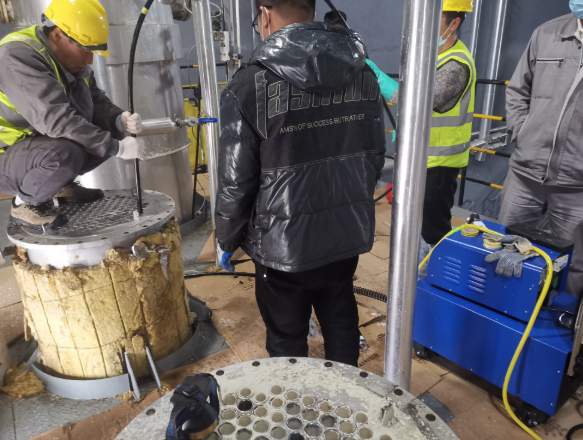
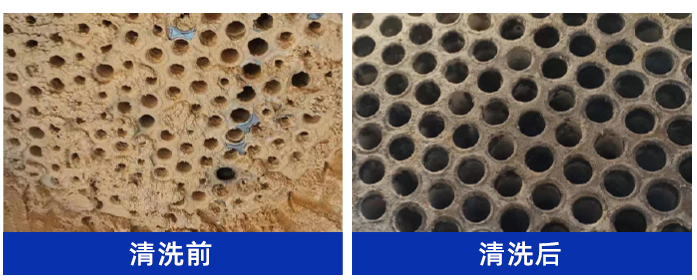
In industrial processes using sodium carbonate or high-concentration salt-bearing media, heat exchangers may experience tube wall crystallization, salt deposition, and composite fouling after long-term operation.
As deposits accumulate, the internal diameter of heat exchange tubes gradually decreases. In severe cases, some tubes may become completely blocked.
For such equipment, a single cleaning method is rarely sufficient for all conditions. Light, soluble deposits may be addressed with chemical cleaning; loose fouling can be handled with water flushing; hard deposits or completely blocked tubes require mechanical unclogging.
1. Why Do Sodium Carbonate Shell-and-Tube Heat Exchangers Become Blocked?
1. Increasing salt concentration
During concentration and evaporation processes, as water content decreases, salt concentration changes continuously. Under certain conditions, salts may precipitate and adhere to the inner walls of heat exchange tubes.
2. Gradual accumulation of crystals
Crystals initially formed may be relatively easy to remove. If maintenance is neglected over extended periods, new crystals continuously attach to existing deposit layers, forming thicker accumulations.
3. Composite fouling from different substances
In actual industrial conditions, fouling layers are rarely a single substance. Besides salt crystallization, calcium/magnesium scale, rust, particulates, and process materials may also be present. Composite fouling is typically more difficult to clean than single soluble salts.
4. Large number of heat exchange tubes
Shell-and-tube heat exchangers often contain numerous tubes. When some tubes become blocked, each tube must be inspected and addressed individually—a key characteristic distinguishing industrial heat exchanger cleaning from ordinary pipe cleaning.
2. Signs of Blockage in Sodium Carbonate Heat Exchangers
If significant blockage occurs, it can typically be identified from the following indicators:
Reduced media flow rate
Partial tubes blocked
Decreased heat transfer efficiency
Changed pressure differential
Increased energy consumption
Some tubes unable to pass flow
Diagnosis should not rely on a single parameter; a comprehensive assessment should consider operating data including inlet/outlet temperature, pressure, differential pressure, and flow rate.
3. Cleaning Methods for Blocked Sodium Carbonate Heat Exchangers
Method 1: Chemical Cleaning
If deposits are soluble and cleaning solution can effectively enter the tubes, chemical circulation cleaning may be considered. This method can be effective for specific chemical compositions. However, if tubes are completely blocked and cleaning solution cannot contact the deposit, effectiveness is limited.
Method 2: High-Pressure Water Flushing
High-pressure water removes fouling through impact and scouring. This is suitable for mud deposits, loose sediments, and some soft scale. For dense hard scale, especially when tube openings are completely blocked, water penetration is restricted and other methods should be considered.
Method 3: Mechanical Drilling Unclogging
Mechanical unclogging transmits power through a flexible shaft to the tube interior. A suitable cutting tool, drill bit, or cleaning brush is mounted at the front to break down deposits through rotation. This method is particularly effective for:
Hard scale blockages
Material fouling
Localized severe blockages
Completely blocked heat exchanger tubes
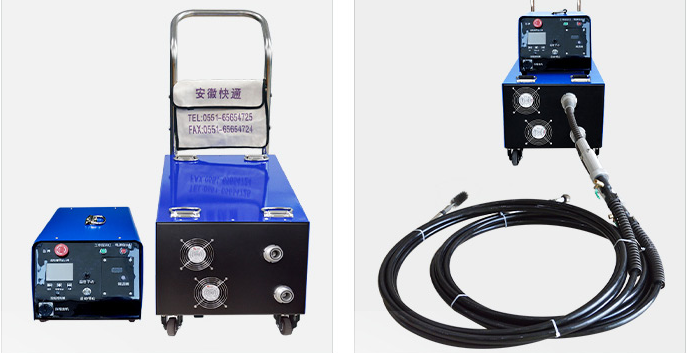
Anhui Kuaitong KT-307 features a 5500W power system and supports various shaft and tool combinations for industrial tube bundle blockage treatment.
4. Working Principle of the KT-307 for Heat Exchanger Blockage
The KT-307 operates as follows:
Power unit → Flexible shaft → In-tube cutting tool → Rotational breakdown of blockage
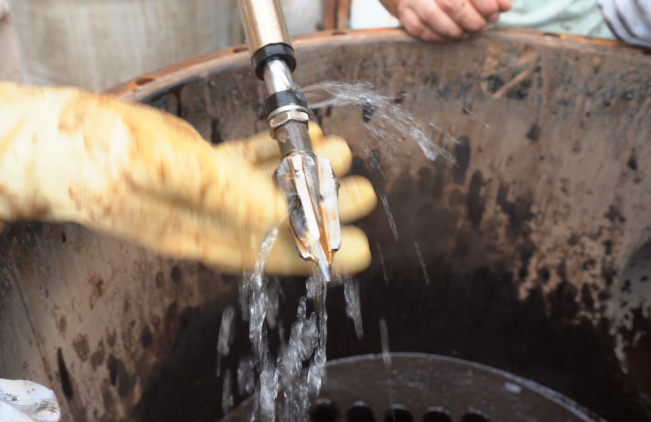
After the cutting tool enters the heat exchange tube, it progressively breaks down salt scale, composite fouling, and other hard deposits. Where water introduction is permitted, water flow can flush out the broken debris.
The KT-307 supports multiple shaft and tool combinations, configurable for different tube diameters and blockage conditions.
5. Why Is the KT-307 Suitable for Severe Blockage?
5500W Power – The motor transmits power through the shaft to the in-tube tool, providing power reserve for breaking hard blockages.
0–4000 rpm Speed Control – Speed can be adjusted based on tube diameter, shaft, and blockage conditions—not fixed speed operation.
Intelligent Torque Protection – When the tool encounters significant resistance, torque control reduces shaft overload, lowering the risk of shaft kinking, deformation, or breakage.
Multi-Specification Shafts – Configurable with different shaft diameters, with types selected for straight tubes, bent tubes, and severe blockage conditions.
6. How to Select Cutting Tools for Sodium Carbonate Heat Exchangers?
Cutting tool selection should consider:
Tube diameter + Tube material + Deposit hardness + Blockage severity + Tube length + Presence of bends
Examples:
Small-diameter tubes → Match with corresponding small tools
Hard blockages → Select alloy steel heavy-duty tools
General scaling → Consider scale removal tools
Residual scale on tube walls → Use cleaning brushes
Bent tubes → Select appropriate bendable shafts based on bend radius
The KT-307 is equipped with tapered (pyramid-type) tools, alloy steel heavy-duty tools, alloy scale removal tools, three-jaw expansion tools, gear-type scale removal tools, sprocket expansion tools, as well as various drill bits and cleaning brushes.
7. Step-by-Step Procedure for Blocked Heat Exchanger Tubes
Step 1: Measure tube diameter
Confirm actual internal diameter rather than selecting tools based solely on equipment model.
Step 2: Assess blockage condition
Determine whether blockage is at the tube opening, localized, or throughout the entire tube.
Step 3: Identify deposit characteristics
Confirm whether deposits are salt scale, crystallized deposits, material fouling, or composite fouling.
Step 4: Select shaft and cutting tool
Match based on tube diameter and blockage severity.
Step 5: Low-speed entry
Insert the tool into the blockage area and observe resistance.
Step 6: Gradual breakdown
Progress based on resistance changes—do not force at maximum speed.
Step 7: Remove residual debris
Where water is permitted, flush broken material out.
Step 8: Verify flow
After initial unclogging, perform secondary descaling or tube wall cleaning as needed.
8. Which Customers Are Suitable for the KT-307?
The KT-307 is particularly suitable for:
Industrial cleaning companies
Heat exchanger cleaning service providers
Power plant maintenance departments
Chemical plant equipment maintenance teams
Pharmaceutical plant maintenance teams
District heating companies
Ship repair facilities
Industrial equipment maintenance contractors
These users typically face severe blockages in heat exchanger tubes, evaporators, condensers, surface condensers, and other industrial tube bundle equipment—not ordinary household pipe blockages.
9. KT-307 Main Technical Specifications
|
Parameter |
KT-307 Intelligent Series |
|
Product Type |
|
|
Operating Voltage |
380V |
|
Motor Power |
5500W |
|
Speed Range |
0–4000 rpm (stepless) |
|
Applicable Tube Diameter |
6.35–800 mm |
|
Power Unit Weight |
120 kg |
|
Power Unit Dimensions |
850 × 530 × 470 mm |
|
Control Cabinet Weight |
19 kg |
|
Control Cabinet Dimensions |
495 × 345 × 275 mm |
|
Control Methods |
Manual + Remote |
|
Structural Design |
Split-Type (Power Unit + Control Cabinet) |
|
Quick-Connect Hose |
20 m |
|
Shafts |
Multiple specifications available |
|
Cutting Tools |
Multiple specifications available |
Specifications based on KT-307 product documentation.
10. How to Select Equipment for Sodium Carbonate Shell-and-Tube Heat Exchangers
A simple selection guide based on blockage severity:
|
Blockage Condition |
Recommended Approach |
|
Light deposition |
Chemical cleaning or water flushing |
|
Moderate scaling |
Mechanical brushing |
|
Hard composite fouling |
Mechanical cutting tool unclogging |
|
Localized blocked tubes |
Mechanical drilling unclogging |
|
Complete blockage |
High-power mechanical unclogging based on tube diameter, blockage length, and material |
When selecting equipment, do not just ask "Can it clean sodium carbonate?" Instead, provide:
Tube internal diameter + Tube length + Tube material + Blockage length + Deposit photos + Presence of bends
This information enables more accurate selection than simply providing the heat exchanger model.
11. Frequently Asked Questions (FAQ)
Q: Can a blocked sodium carbonate heat exchanger be flushed with water?
A: It depends on deposit condition. For loose or soluble deposits, water flushing may be effective. If severe physical blockage prevents water from reaching the deposit, flushing alone may not resolve the issue.
Q: Is sodium carbonate crystallization always hard scale?
A: Not necessarily. Sodium carbonate itself has good water solubility. Actual industrial blockages may be sodium carbonate crystals or composite fouling containing other salts and impurities—deposit samples should be evaluated.
Q: Can the KT-307 clean heat exchangers?
A: Yes. The KT-307 explicitly lists heat exchangers, condensers, evaporators, and surface condensers among its applicable industrial equipment.
Q: Can the KT-307 handle completely blocked heat exchanger tubes?
A: The KT-307 is positioned as a heavy-duty blocked tube unclogging machine, using 5500W power to drive shafts and tools for mechanical breakdown. Final restorability depends on deposit hardness, blockage length, tube diameter, and tube material—on-site assessment is required.
Q: What tube diameter is suitable for the KT-307?
A: Applicable diameter range is 6.35–800 mm. Actual operation requires shaft and tool selection based on specific tube diameter.
Q: Can the KT-307 only clean salt scale?
A: No. The product is positioned as a heavy-duty industrial pipe unclogging machine and can mechanically unclog scale, rust deposits, slime, welding slag, and other hard deposits.
About Anhui Kuaitong Pipeline Cleaning Technology Co., Ltd.
Anhui Kuaitong Pipeline Cleaning Technology Co., Ltd. specializes in the R&D and application of pipeline cleaning and unclogging equipment, providing pipeline cleaning equipment and technical support for industrial cleaning companies, equipment maintenance firms, and industrial customers. The company has been recognized as a National High-Tech Enterprise, a Technology-Based SME, and a Training Base of the China Industrial Cleaning Association. Our products are certified under ISO 9001 Quality Management System and EU CE certification. Over the past 17 years, we have provided pipeline cleaning, unclogging, and inspection solutions to more than 23,000 enterprises worldwide.
For severe blockages in heat exchangers, evaporators, condensers, boiler tube bundles, and other equipment, the company develops multi-specification shafts, cutting tools, and mechanical unclogging equipment for various tube diameters, deposit types, and site conditions.
The KT-307 features 5500W power, intelligent torque control, and 0–4000 rpm stepless speed control, with multi-specification shaft and tool configurations, designed for heavy-duty blockage, hard scale, and completely blocked pipes in industrial applications.
Website: www.kuaitonggroup.com
Technical Consultation (Phone/WhatsApp/WeChat): +86 18226181287
Table of Contents
- 1. Why Do Sodium Carbonate Shell-and-Tube Heat Exchangers Become Blocked?
- 2. Signs of Blockage in Sodium Carbonate Heat Exchangers
- 3. Cleaning Methods for Blocked Sodium Carbonate Heat Exchangers
- 4. Working Principle of the KT-307 for Heat Exchanger Blockage
- 5. Why Is the KT-307 Suitable for Severe Blockage?
- 6. How to Select Cutting Tools for Sodium Carbonate Heat Exchangers?
- 7. Step-by-Step Procedure for Blocked Heat Exchanger Tubes
- 8. Which Customers Are Suitable for the KT-307?
- 9. KT-307 Main Technical Specifications
- 10. How to Select Equipment for Sodium Carbonate Shell-and-Tube Heat Exchangers
- 11. Frequently Asked Questions (FAQ)
- About Anhui Kuaitong Pipeline Cleaning Technology Co., Ltd.